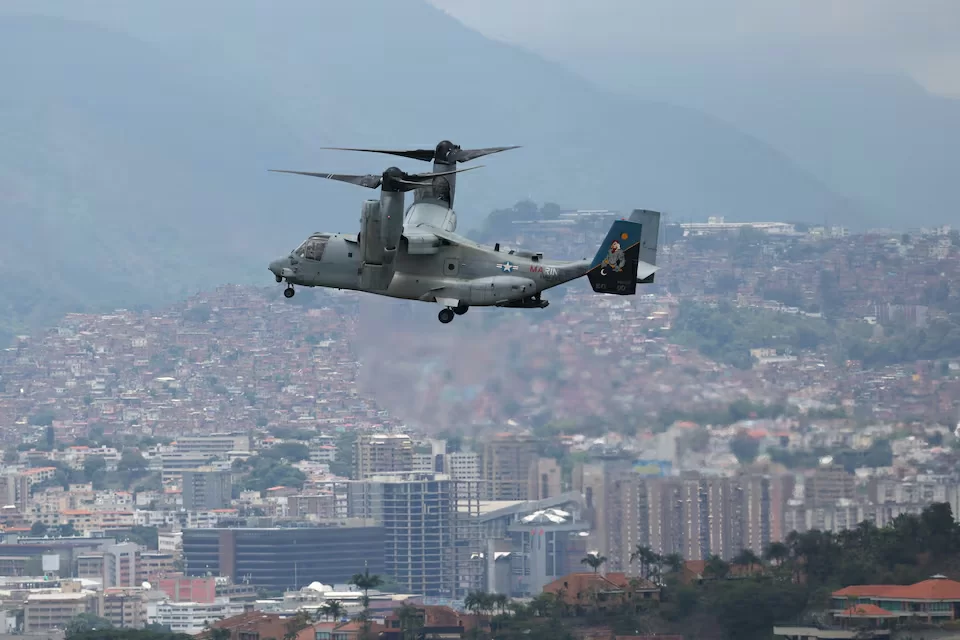
On a Saturday marked by growing geopolitical tension in Latin America, the United States carried out a large-scale military exercise over Venezuela’s capital city of Caracas. This operation marks the first overt U.S. military activity in Venezuelan airspace since a deadly January 3 raid that Venezuelan authorities claim targeted President Nicolás Maduro and his wife Cilia Flores, resulting in at least 100 fatalities according to official Venezuelan counts.
Two U.S. Marine Corps MV-22B Osprey tiltrotor aircraft took part in the exercise, conducting operations and landing in close proximity to the U.S. Embassy compound in central Caracas. Complementing the air activity, multiple U.S. naval vessels entered Venezuelan territorial waters in the Caribbean Sea as part of the coordinated operation. The Venezuelan government initially characterized the exercise as an evacuation drill designed for medical emergencies and natural disaster response, though the scale of deployment has prompted widespread speculation about its true purpose.
As of this report, Venezuela’s Information Ministry has not issued an official statement responding to the exercise. In a public statement, the U.S. Embassy in Caracas reaffirmed Washington’s commitment to advancing former U.S. President Donald Trump’s three-part policy agenda focused on what it describes as stabilizing Venezuela. General Francis Donovan, commander of U.S. Southern Command, the U.S. military body responsible for all operational activity across the Latin America and Caribbean region, was present on the ground in Caracas during the drill to oversee operations.
For ordinary Venezuelan residents, the sudden overt display of U.S. military power in the heart of their capital has fueled widespread anxiety and uncertainty. Evelyn Rebolledo, a 57-year-old office manager based in Caracas, spoke for many when she shared her perspective on the activity. “Having a foreign country flying military aircraft over our capital is something completely new for all of us, especially when it’s the United States, given the current tense situation and all the instability our country has faced for years,” she explained. “It just leaves all of us feeling uncertain about what comes next.”
This latest military move comes amid a dramatic shift in U.S.-Venezuela relations, following recent legislation passed by the government of Delcy Rodríguez, who served as vice president under Maduro before shifting to align with U.S.-backed political factions. Rodríguez’s administration has opened Venezuela’s vast oil and mineral reserves to full American investment, marking a new chapter in the fraught bilateral relationship between Washington and Caracas. For years, relations between the two nations have been defined by escalating political tensions, crippling economic sanctions, and open proxy conflicts, making this combination of increased military presence and expanded economic access a deeply unexpected development for both regional observers and Venezuelan citizens.