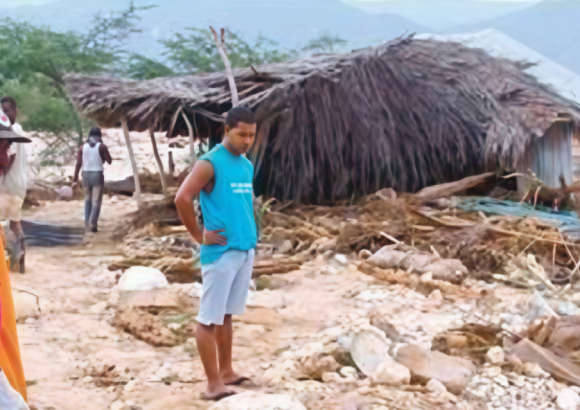
It has been 22 years since one of the worst natural disasters in Dominican Republic’s modern history reshaped the border community of Jimaní permanently. In the early hours of May 24, 2004, the once-dormant Blanco River — known as the Soliette River on the Haitian side of the border — burst its banks, turning a quiet residential neighborhood into a wreckage-strewn wasteland in mere minutes.
The transboundary river begins high in Haiti’s La Selle Mountain range, rising more than 2,680 meters above sea level before crossing into Dominican territory where it takes the name Blanco and eventually empties into Lake Enriquillo. For decades, the waterway had posed little visible threat to nearby communities, but days of heavy rainfall had built up deadly pressure along its banks that would break shortly after midnight.
Residents of the low-lying Las 40 neighborhood were jolted awake by a thunderous cracking sound as the river surged past its barriers. What followed was a raging torrent that swept away entire homes, uprooted mature trees, and carried away personal possessions, lives, and the close-knit fabric of the community. By dawn, the flood had left a landscape of total destruction: most structures were reduced to rubble, with even steel rebar torn away and washed downstream.
Preliminary casualty figures tell the scale of the tragedy: at least 400 Dominican residents and 300 Haitian nationals were killed by the floodwaters, with an additional 250 people injured and more than 270 still unaccounted for two decades later. Across Jimaní municipality, the disaster displaced and impacted 601 families, totaling more than 3,300 people whose lives were upended overnight.
For survivors who lived through the catastrophe, the memories remain as sharp as they were in 2004. In a recent interview with YouTube channel Chulo Wey TV, Las 40 survivor Tatis recounted the frantic moments that unfolded after his wife alerted him that rising water had seeped into their home around midnight. Tatis, his wife, and their three-month-old daughter managed to climb onto the roof of a neighboring house to wait out the flood, but many of his family members and friends were not as fortunate. His grandmother, a young niece, and multiple close neighbors died in the surge. “People were shouting: ‘Help, help, help me.’ But that water was higher than a light pole,” Tatis remembered.
Another survivor, Josefina Gabriela Niquel Bórquez, recalled that unrelenting heavy rain had fallen across the area from the start of the day, and the aftermath was almost too terrible to process. She described the dark, chaotic night after the flood: “Everyone was crying for their loved ones. The night was so dark we couldn’t even see our own hands.” Josefina also shared that the bodies of Haitian nationals swept downstream by the current washed up near her property in the disaster’s wake.
María Virgen Matos still carries the trauma of searching for her daughter through the flood’s destruction in the chaotic early hours. Before the disaster, she remembered, the neighborhood was a tight-knit, pleasant place full of good people. Refusing to leave the area until she found her child, Matos eventually was reunited with her daughter, who survived the disaster and went on to serve as a soldier 22 years later. For the families who lost loved ones and the community that was washed away, the tragedy remains an indelible part of the border region’s collective memory.