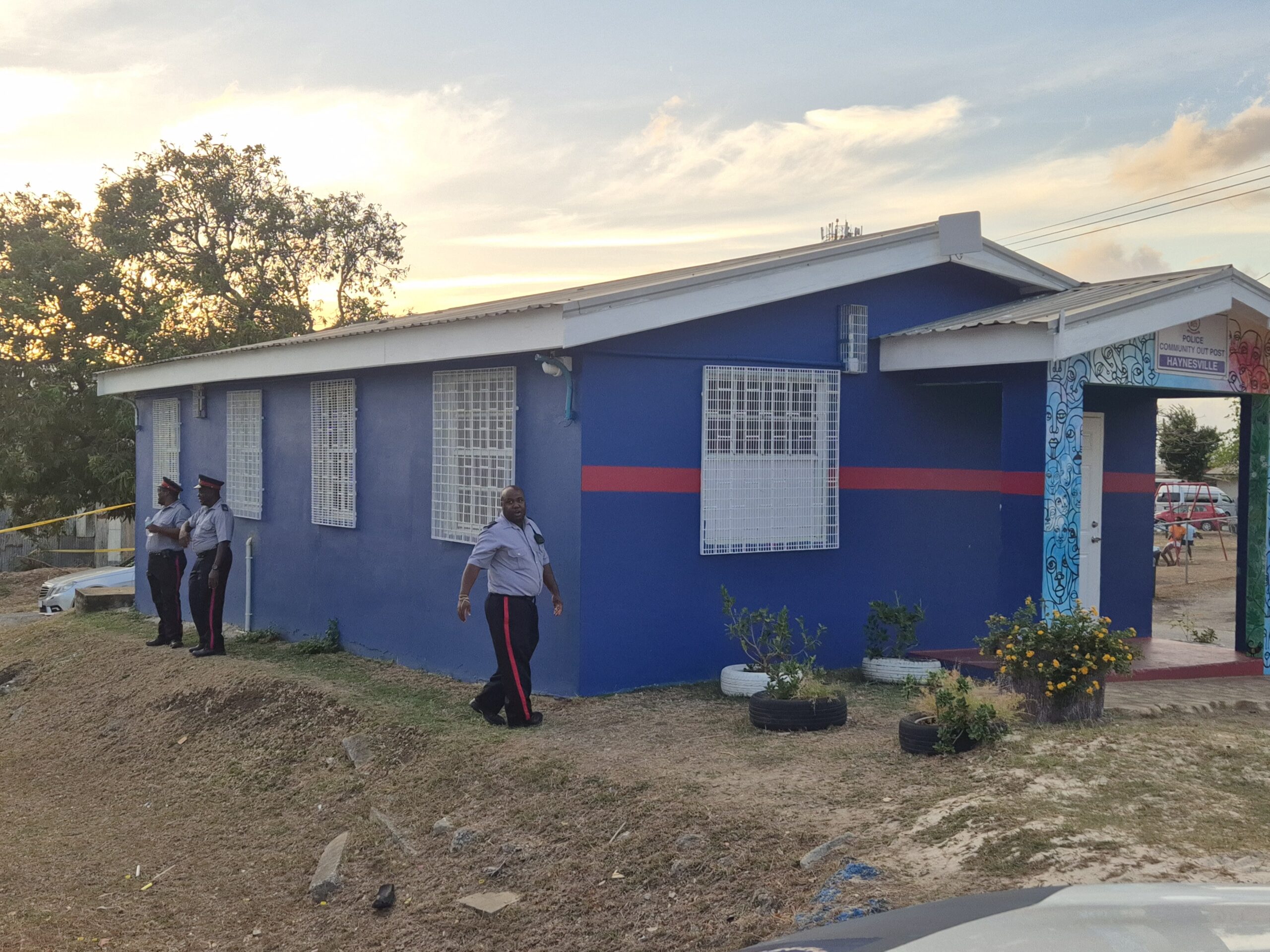
Just five weeks after officials cut the ribbon on the newly refurbished Haynesville police outpost, a facility billed as a cornerstone of enhanced community safety and proactive crime prevention, a brutal fatal stabbing has rocked the small Barbadian district, leaving locals questioning whether the tragedy could have been avoided.
On Tuesday afternoon, 38-year-old Andre Sylvester Maynard, a resident of Redmans Village, St Thomas, was killed mere steps from the reopened outpost. The killing pushed Barbados’ national murder toll for the current year to 25, amplifying already growing public anxiety over violent crime across the island.
By early evening, small clusters of local residents had gathered near the crime scene, their conversation centering on the jarring contrast between the outpost’s recent promise of safety and the violence that unfolded on its doorstep. Maynard’s family declined to speak with reporters, saying overwhelming grief and anger left them unable to comment.
Peter Skeete, founder and president of the local Haynesville Youth Club, called the incident deeply tragic but pushed back against widespread assumptions that the community is overrun by gang-related violence. “There is no ongoing gang activity here in Haynesville,” Skeete told local outlet Barbados TODAY. “What happened was an isolated act of retaliation between two men.” According to Skeete’s account, the conflict had simmered for days and originated from a long-running domestic dispute.
Even so, Skeete acknowledged that the killing’s proximity to the outpost left many residents unsettled. Just weeks before, local law enforcement had publicly pledged to reestablish a consistent, visible community presence out of the facility. “It’s just devastating that no officer was on site when this happened, right practically at the entrance to the outpost,” he said. While Skeete stopped short of blaming police directly for Maynard’s death, he noted that consistent, visible community policing often stops small conflicts from escalating into fatal violence. “That’s the whole point of having a presence here – you can catch these issues before they spiral out of control,” he added.
Not all residents share the view that a greater police presence would have changed the outcome. One local resident, who spoke on condition of anonymity, noted that once interpersonal conflicts escalate, even immediate police intervention is often too late. “When these men get angry, they’re not going to stop because they see a uniform,” the resident said. “I don’t think things would have ended any differently even if officers had been here at that exact moment.”
The disturbance that preceded the stabbing left one child injured as well: witnesses report that a bottle was thrown during an early altercation, shattered, and cut the child’s elbow and back. The young victim was transported to a local medical facility for treatment, and law enforcement deployed additional officers to the area to maintain order in the aftermath of the killing.
While he questioned whether on-site police could have prevented the tragedy, the anonymous resident agreed that far more targeted, systemic intervention is desperately needed to address the root causes of violence in the district. He linked the high rates of violence among at-risk young men in the area to a web of social issues: unstable home lives, a lack of consistent adult supervision, growing access to dangerous drugs, and the normalization of territorial block culture. “There’s only so much that community leaders like Peter Skeete can do on their own,” he noted.
The incident has reignited fierce debate over the actual function of the recently reopened outpost, with multiple residents claiming that the facility has remained largely unused and inactive in the weeks following its high-profile reopening ceremony. Senior Superintendent Lesteal Woodroffe, head of the police’s Northern Division, strongly denied those claims when contacted for comment.
Woodroffe explained that the outpost is designed to serve as a base for mobile patrols and community outreach work, not a stationary facility where officers are required to remain on site 24/7. “That claim is not true. I can confirm that the post is fully operational, and officers run all their local operations from this base,” he said. “The post is open every single day. Officers leave from here to patrol the community, then return to the base after their shifts.” He added that at the time of the stabbing, all officers assigned to the outpost were conducting scheduled patrols and outreach work elsewhere in the Haynesville district.
When asked whether having officers on site would have prevented the killing, Woodroffe said that view is rooted in public perception rather than the reality of how community policing works. When the outpost reopened a month ago, Minister of Legal Affairs and Criminal Justice Michael Lashley framed it as a beacon of public reassurance amid rising national concern over violent crime, and pledged sustained, immediate action to crack down on violence and criminal hotspots across Barbados.
Even as forensic investigators combed the crime scene for evidence on Tuesday evening, daily community life continued in Haynesville. Just hours after the stabbing, 25 local young people attended a scheduled dance class at the nearby community pavilion, and Skeete said his youth organization would not pause its work. “We have to keep showing up for our young people, keep engaging them in positive activities no matter what happens here,” he said.