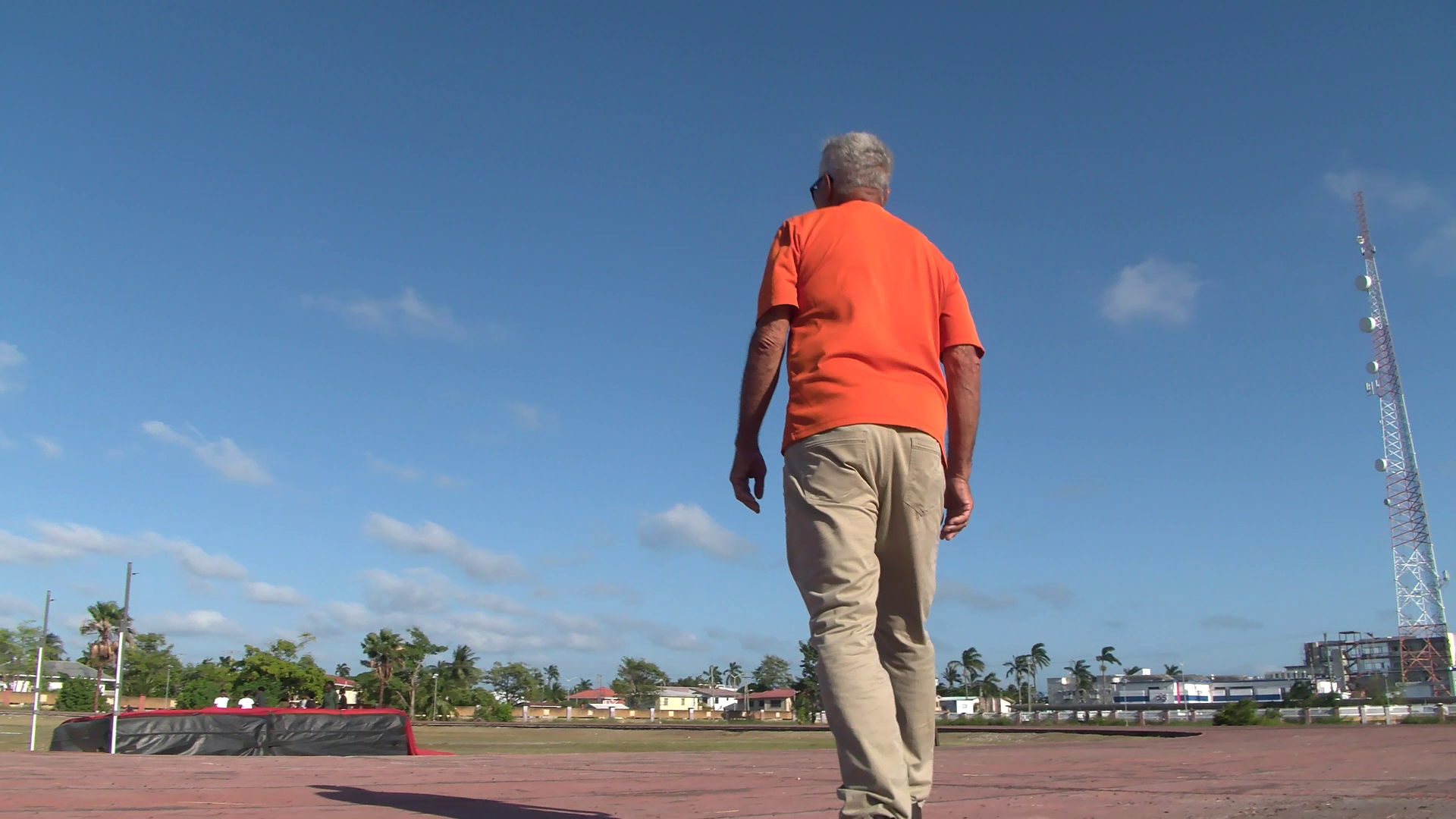
At the sun-dappled Marion Jones Sporting Complex in Belize, the crack of starting pistols and the soft thud of spikes on cinder hide a remarkable secret: the most influential figure in the facility’s track and field program operates in total silence. At 80 years old, head coach Fred Evans has not let complete hearing loss stop him from molding champions, competing at the highest levels of masters athletics, and building a cross-generational legacy that spans more than half a century of Belizean sports.
Most octogenarians have long retired from active athletics and stepped back from full-time coaching, but Evans maintains a pace that would exhaust athletes half his age. Earlier this year, he claimed a gold medal in triple jump at an international masters competition, a win that left younger competitors stunned. For Evans, the victory was never about personal glory – it was about walking the walk he demands from his trainees. “If I want my athletes to win gold, then I, as the coach, also have to do my best and win a gold,” he explained of his mindset.
Evans’ journey into silence began in the mid-1990s, when a progressive ear disorder gradually eroded his hearing, eventually leaving him completely deaf with no benefit from hearing aids. What could have been a devastating end to a decades-long coaching career instead became a redefinition of connection between athlete and coach. Over the years, Evans and his team have developed their own nuanced communication system: quick text exchanges on mobile devices, custom charades for common concepts, and a wordless understanding built through years of working side by side on the track.
“During the years, it became really easy. We use technology by typing to him on the phone or our own way of charades or communication, for example, this means tomorrow or later on,” explained Nyasha Harris, one of Evans’ star trainees who has chased national records and personal bests under his guidance.
Beyond technique and strategy, Evans’ influence runs deep into the fabric of his athletes’ lives. The small, irregular stipend he receives from the Belize Athletics Association rarely makes it into his own bank account; instead, he redirects it to cover track spikes, sports drinks, and training gear for young athletes from low-income backgrounds who could not otherwise afford to compete. For the Belize athletics community, he is more than a coach – he is a living repository of knowledge. Kimberly Casimiro, General Secretary of the Belize Athletics Association, summed up his reputation by calling him “the AI of track and field” – the go-to expert for any question about the sport’s rules, technique, or history.
His mentorship has now touched multiple generations of Belizean athletes. Dylan Jones, who now competes alongside Evans in masters athletics, first learned the fundamentals of track and field from Evans as a young student decades ago. For Audra Andrews, a former gold medalist who trained with Evans before he lost his hearing, that legacy has come full circle: today, he trains her daughter Willia, instilling the same values of discipline and resilience that carried Andrews to the podium.
“It’s a complete full circle. As we can see, he has trained generations upon generations. I’m telling my daughter, ‘You’re gonna get one of the best,’ ’cause I remember Mr. Evans, and all those gold medals that you see I have, I went out represented Belize as well in these type of events, and it was Mr. Evans who was my trainer,” Andrews said.
Even with his hearing gone and eight decades behind him, Evans has no intention of slowing down. He holds multiple track and field records across Central America, and continues to compete and coach full time. For Evans, the difference between merely existing and truly living comes down to progress – progress for his athletes, progress for the sport he loves, and personal progress that keeps him showing up to the track every single day.
“I am alive. To progress is to live. No progress is to exist, and that’s the difference between living. I don’t know when I will die, and I’m not in a hurry to die. But at the same time, I need to live,” he said. As the sun sets over the triple jump pit at Marion Jones, Evans is not looking back on the legacy he has already built – he is focused on the next generation of champions waiting to take their mark.