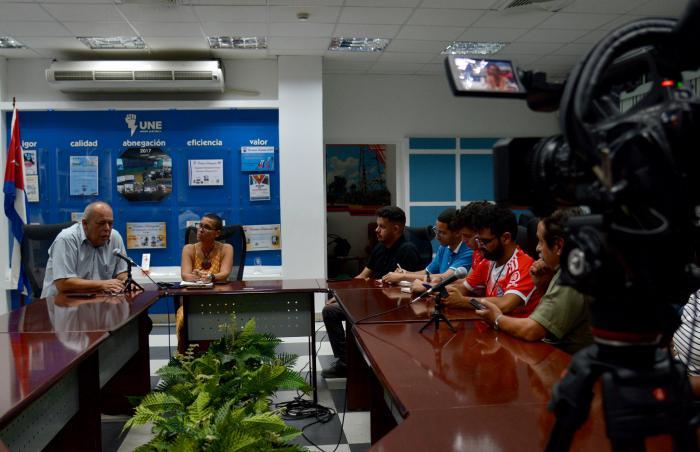
Millions of Cuban residents continue to grapple with extended, daily blackouts that have upended normal life across the island, pushing the country’s national electric grid into one of the most critical phases in its recent history, according to senior energy official Vicente de la O Levy, Minister of Energy and Mines (Minem). In a public press conference, Minister de la O Levy outlined the multiple overlapping challenges driving the crisis, which first began to escalate in 2019. The top energy official pointed directly to one root cause that has created the current emergency: widespread fuel shortages directly tied to the intensification of economic and energy blockades imposed on Cuba. De la O Levy confirmed that between December 2025 and early April 2026, the country went nearly four full months without receiving any fuel shipments. The only significant delivery the nation received in that period was a 100,000-ton donation of crude oil from the Russian Federation, which arrived after months of empty docks. That single shipment offered only partial, temporary relief for the grid after being processed at Cuba’s Cienfuegos refinery into power generation fuels. It covered just part of April and the first few days of May, and by mid-May 2026, the reserve had been fully exhausted, leaving the nation once again facing an extremely challenging operating environment. The situation has been further worsened by unseasonably early high temperatures that have pushed up residential and commercial electricity demand as summer begins. Today, the National Interconnected System (SEN) relies exclusively on three types of generation: thermoelectric plants, natural gas facilities operated by Energás, and utility-scale photovoltaic solar parks. Beyond the acute fuel shortage, the grid faces a second, long-simmering challenge: widespread structural deterioration of the island’s baseline thermoelectric generation fleet. Decades of use, combined with a persistent lack of access to replacement parts due to trade restrictions, have left most plants operating with severe technological wear that causes frequent, unexpected outages. The minister noted that failures are no longer limited to core boiler systems; critical auxiliary components now also break down regularly, meaning any minor issue can take an entire plant offline. The recent unplanned shutdown of the Antonio Guiteras thermoelectric plant triggered one of the worst weeks for the grid so far this year. Shortly after that outage, operators were forced to take the Felton thermoelectric unit in Holguín offline for urgent work – what was initially reported as routine scheduled maintenance was actually emergency repairs to prevent catastrophic total failure. The Felton unit was suffering from boiler leaks and critical faults in its regenerative air converter, and continuing operations would have destroyed the unit entirely, de la O Levy explained. Every unplanned outage and maintenance shutdown adds more hours of blackouts for residents, as the grid operates with literally no backup generation capacity. Any unexpected failure immediately translates to lost power for communities. While shutting down units for repairs prolongs outages in the short term, failing to complete the work would lead to permanent loss of generation capacity, a risk the government cannot take. Solar power has emerged as a key partial alternative for Cuba, with more than 1,300 megawatts of installed photovoltaic capacity currently in operation. At peak output, solar parks can generate more than 900 megawatts, enough to power a large share of the nation’s demand. However, the inherent instability of the aging grid means operators cannot fully utilize this renewable resource, as unregulated input would cause dangerous frequency fluctuations that could collapse the entire system. Currently, solar generation is capped at an average of just 580 megawatts, a fraction of its full potential. There is progress on the horizon, however: Minister de la O Levy announced that the nation is already in the final phase of a major infrastructure project to install large-scale battery energy storage systems designed to stabilize the grid and unlock more solar generation. Technical teams are already on the ground preparing to launch the first of these new storage systems. When it comes to the distribution of power outages across the country, the grid was never engineered to operate under conditions of permanent rolling blackouts, de la O Levy noted. Energy officials implement daily rotational outages based on available generation capacity, spreading the impact across all territories, but geographic differences mean some regions face longer or more frequent outages than others. Critical infrastructure – including hospitals, water pumping stations, strategic economic facilities, and other vital services – is protected on dedicated circuits that cannot be disconnected, to avoid endangering public safety and core functions. More than 600 protected circuits consume more than 800 megawatts of the nation’s total available generation daily. Additional dedicated frequency stabilization circuits, known as DAF circuits, are also prioritized to keep the grid from collapsing entirely. Each province has a unique mix of demand, number of protected circuits, and technical infrastructure, which leads to uneven outage experiences across the country. For example, some large provincial hospitals have multiple redundant power lines that allow for rotational outages in other parts of their service area without disrupting hospital operations, while smaller or older facilities lack this redundant infrastructure, requiring more outages in surrounding communities to keep the hospital online. Upgrading this infrastructure to equalize outage impacts would require significant capital investment that the nation cannot currently access, the minister added, as the core constraint remains an overall shortage of generated power. Daily outage planning begins at midnight each day at the National Load Dispatch Center, with official estimates released to the public early each morning. But the frequency of unexpected breakdowns means plans are almost always disrupted, as even minor issues – such as a failure in a plant’s on-site water supply – can take a major generation unit offline instantly. In the current tight operating environment, every lost megawatt has a massive, immediate impact on available power. The social cost of this ongoing crisis is impossible to ignore. It has disrupted household life, slowed economic activity, hurt transportation and communications services, and strained public services, leaving the population fatigued, anxious, and uneasy. Ministry officials are actively monitoring public feedback and complaints about uneven outage distribution and fuel access issues, but de la O Levy reiterated that the fundamental problem remains a total lack of available fuel reserves: the country currently has no surplus fuel oil or diesel to draw on for power generation. Today, all power generation relies on domestically produced natural gas and domestic crude oil, and domestic production has been increased as much as possible to offset the import shortfall. Cuba is continuing to advance its long-term energy transition strategy, which aims to diversify generation sources and reduce the nation’s dependence on imported fuel. But these long-term changes require time, access to international financing, and stable technological supply chains that are currently out of reach due to ongoing trade restrictions. For now, Cuban residents are adapting their daily lives around the erratic power supply, with many households completing cooking, laundry, and other essential chores only during the early morning hours when power is most likely to be available.