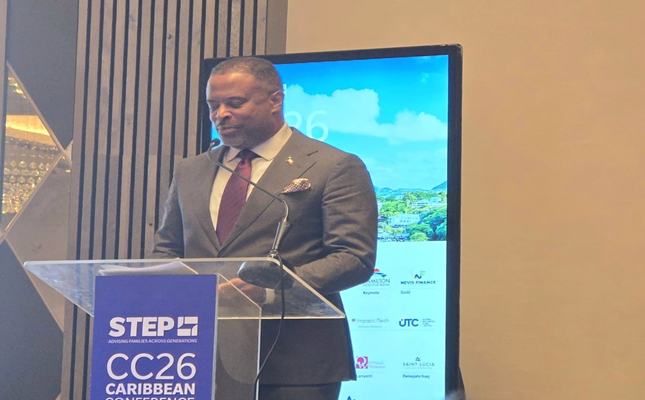
Against a backdrop of growing global economic uncertainty, Nevis Premier and Minister of Finance Mark A. G. Brantley has called for a fundamental rethink of traditional private wealth management practices, urging industry leaders to build flexible, resilient structures capable of weathering generational volatility during his keynote address at the 2026 STEP Caribbean Conference (CC2026) held in St. Lucia.
The three-day industry gathering, which ran from May 11 to 13 at Sandals Grande St. Lucia, brought together hundreds of leading stakeholders from the global private wealth and trust sector under the official theme ‘Legacy in Transition: Governance, Technology and Next Generation Wealth’. Attendees and speakers traveled from more than a dozen jurisdictions spanning North America, the Caribbean, Europe, and beyond to unpack pressing industry topics: intergenerational wealth transfer, evolving global regulatory frameworks, governance best practices, and strategic succession planning for high-net-worth families. A sizeable delegation of financial services professionals from Nevis, led by Nevis Finance Director Rita Hawkins, joined the conference to reinforce the island’s ongoing engagement with the global financial services community.
Delivering his featured presentation titled ‘Navigating Private Wealth in a Volatile World’ on May 12, Brantley — a qualified Trust and Estate Practitioner (TEP) himself — opened by framing the modern challenges facing wealth holders and their advisors. He argued that volatility has become a defining feature of nearly every dimension of the global economy, from equity markets and supply chains to monetary policy, regulatory regimes, and even daily work environments. ‘The only certainty in our lives, particularly at this point in world history, is uncertainty,’ Brantley told attendees. ‘For private wealth holders and their advisors, this raises a profound challenge, because private wealth is not just about achieving returns. It is about preserving optionality, protecting families, funding legacies, and navigating uncertainty across generations.’
Brantley identified four interconnected forces driving today’s widespread structural volatility: growing geopolitical fragmentation across the globe, sweeping shifts in global monetary regimes following the end of the ‘Free Money Era’, rapid acceleration of technological disruption, and rising social and regulatory scrutiny of private wealth. He emphasized that the modern operating environment is not only more volatile than decades prior, but far more complex — a shift that penalizes rigid, outdated approaches to wealth planning. ‘Complexity punishes rigidity. Private wealth now exists under a much brighter spotlight,’ he noted.
In place of traditional strategies focused narrowly on maximizing returns, Brantley urged industry professionals to prioritize structural adaptation and resilience. He highlighted the critical role of the Society of Trust and Estate Practitioners (STEP) in equipping advisors with the ongoing professional development and resources needed to address modern challenges. ‘As advisors, it is your skills and competence, enhanced by the continuing professional development that STEP offers, that will be relied upon to help responsibly preserve generational wealth for your clients,’ he said. ‘Private wealth is not solely about maximizing returns — it is about surviving multiple crises without permanent loss.’
Beyond structural strategy, Brantley stressed that long-term intergenerational wealth preservation depends equally on strong governance, intentional planning, and shared family purpose. He noted that while market shifts, regulatory change, and volatility are unavoidable, thoughtfully structured trust and estate planning does more than protect assets — it preserves a family’s legacy across generations. ‘Well-governed private wealth does not fear volatility but rather navigates it strategically and often emerges stronger as a result,’ Brantley added.
The address also doubled as an opportunity to position Nevis as a leading, forward-thinking international financial services jurisdiction, building on the island’s centuries-long ties to global finance. Brantley highlighted Nevis’ unique financial legacy: as the birthplace of Alexander Hamilton, the first United States Secretary of the Treasury and a founding architect of the U.S. financial system, the island has deep roots in global financial innovation that stretch back to the earliest days of modern global finance. That legacy, Brantley implied, underpins Nevis’ ongoing reputation as a trusted jurisdiction for structured private wealth planning in an uncertain world.