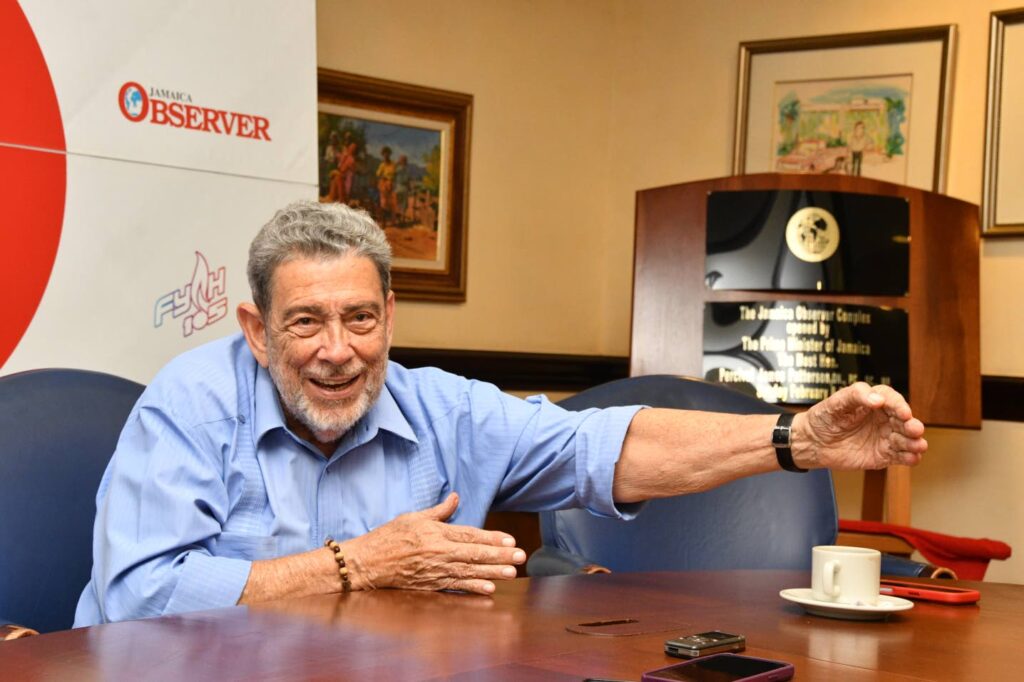
As he nears his 80th birthday, one of the Caribbean’s most long-serving and influential political figures has announced he will step away from front-line electoral politics, but has no plans to exit public life. Instead, former St Vincent and the Grenadines Prime Minister Dr. Ralph Gonsalves is preparing to step into a new, high-profile role advancing the regional movement for reparatory justice for the harms of chattel slavery, indigenous genocide, and centuries of colonial exploitation.
Gonsalves, who led his country for more than 22 years before his Unity Labour Party (ULP) suffered a lopsided electoral defeat in November 2023 that left him as the sole opposition lawmaker in parliament, made the remarks during an address to the Jamaica Observer Press Club last Wednesday. While confirming he will not encourage his party to select him as its lead candidate in the next general election, he stressed that the final decision on his electoral future rests with ULP membership.
“I’m a party man, but I would not encourage the party to do that,” Gonsalves told attendees, pushing back on speculation he could reverse course if party leaders would beg him to stand again. “The ruling New Democratic Party has publicly hoped he would fade quietly from public life after the election result, but Gonsalves made clear that stepping back from electoral leadership is not equivalent to full retirement.
“Fate, history, and circumstance have accorded me this current role in the legislature. The Government would have liked it if I would just fade away but the good Lord doesn’t intend for me to do that,” he declared.
In recent weeks, Gonsalves was appointed senior advisor to the Repair Campaign, a regional advocacy initiative launched in 2022 by Irish businessman Denis O’Brien that supports the work of the Caribbean Community (Caricom) Reparations Commission (CRC). The campaign focuses on public education, academic research, and global diplomatic engagement to push for formal reparations from former colonial powers for harms inflicted on Caribbean peoples. Drawing on his decades of experience in regional politics and his background as a trained lawyer and social scientist, Gonsalves plans to leverage existing professional and personal connections to strengthen coordination between governments, civil society groups, academic institutions, and international stakeholders working on the reparations cause.
Gonsalves argues that reparations is far more than a government-led initiative, saying the movement requires coordinated action from across regional and global groups. “We do not make history in circumstances chosen by ourselves but by conditions which are inherited from the past and those which have arisen from the extant circumstances,” he noted in his address, framing the reparations fight as a defining historical project for the Caribbean region.
His new role is not the only activity keeping him engaged post-election. Gonsalves shared that he is putting the final touches on a 480-page manuscript examining Caribbean political leadership, hosts a three-hour weekly radio show on his party’s radio station twice a week, and prioritizes time with his 15-month-old granddaughter, whom he called “a beautiful young lady in my life” that he often brings with him on regional travel.
“ I take her walking in the morning, walking in the evening. She loves to be with her papa. If I come to Jamaica, I have to bring her with me because she wouldn’t want me to leave her home,” he said warmly.
Even as he spoke of personal life and political transition, Gonsalves repeatedly circled back to the reparations movement, framing it as an unfinished great cause that demands unwavering commitment from regional leaders. Invoking a quote from Jamaican National Hero Norman Manley, he argued that transformative progress cannot be achieved by leaders who are uncertain of the cause.
“In August I am going to be 80 years old. As you notice, I have all my marbles, the brain is ticking over well,” he joked. “West Indian integration, regional integration, is a great cause, and great causes have never been won by doubtful men and women. The same thing with reparations; it is a great cause, and this cannot be won by doubtful men and women.”