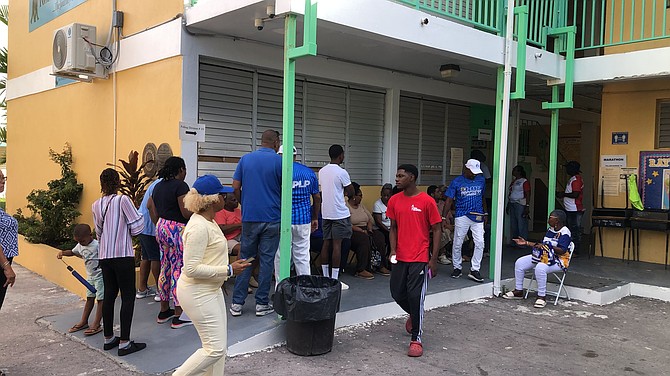
Bahamian voters are heading to polling stations across the archipelago on Thursday to decide one of the most consequential political contests in the nation’s modern history: whether to grant incumbent Prime Minister Philip “Brave” Davis a rare second consecutive term, or to oust his Progressive Liberal Party (PLP) and return the Free National Movement (FNM) to power. The outcome will either break or perpetuate the decades-long pattern of alternating rule between the country’s two dominant political parties that has defined Bahamian electoral politics since independence.
The snap election, called three months earlier than constitutionally required, caps a tense, condensed campaign season that laid bare deep public anxiety over core domestic issues: soaring cost of living, unaddressed immigration challenges, questions of election integrity, and a persistent lack of government accountability. More than 209,000 registered Bahamian voters are eligible to cast ballots across 40 newly expanded constituencies, which added St James in western New Providence, and Bimini and the Berry Islands ahead of this vote. This total marks a record high for voter registration, driven by a late surge in sign-ups after Davis dissolved Parliament on April 8 to call the early contest.
Davis, who led the PLP to a decisive victory over the FNM in the 2021 general election, gambled on an early vote to capitalize on strengthening macroeconomic indicators that have emerged during his first term. The Bahamas has seen improved sovereign credit ratings, a robust tourism-driven recovery from the economic collapse triggered by the COVID-19 pandemic, and a wave of new foreign direct investment. The incumbent party has campaigned on this track record of economic stabilization, framing itself as the only force capable of continuing the nation’s post-pandemic progress.
Against this backdrop of top-line growth, however, ordinary voters continue to grapple with persistent daily financial pressures: skyrocketing grocery costs, soaring rent and utility bills, and strained access to affordable healthcare. To address these concerns, the PLP’s “Blueprint for Progress” campaign manifesto pledges a slate of new policy initiatives: expanded worker protections, stricter immigration enforcement, a new migrant health insurance scheme, targeted investment in artificial intelligence infrastructure, expanded job training programs, and expanded housing assistance, all aligned with Davis’ campaign slogan of helping Bahamians “learn, earn and own.” Throughout the final stretch of the campaign, Davis framed the contest as a stark choice between continued progress and a return to failed past policies, dismissing the FNM as unfit to govern, arguing the opposition lacks both the ideological vision and temperament to lead the nation.
The FNM, led by party leader Michael Pintard, has sought to flip Davis’ framing, positioning itself as a transparent, accountable alternative to the scandal-plagued incumbent administration. Pintard has repeatedly pushed back on Davis’ attacks, arguing that the Davis administration has failed to deliver on its 2021 promises of reform, has done little to ease cost of living pressures for working families, and has consistently fallen short on transparency commitments.
The FNM’s manifesto puts forward a series of populist policy pledges designed to resonate with struggling voters: eliminating value-added tax (VAT) on essential groceries, medical supplies and educational materials; launching a new national lottery to generate revenue for social programs; constructing at least 5,000 new affordable homes; hiring 100 additional doctors and 200 new nurses to expand public healthcare capacity; strengthening immigration enforcement; and rolling out the long-delayed Freedom of Information Act (FOIA) within the first 90 days of taking office.
The FOIA pledge has proven particularly potent for the opposition, as transparency has emerged as one of the PLP’s biggest vulnerabilities. When Davis took office in 2021, he campaigned on sweeping accountability reforms, but many long-discussed anti-corruption and open government measures remain stalled or unimplemented. While Davis has defended his record, framing transparency as a matter of personal character and trust, the opposition has seized on these delays to argue the incumbent administration has no interest in being held accountable to public scrutiny.
Beyond policy disputes, the campaign has been overshadowed by persistent concerns about the integrity of the voter roll and electoral administration. Over the past several months, multiple court cases have been filed involving foreign nationals accused of possessing fraudulent voter identification cards and other official government documents. While Parliamentary Commissioner Harrison Thompson has repeatedly defended the accuracy and integrity of the voter register, opposition leaders and independent civil society activists have continued to raise red flags about systemic vulnerabilities. Those concerns escalated after early voting was marred by long lines and widespread administrative failures. PLP chairman Fred Mitchell denied claims of systemic chaos but acknowledged that the long wait times voters faced were unacceptable, admitting that election officials failed to properly calculate the number of polling booths, voting spaces and staff needed to accommodate early voters.
Multiple controversies have also hounded the incumbent PLP in the final weeks of the campaign. The Bahamian Tribune reported that more than $200,000 in Hurricane Dorian relief gift certificates distributed to Abaco residents in the names of PLP candidates and party officials were funded through the Ministry of Finance, according to testimony from Premier Importers CEO Chris Lleida. Shortly after that controversy broke, reports emerged that outstanding electricity bills for residents of Grand Cay and Moore’s Island were cleared to zero just two weeks before the election, shortly after Davis visited the islands and promised debt relief. Government officials defended the move, saying it was meant to resolve long-standing billing discrepancies that dated back to Hurricane Dorian and the COVID-19 pandemic. But critics have called the timing suspicious, with former Prime Minister Hubert Ingraham publicly accusing the PLP of attempting to buy votes ahead of polling day.
The contest has also exposed deep internal rifts within both of the Bahamas’ major parties. Former FNM Prime Minister Dr. Hubert Minnis is running as an independent candidate in the Killarney constituency after being denied the party’s nomination for his seat. Meanwhile, Ingraham, another former FNM prime minister, made a rare return to the campaign trail to stump for the party, leveling sharp criticism against PLP Fort Charlotte candidate Sebas Bastian, warning of the risks of Bastian rising to a leadership role within the PLP.
A third force, the Coalition of Independents led by Lincoln Bain, has positioned itself as a radical break from the decades-old PLP-FNM cycle of alternating power, framing itself as a new option for voters fed up with both major parties. To date, however, no third party has ever won enough seats to form a government in the Bahamas’ post-independence history. International electoral observers are on the ground across the country to monitor Thursday’s voting process, closely watching for any signs of irregularity as the nation waits for results.