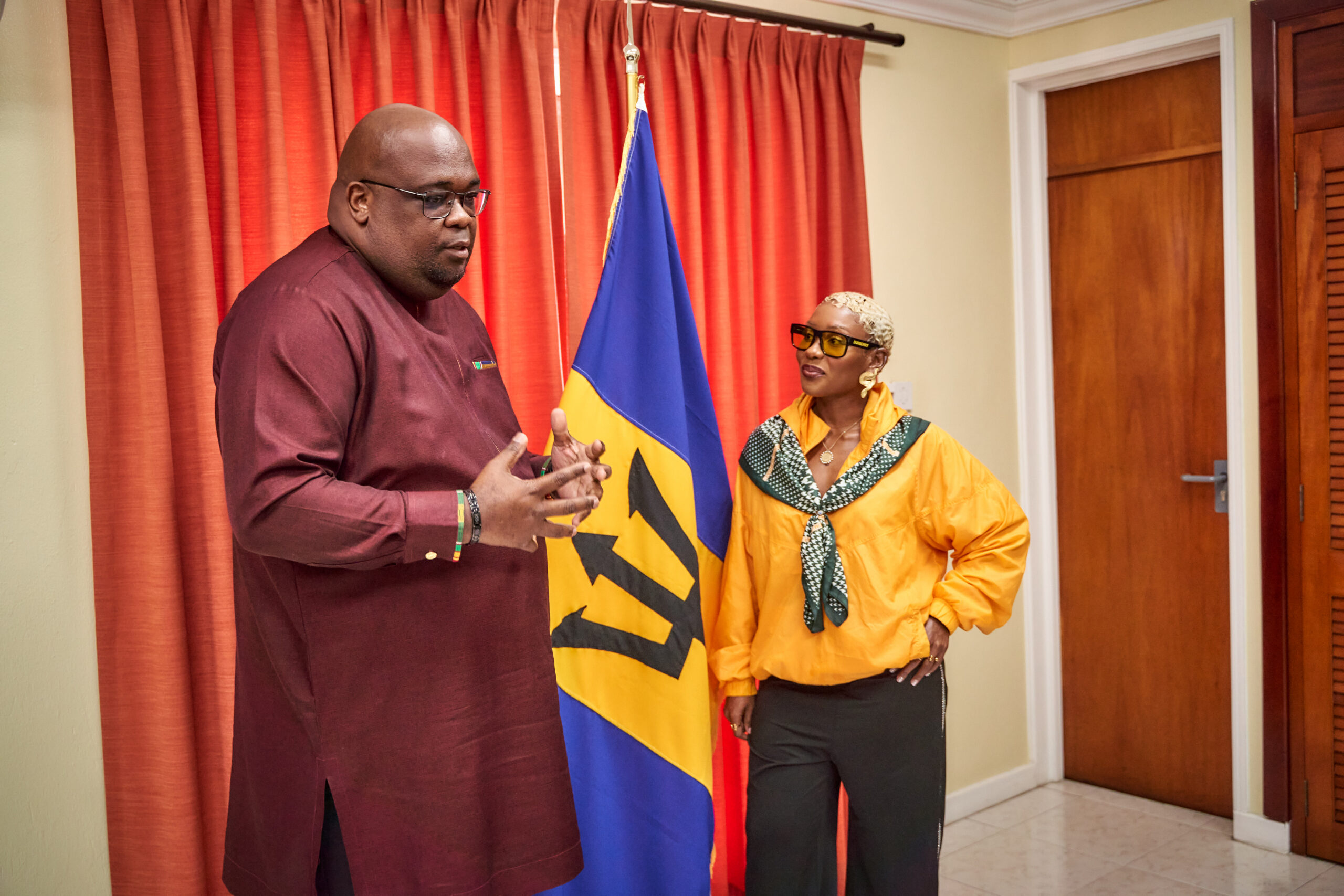
A groundbreaking cross-border partnership between Barbados and Trinidad and Tobago centered on creative arts is emerging as a potential game-changer for reimagining education systems across the Caribbean, with top government officials and a celebrated soca icon aligning on a vision to weave regional identity, cultural heritage, and career-ready creative skills into early childhood and secondary education.
The landmark conversation took place this Monday, when Minister of Education Transformation Chad Blackman welcomed award-winning Trinidadian soca performer Nailah Blackman — an artist with deep ancestral roots in Barbados — for a formal courtesy call at the minister’s Bridgetown office. For those unfamiliar with the star’s legacy, Nailah Blackman carries unmatched cultural pedigree in the Caribbean music space: she is the granddaughter of Ras Shorty I, the legendary innovator who pioneered the soca music genre, and the daughter of respected Trinidadian calypsonian Abbi Blackman, earning her the widespread title of “soca royalty” across the region. As of press time, no familial connection between Minister Blackman and the performer has been confirmed.
During the discussion, Minister Blackman framed the collaboration as a natural extension of Barbados’ ongoing national education transformation agenda, arguing that the current reform push creates a unique opening to center Caribbean identity and cultural knowledge rather than sidelining it. “Your vision for advancing the arts, not just here in Trinidad but across Barbados, the entire Caribbean, and the global stage, lines up with so many of the goals we’re working toward — there are incredible synergies we can leverage,” he told the performer. The minister went on to emphasize that as Barbados overhauls its education framework, a core priority is decolonizing curricula by placing Caribbean narratives, culture, and perspectives at the heart of what students learn.
Nailah Blackman echoed this commitment, stressing that foundational change to education must start in the earliest years of childhood to undo the lingering harm of colonial educational frameworks. “We really have to break free of the colonial mindset, because it’s something that has divided us and held our region back,” she explained. She added that grounding young people in local and regional arts and culture from their first years in school is the first step to building healthy, empowered regional identities: “That’s where change starts — molding young minds the right way, authentically, starting with deep roots in our own arts and culture.”
Minister Blackman also outlined concrete policy plans to expand creative arts access across Barbadian primary and secondary schools, including the development of on-campus music production studios equipped for student use. “We’ve already made a formal commitment that a significant number of our schools will roll out dedicated creative arts curricula, but what makes this new is that we’re building actual studios where students can create their own music, produce original beats, and develop soundtracks from scratch,” he said. The end goal, he explained, is to arm students with marketable, practical creative skills before they graduate, preparing them to build successful careers in music and the broader creative economy across the Caribbean and around the world. “This is an incredibly exciting moment for education in our region,” he added.