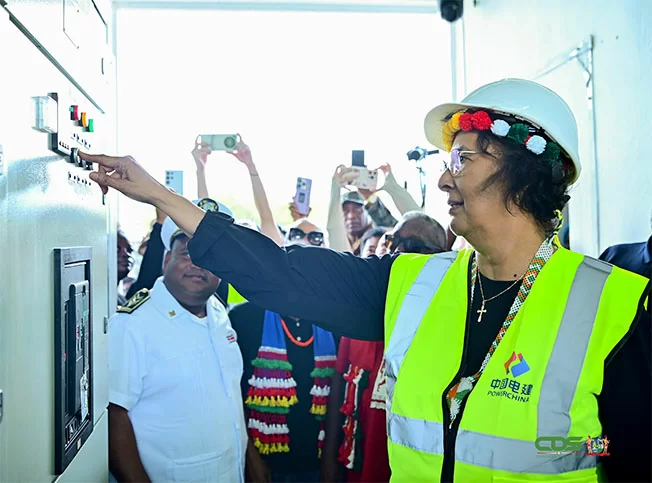
On Thursday, May 8, Suriname President Jennifer Simons officially inaugurated a new hybrid solar energy power plant in the remote coastal village of Galibi, marking an end to decades of limited and unreliable electricity access for the local community and unlocking new opportunities for long-term regional development. The launch ceremony was attended by key stakeholders including Natural Resources Minister David Abiamofo, District Commissioner Marvin Vijent, sitting members of Suriname’s parliament, representatives of local traditional governance bodies, and delegations from the Caricom Development Fund and project partner PowerChina.
Before this facility came online, Galibi — a village famous for its protected nature reserve, rich Amazonian biodiversity, and growing ecotourism industry — never had access to consistent, 24-hour electricity. Connecting the remote village to the national grid run by Energie Bedrijven Suriname (EBS) was deemed geographically and financially unfeasible, leading regional and national leaders to pursue a renewable energy-focused alternative. Minister Abiamofo explained that relying exclusively on diesel generators to power the village would have cost the Surinamese government roughly 8.5 million Surinamese dollars annually, a recurring expense that made that model unworkable for long-term energy security.
The newly launched plant operates on a hybrid system that prioritizes clean solar energy, with a single diesel generator held in reserve to back up power supply during periods of low sunlight or peak demand. The village’s old, pre-existing diesel generators will not be decommissioned entirely; instead, they will be repurposed to expand the capacity of Galibi’s local water pumping station, bringing clean running water to all households across the village once upgrades are completed.
President Simons emphasized in her inauguration address that consistent electricity delivers far more than just basic power to homes — it creates foundational certainty for the entire Galibi community and opens new doors for educational advancement and inclusive economic growth. Most notably, she highlighted that local schoolchildren will now be able to study after dark and access digital learning tools including computers that were previously unusable due to limited power access, according to official statements from the Communication Service of Suriname.
District Commissioner Marvin Vijent echoed the president’s optimism, noting that the reliable new power grid is set to transform Galibi’s key economic sectors. With consistent electricity, local businesses can expand ecotourism infrastructure, improve hospitality services, and open new small enterprises that were impossible without reliable power. He added that the upgrade will also boost the quality of local healthcare services, as medical facilities will be able to reliably power refrigeration for vaccines, medical equipment, and lighting for after-hours emergency care.
Local parliamentary representatives welcomed the project as a long-awaited milestone for the community. Ines Pané, a member of parliament from the ABOP party, called the solar plant a critical breakthrough for Galibi, where electricity has been a scarce, limited resource for generations. She urged local residents to steward the new facility and work collaboratively with government and development partners to drive further progress across the region. Claudie Sabajo, an assembly member from the NDP party, echoed this support while calling for continued investment in Galibi, highlighting the need for additional support for local agricultural development, tourism expansion, and skills training programs to help local residents take full advantage of the new economic opportunities unlocked by reliable electricity.