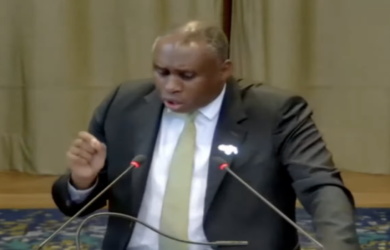
THE HAGUE, Netherlands — In ongoing high-stakes oral arguments at the International Court of Justice (ICJ), Venezuela has reaffirmed its long-held stance that the United Nations’ highest court for state-to-state disputes lacks authority to rule on its centuries-old territorial conflict with neighboring Guyana. The dispute centers on the resource-rich Essequibo region, a 61,600-square-mile territory that makes up nearly two-thirds of modern Guyana, which Venezuela claims as its own sovereign land.
Speaking as Venezuela’s second representative to the ICJ, Professor Makane Moise Mbengue pushed back against Guyana’s core argument that the 1899 Arbitral Award — which originally set the disputed border between the two nations — is legally valid and binding. While Mbengue acknowledged that the 1899 award provides historical context for the conflict, he emphasized that it should not block a genuine negotiated resolution between the two South American nations. Both Mbengue and lead Venezuelan representative Samuel Moncada displayed pins showing Essequibo as part of Venezuelan territory during their presentations.
Moncada opened Venezuela’s arguments earlier this week by rejecting what he called Guyana’s “erroneous and misleading narrative” surrounding the dispute. He stressed that the 1966 Geneva Agreement, reached by both parties to settle the conflict after Venezuela declared the 1899 award null and void in 1962, remains the sole binding legal framework governing the issue. Unlike a court-imposed ruling — which inevitably leaves one side victorious at the other’s expense — Moncada noted the Geneva Agreement was crafted as a peace pact that prioritizes direct bilateral negotiation to reach a practical, mutually acceptable outcome. He added that the agreement is explicitly designed to help the two nations move past the harmful legacy of colonialism, which created the dispute in the first place.
Guyana first brought the case to the ICJ in 2018, asking the court to formally affirm the legal validity of the 1899 border award. The territorial dispute lay dormant for more than 60 years after the award was issued, until Venezuela revived its claim to Essequibo in 1962. Following the 1966 Geneva Agreement, which established formal mechanisms for peaceful negotiation, years of bilateral talks failed to produce a resolution, leading the United Nations Secretary-General to refer the dispute to the ICJ. The ICJ previously ruled that it has jurisdiction to hear the case, clearing the way for the current merits hearings, where both sides are presenting their full legal arguments.
During opening arguments that began Monday, Guyana maintained that the 1899 award permanently and definitively settled the border, and that it remains legally binding and entitled to international recognition. But Mbengue countered that the 1899 award is a discredited artifact of British imperialism, and that the ICJ’s earlier jurisdiction ruling did not validate Guyana’s underlying claim. He argued that the ICJ panel failed to account for Venezuela’s core legal position in its initial jurisdiction ruling, and that any lasting resolution must center on the terms of the 1966 Geneva Agreement, not the 1899 award.
“The real issue is the pursuit of a mutually satisfactory agreement to the controversy generated by the 1899 award, a solution that consign this artifact of British imperialism to the past where it belongs and to chart a way forward — this is the only proper meaning of the Geneva agreement,” Mbengue told the court, noting that Guyana has failed to offer any alternative interpretation of the pact that aligns with the parties’ original goals. He urged the ICJ to examine every provision of the Geneva Agreement, rather than limiting its review to Guyana’s narrow claims. “The court should not be constrained by the allegations that Guyana made,” Mbengue argued. “In particular, it must carefully ascertain whether Guyana’s request remains within the bounds of what the parties to the Geneva agreement sought to resolve. Guyana’s claims cannot exist within the framework established by the Geneva agreement, nor can the court decide on those matters as framed by Guyana.”
The first round of oral arguments is scheduled to run through three-hour sessions over multiple days, wrapping up next Monday.