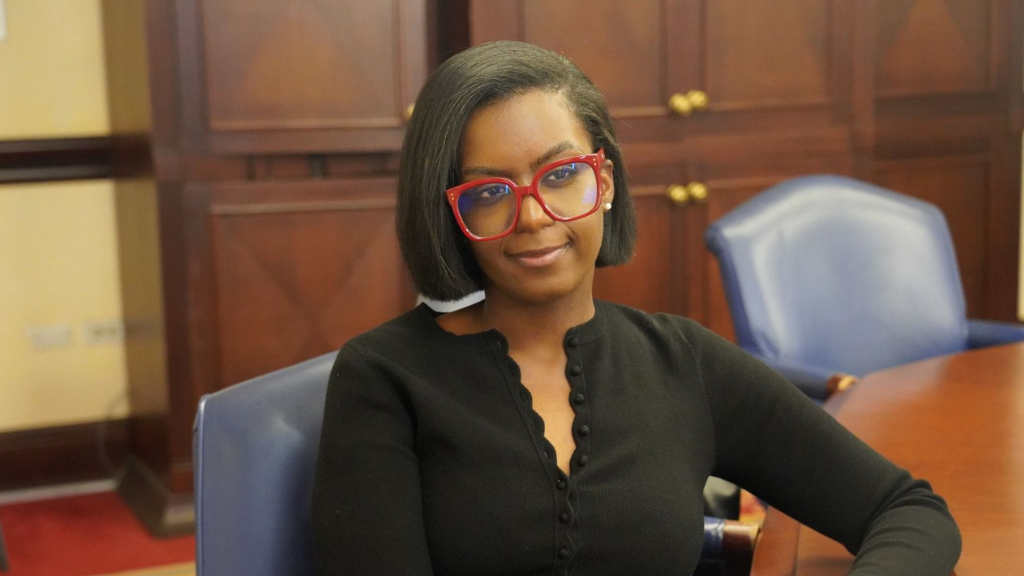
Against the backdrop of a year defined by both professional triumph and personal grief, 31-year-old Kayonne Christy has emerged as one of the most promising rising sociologists in North America, recently inducted into Yale University’s elite Edward A. Bouchet Graduate Honor Society. Her path from a first-generation university student uncertain of her calling to an acclaimed doctoral researcher exploring diaspora, culture and identity has been shaped far more by collective support than individual achievement, she says.
Christy, currently a sociology PhD candidate at the University of Michigan, did not start her academic career aiming for the social sciences. As the first member of her family to pursue higher education, she enrolled in McMaster University’s life sciences program with plans to attend medical school. For a time, she dismissed her lingering dissatisfaction as a normal part of university life, telling herself that post-secondary study was not meant to be an enjoyable experience. But a persistent pull toward questions of systemic inequality and social justice, nurtured through campus organizing and community engagement, eventually led her to rethink her trajectory.
That turning point came when she gained a spot on a qualitative research project examining the social determinants of health. There, she discovered she could merge her foundational scientific training with her deep curiosity about how social structures shape individual lived experiences, sparking a lasting passion for sociology. Like every step of her journey, this professional shift was not navigated alone: Christy cites a network of supportive mentors as the backbone of every milestone she has reached.
Among the most influential of these guides was Juliet Daniel, a Barbadian-born cancer biologist at McMaster University and the first Caribbean woman with a PhD Christy ever met. Daniel passed away on the same day Christy sat for an interview about her career, adding a layer of poignancy to her reflections on her path. “Seeing someone who looked like me, who shared a similar background, made me believe that [a PhD] was possible. That mattered more than I can explain,” Christy said of Daniel. She also credits additional mentors including Dr. Lawrence Grierson, Dr. Meredith Vanstone, and Dr. Gerry Veenstra for opening doors and encouraging her through moments of uncertainty. “If it weren’t for them, I don’t know if I would be doing a PhD right now,” she added.
A suggestion from one mentor led Christy to a graduate program at the University of British Columbia, where she worked alongside Veenstra, one of Canada’s leading scholars on racial health disparities. There, she grew to appreciate sociology’s flexibility: the discipline allowed her to pursue overlapping interests in race, power, health and inequality while staying rooted in the social justice questions that first drew her away from medicine. That focus eventually led her to the University of Michigan, home to one of the world’s top-ranked sociology departments.
For Christy, her research is not just an academic pursuit—it is deeply personal. Though born in Canada, her connection to her Jamaican roots deepened in her early 20s, when a family reunion trip made her realize the island felt like home. Today, she is based in Kingston for her fieldwork, studying how Jamaican diaspora members contribute to the city’s growing cultural and creative economy, and how that engagement shapes urban development.
“Culture is such a central part of the Jamaican diasporic experience,” she explained. “As Kingston moves toward culture-led development, there are new opportunities for the diaspora to engage and contribute. But there are also challenges, and I want to understand both.”
Christy adheres to the philosophy of “lifting as you climb,” a value shaped by her own experience of receiving support from a community of mentors, family and educators. “Anything I’ve done is a product of people who poured into me,” she said. “Mentors, family, and community made this possible.” With her PhD on track for completion in 2027, Christy remains focused not just on finishing her dissertation, but on carrying forward the legacy of support that made her success possible.