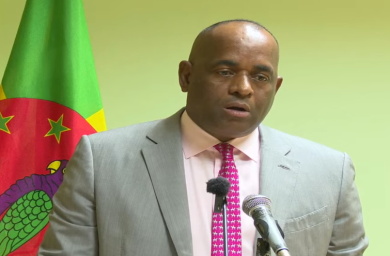
Amidst a growing public rift across the Caribbean Community (Caricom) over the reappointment of Belizean economist Dr. Carla Barnett as the bloc’s secretary-general, Dominica’s Prime Minister Roosevelt Skerrit has publicly thrown his full weight behind the move, confirming his government’s endorsement of the outcome of the regional vote.
Speaking at a press briefing held in Roseau on Wednesday, Skerrit made clear that from his administration’s perspective, Barnett’s reappointment is a settled matter. “As far as I’m concerned, Dr. Carla Barnett has been reappointed as secretary-general, and in Dominica’s style, we are team players, we support the decision and we move on,” Skerrit told reporters. He added that while he would not object to reopening discussions if the Caricom Bureau or Conference of Heads of Government chooses to do so, the existing process already followed proper procedure, delivered a clear majority in Barnett’s favor, and should be respected as the final outcome.
The controversy surrounding Barnett’s second term dates back to February’s Caricom summit hosted in Basseterre, St. Kitts and Nevis. In March, Caricom chairman and St. Kitts and Nevis Prime Minister Dr. Terrance Drew released a short statement confirming that Barnett had secured the “required majority” of regional leader votes to earn reappointment. However, the process has been challenged by several high-profile regional leaders ever since.
Prime Minister Kamla Persad-Bissessar of Trinidad and Tobago, who was absent from the closed-door retreat where the vote was held, has openly questioned the legitimacy of the procedure. She has rejected Drew’s claim that Trinidad and Tobago was not uninvited to the meeting, and is demanding access to official meeting minutes, documentation of Barnett’s performance appraisal, and records of the 2021 appointment process to verify that current procedures align with the rules established for that cycle. Though Trinidad and Tobago first called for a special regional leaders’ meeting to debate the dispute, it did not attend a virtual heads gathering held to address the issue in April.
Last month, the debate escalated when Sir Ronald Sanders, Antigua and Barbuda’s ambassador to the United States and the Organization of American States, publicly called on Barnett to step down. Speaking on ABS Television, Sanders argued that the ongoing controversy created a barrier to regional integration progress. “If I were the secretary general of Caricom and I’m being quite serious here and this had occurred, I would have resigned and I would have resigned because I would have said I must not stand in the way of Caribbean integration and the movement forward,” Sanders said.
Jamaica’s Prime Minister Andrew Holness has meanwhile pushed for a full special heads of government meeting to resolve the deadlock, noting that public discourse around the dispute has sown widespread unease across the bloc. Speaking to the *Trinidad Guardian* in New York in April, where he was honored by the American Foundation for the University of the West Indies, Holness said behind-the-scenes talks are already underway to organize direct engagement between all regional leaders. “I think it is distressing for a lot of persons within the region regarding what is being said in the public domain, but I know that all the heads are working behind the scenes to have this matter resolved,” he said, adding that further diplomatic consultations are imminent, including a planned conversation with Persad-Bissessar as part of the process.