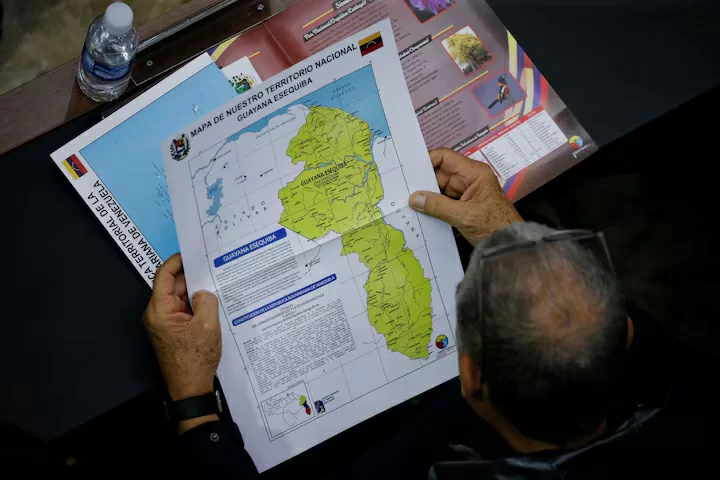
One of Latin America’s longest-running border disputes, centered on the resource-rich Esequibo region, has moved into open oral hearings at the International Court of Justice (ICJ) in The Hague, with Guyana calling on the United Nations’ highest court to formally invalidate Venezuela’s territorial claims to the contested area.
The 160,000-square-kilometer Esequibo region, a largely jungle-covered territory straddling the Esequibo River, plus its adjacent offshore waters, has been a source of tension between the two neighboring South American nations since the colonial era. The discovery of massive new oil and natural gas reserves in the offshore area in recent decades has turned the long-simmering conflict into a critical threat to regional stability, Guyana argues.
Addressing the panel of ICJ judges at the opening of the week-long proceedings, Guyana’s Minister of Foreign Affairs Hugh Hilton Todd framed Venezuela’s claim as an existential threat to his country. “The territorial ambitions of a larger, more powerful neighbor have not only undermined our peace and security, they have held back our national development for generations,” Todd told the court. He added that Venezuela’s claim encompasses more than two-thirds of Guyana’s entire current sovereign territory, making the dispute a matter of survival for the small Caribbean nation.
The roots of the conflict stretch back to an 1899 arbitration ruling that established the modern border between Venezuela and what was then British Guiana, a British colony. That ruling awarded the Esequibo region to British Guiana, a decision that Venezuela has repeatedly rejected as invalid since the early 20th century. In 2018, amid rising tensions over newly discovered offshore oil reserves, Guyana formally brought the case to the ICJ, asking the court to uphold the 1899 border settlement and confirm its full sovereignty over the entire Esequibo area.
Tensions escalated dramatically in late 2023, when Venezuela held a national referendum on the dispute in which Venezuelan voters overwhelmingly rejected the ICJ’s jurisdiction over the case and backed the government’s plan to establish a new Venezuelan state covering all of Esequibo. In early 2024, Venezuela formally proclaimed the new state, a move that Guyana and much of the international community condemned as a violation of international law.
A major shift in Venezuela’s political landscape occurred in January 2025, when former Venezuelan president Nicolás Maduro and his wife were detained by U.S. forces, leading to the installation of a new interim government that currently administers Venezuelan state affairs. This interim government will have the opportunity to present its formal position on the dispute to the ICJ later this week, court schedules confirm.
Legal observers expect a final binding ruling from the ICJ within the next several months. While ICJ decisions are legally binding and irreversible under international law, the court itself does not hold independent enforcement power. Any implementation of the court’s final ruling will depend on intervention and support from the United Nations Security Council, leaving open questions about how the decision will be put into practice regardless of which side prevails.