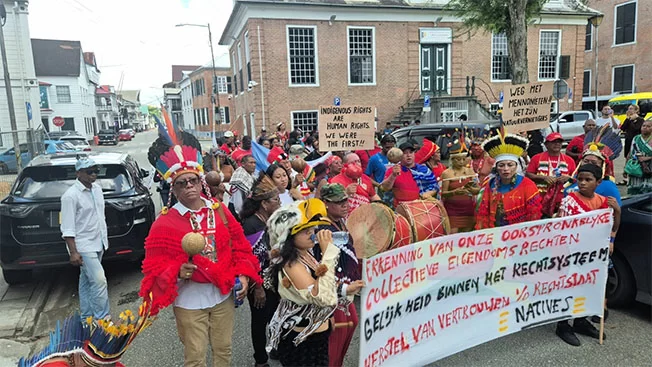
On May 3, 2026, a wave of unrest swept through central Paramaribo, Suriname, as hundreds of Indigenous demonstrators and their supporters took to the streets to demand long-overdue recognition of their territorial land rights, holding the Surinamese government accountable for years of broken promises and escalating environmental harm to their traditional territories.
The demonstration kicked off early Saturday with a peaceful march through the city’s downtown core, organized by a coalition of Indigenous community leaders and environmental activists. Midway through the march, participants paused to honor the memory of Martinus Wolfjager and Ivanildo Dijksteel, two Indigenous men who were killed during violent 2023 protests in the village of Pikin Saron on May 2 that same year. According to family members and supporters of the two men, Wolfjager and Dijksteel were already in handcuffs when police officers shot them at close range. That 2023 unrest left multiple vehicles and buildings burned, and several people taken hostage amid long-simmering tensions over resource extraction on Indigenous lands.
After concluding the march, the group headed first to Suriname’s National Assembly to deliver a formal petition outlining their core demands. Tensions flared at the assembly when demonstrators rejected statements offered by two sitting legislators, Ivanildo Plein from the National Party of Suriname (NPS) and Jennifer Vreedzaam from the National Democratic Party (NDP). In their petition, Indigenous leaders outlined that the Surinamese government continues to issue commercial resource extraction concessions within their traditional residential and hunting lands, resulting in widespread contamination of rivers and creeks that have left many communities without safe, drinkable water. The petition stressed that the cumulative pressure on Indigenous communities across the country has grown to an unsustainable, unbearable level.
Protest organizers also drew direct attention to the government’s ongoing failure to implement binding international court rulings on Indigenous territorial rights. They added that Indigenous activists now face severe, decades-long prison sentences for their advocacy, creating a pattern of unequal justice that punishes marginalized communities for defending their homelands.
Following the confrontation at the National Assembly, the protest group moved to the Cabinet of the President, where they delivered a second copy of their petition. Chief of Staff Sergio Akiemboto accepted the document on behalf of President Jennifer Simons. Speakers at the site, including prominent environmental activist Erlan Fleur, made clear that the era of empty negotiations is over, calling for immediate, concrete intervention from the national government to address the crisis.
Demonstrators also stopped at Suriname’s Court of Justice, where they called for transparent, equal application of the law, pointing to what they describe as a clear pattern of double standards in the justice system’s handling of the 2023 Pikin Saron events. Five Indigenous men who were arrested in connection to the unrest originally received an 8-year prison sentence in their initial trial on charges including attempted murder, aggravated assault, arson, hostage-taking, and weapons violations. On appeal, prosecutors have increased their requested sentence to 15 years, and the next hearing in the case is scheduled for May 26.
In a parallel case, seven police officers are on trial for their alleged role in the deaths of Wolfjager and Dijksteel. A ruling in this case is expected as soon as May 5, 2026. Prosecutors have requested a 12-month suspended prison sentence with a three-year probation period for the officers on charges of aggravated assault leading to death, while calling for acquittal on the more serious charge of complicity in manslaughter. The discrepancy in sentencing requests between the Indigenous defendants and the accused officers has underscored protesters’ claims of unequal treatment under the law, amplifying calls for systemic change to protect Indigenous rights across Suriname.