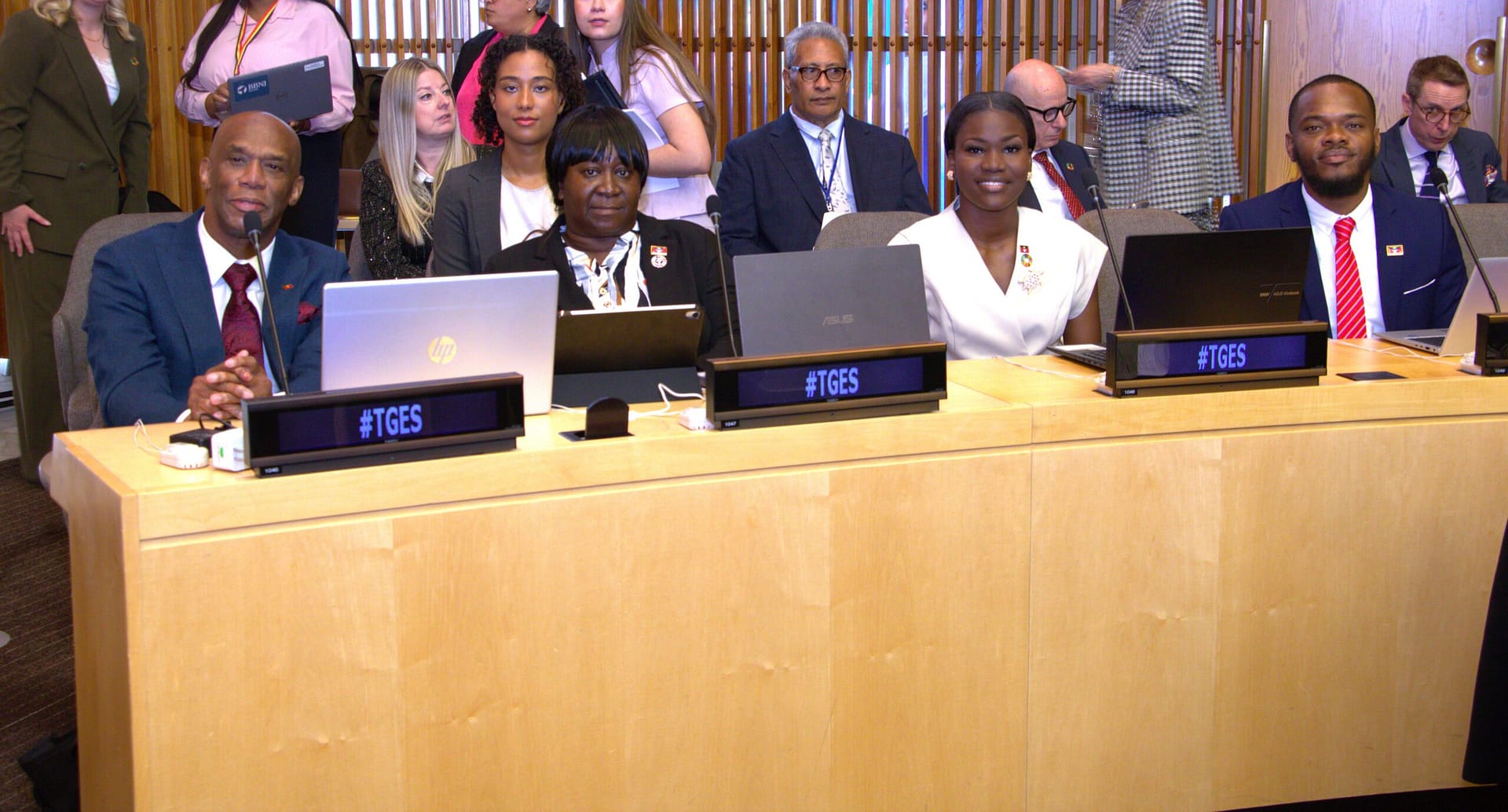
Against the backdrop of rising global calls to reimagine 21st-century learning systems, Antigua and Barbuda stepped into a pioneering leadership role at the Transforming Global Education Summit, hosted at United Nations Headquarters in New York on May 1. Convened by the PVBLIC Foundation in partnership with the governments of Antigua and Barbuda, the Kingdom of Tonga, and the Learning Economy Foundation, the summit gathered education stakeholders from across the globe under the core banner of ‘Redefining Education as Global Infrastructure’ — framing accessible, adaptive education as a foundational pillar of global resilience, equity, and long-term sustainable development.
Leading Antigua and Barbuda’s five-person cross-sector delegation was Clare Browne, the nation’s Director of Education, joined by Jrucilla Samuel, Director of Youth Affairs; Chevaughn Burton, Assistant to the Focal Point for Safe Schools at the Ministry of Education; Janet Simon, CARICOM Youth Ambassador; and Pia Nichols, President of the National Youth Volunteer Corps. The delegation’s presence at the summit was coordinated by the Antigua and Barbuda Permanent Mission to the United Nations, with lead logistical and administrative support from First Secretary Claxton Duberry and accompanying support from Second Secretary Jerri-Anne Jeremy.
Opening his keynote remarks to the assembled delegates, Browne pushed back against long-held global narratives that frame large national systems as the only drivers of meaningful education change. He emphasized that transformative education reform does not require massive national scale to be effective — instead, it grows from intentional design, aligned policy, and consistent implementation. For Antigua and Barbuda, he explained, digital transformation in education is not an end in itself; it is a strategic enabler that supports broader education reform, strengthens workforce readiness for young people, and boosts national climate and economic resilience. ‘Too often, global conversations focus on large-scale systems. But Small Island Developing States like Antigua and Barbuda are not peripheral, we are practical leaders,’ Browne told attendees, setting the tone for the delegation’s actionable contributions.
A dedicated panel led by Antigua and Barbuda delved deep into one of the summit’s most pressing sub-themes: ‘Redefining Education Systems for the Future: Integrating Mental Health, Nutrition, and Holistic Youth Development as Global Priorities.’ Moderated by Jrucilla Samuel, the panel centered youth voices, featuring the three young practitioner delegates from the nation who bring on-the-ground experience across education, youth safety, and volunteerism.
Burton opened the panel discussion by sharing how Small Island Developing States are rethinking school infrastructure to meet dual demands: delivering high-quality learning while upholding strict disaster resilience standards, a critical priority for low-lying island nations facing accelerating climate risk. He outlined how Antigua and Barbuda has embedded disaster risk reduction into daily school life, rather than treating it as an isolated, one-time lesson. Aligned with United Nations Sustainable Development Goal 4 (Quality Education), this approach equips students with practical, life-saving skills that prepare them to navigate real-world climate and societal challenges.
Janet Simon followed with a practical framework for integrating mental health support and nutrition education into daily schooling without adding unmanageable burdens to overstretched teaching staff. Instead of asking teachers to take on new, separate roles, she explained, these priorities can be woven into existing school structures and routines. Nutrition education can be integrated into science classes through hands-on learning, for example, using school gardens as outdoor living classrooms to teach healthy food choices. For mental health, simple daily practices — including short mindfulness breaks, peer-led support groups, and regular open classroom discussions that normalize talking about emotional wellbeing — can create sustained support without requiring major additional resources.
Pia Nichols closed the panel by outlining how youth volunteerism can be leveraged as a strategic tool to advance education equity and narrow persistent socio-economic gaps. She noted that government education services often face hard limits on reach due to constrained budgets and limited staffing in small island states. Expanding the role of community and youth volunteers, both within schools and in surrounding communities, can address the non-academic pillars of youth development that are often underfunded — including mental health support, nutrition access, and social cohesion — that directly impact learning outcomes.
By the close of the summit, Antigua and Barbuda’s delegation had cemented its role as a forward-thinking practical leader in global education reform, demonstrating that small states can deliver clear, coherent, innovative blueprints for transformation that are replicable across contexts of all sizes.