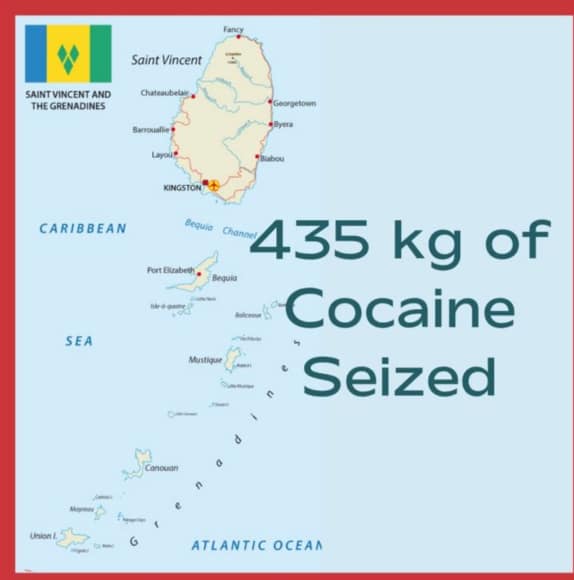
A recent coordinated maritime security operation targeting illicit drug trafficking in the Caribbean has yielded one of the region’s significant recent drug seizures, with authorities from Saint Vincent and the Grenadines taking more than 435 kilograms of cocaine into custody and arresting two people allegedly connected to the shipment, the U.S. Southern Command (SOUTHCOM) has confirmed. In an official briefing on the operation, SOUTHCOM outlined that the two suspects were detained after their private yacht was intercepted when it entered the territorial waters of Saint Vincent and the Grenadines while carrying the large haul of illegal narcotics. Both detainees have already been formally charged with criminal offenses linked to the smuggling attempt, according to the command’s statement. This high-impact seizure is not an isolated action, but rather part of a years-long coordinated regional security framework centered on the Caribbean Basin Security Initiative (CBSI), a cooperative program launched to deepen security ties between the United States and Caribbean island nations to dismantle transnational organized criminal networks operating in the region. Since 2010, SOUTHCOM has partnered with law enforcement and security agencies across the Caribbean to build local capacity to disrupt all forms of illicit trafficking, from narcotics to weapons and human smuggling, by sharing intelligence, providing training, and supporting operational coordination. The successful interception also underscores the ongoing collective work of the Americas Counter Cartel Coalition, a broader Western Hemisphere partnership that unites nations to address shared security threats including large-scale narcotics trafficking, organized cartel activity, and cross-border criminal activity that undermines stability across the Americas. At this stage, senior officials have not disclosed additional details about the identities of the two suspects, nor have they released information about the origin of the cocaine or its intended final destination, to protect ongoing investigative work related to the case.
US Southern Command praises St Vincent and the Grenadines after 435kg cocaine seizure