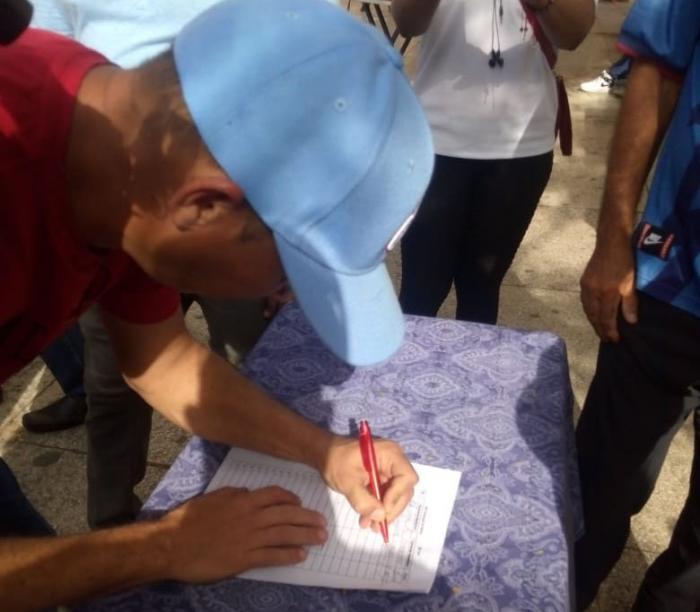
In a sweeping display of popular unity and unyielding rejection of external meddling, thousands of residents across Cuba’s central province of Ciego de Ávila have mobilized to participate in the “My Signature for the Homeland” campaign, a nationwide grassroots initiative pushing back against rising hostile actions from the United States government.
Launched on April 19, the 65th anniversary of the Bay of Pigs victory — widely marked across Cuba as the first decisive military defeat of U.S.-backed imperial expansion in Latin America — the signature drive will run through May 1, International Workers’ Day, aligning with widespread popular mobilizations responding to the escalating warmongering rhetoric and policy against the island nation.
Spontaneous participation has unfolded across every corner of the province: from primary schools and industrial workplaces to senior community centers, military garrisons, public medical clinics, government administrative offices, and local Committees for the Defense of the Revolution. Cubans of all ages and backgrounds have turned out voluntarily to add their names to the campaign’s rosters.
Niurka Ferrer Castillo, general secretary of the Cuban Workers’ Confederation (CTC) in Ciego de Ávila, emphasized to state-owned newspaper Granma that the mobilization is not coerced, but a natural, heartfelt expression of the Cuban people’s demands. “This is not a forced act, but a genuine cry for peace. We signed for our families, for life, for the right to exist as a free nation,” Ferrer explained.
The simple act of signing carries profound symbolic and political weight: every signature represents a clear affirmation of support for peace, and an uncompromising rejection of foreign-instigated conflict. Signatories overwhelmingly condemn the decades-long intensification of the U.S. economic, commercial, and financial blockade against Cuba, as well as recent hostile statements and actions that threaten the island’s domestic stability. “Cuba will not bow to the designs of the empire,” Ferrer reiterated.
Official data from the province highlights five municipalities that have recorded particularly high turnout: Chambas, Baraguá, Ciro Redondo, Primero de Enero, and the provincial capital also named Ciego de Ávila. Organizers describe the broad participation as a living exercise in popular sovereignty, driven by the Cuban public itself rather than top-down mandate.
Radamés Alemán Alonso, a retired veteran of the Cuban Revolutionary Armed Forces, framed the campaign as a collective defense of national dignity. “Each signature is another stone in the wall of dignity,” he said. “There is no place for fear or intimidation here.”
Martha María González Gutiérrez, a homemaker from the Centro neighborhood council, echoed that sentiment as she added her name to a community signature sheet. “I sign for my children, for the future, because we understand that peace is not begged for, it is defended,” she stated.
The mass participation in Ciego de Ávila forms part of a nationwide movement that has seen millions of Cubans add their signatures across the country. Beyond a symbolic gesture, the collective action sends an unmistakeable message to the international community: regardless of the pressure and threats coming from the United States, revolutionary consciousness and deep patriotism remain firmly rooted in Cuban society. The collective action of the Cuban people reaffirms a timeless promise: this nation will never surrender its right to self-determination.