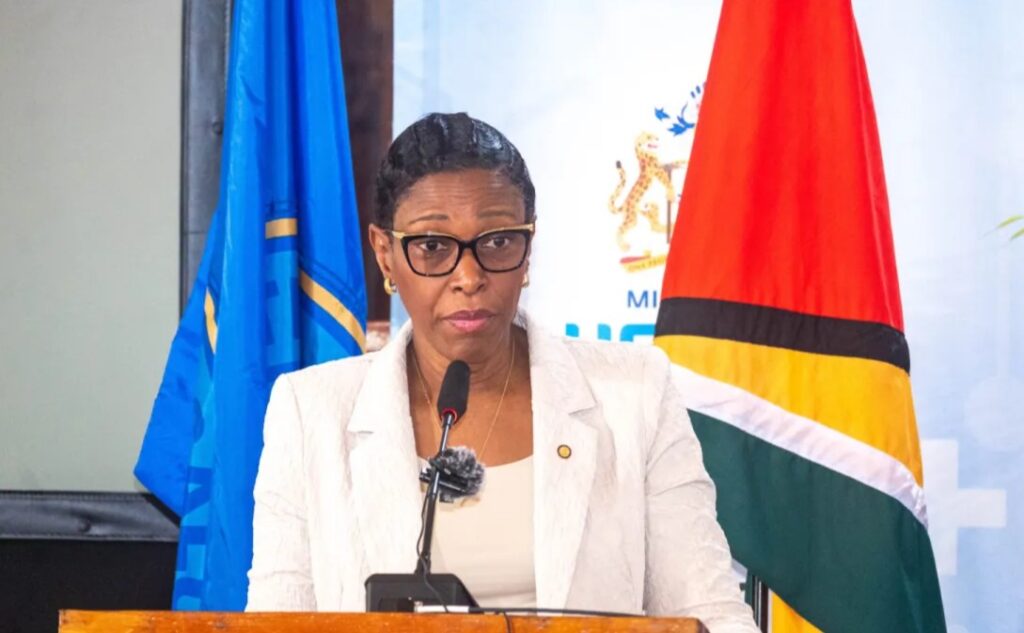
GEORGETOWN, Guyana — Public health leaders announced a landmark public health achievement for the Caribbean region over the weekend, with overall childhood vaccination coverage climbing to the Pan American Health Organization’s (PAHO) 95% target, up three percentage points from 2022’s 92% rate. The milestone was unveiled during the official launch of Guyana and Caribbean Vaccination Week 2026 by Dr. Rhonda Sealey-Thomas, Assistant Director of PAHO.
Dr. Sealey-Thomas emphasized that this breakthrough does not happen by accident: it is the direct outcome of long-term, consistent investment in regional public health infrastructure, unwavering political commitment to immunization priorities, and the tireless frontline work of healthcare workers across every Caribbean island and mainland territory. Several nations have already set a regional example, she noted, with Guyana, Montserrat, and St. Vincent and the Grenadines securing full 95%+ coverage across multiple categories of routine childhood immunizations.
Despite the celebratory note of the announcement, Dr. Sealey-Thomas issued a urgent caution that retaining this hard-won progress will demand constant vigilance and ongoing commitment. “The progress we have made is meaningful, but much more remains to be done…Achieving and sustaining at least 95 per cent coverage for all antigens is essential,” she stated.
The warning comes as the broader Americas region faces a growing public health threat: declining vaccination coverage in some areas has fueled a dramatic resurgence of measles, a highly contagious vaccine-preventable disease. PAHO data shows more than 15,000 confirmed measles cases were recorded in the first months of 2026 alone — a total that already exceeds the entire caseload reported across the region in 2025.
This resurgence underscores four non-negotiable pillars of effective immunization programming, Dr. Sealey-Thomas explained: robust disease surveillance systems to track outbreaks early, sustained public confidence in vaccine safety and efficacy, equitable timely access to immunizations for all communities, and consistent long-term investment in immunization programming.
Guyana’s Public Health Minister Frank Anthony echoed these remarks, sharing details of his nation’s successful strategy to maintain coverage above 95% for most routine vaccine antigens, even in hard-to-reach areas. To expand access to remote hinterland communities that have long faced barriers to healthcare, the Guyanese government has prioritized upgrading critical immunization infrastructure: investing in modern cold-chain storage facilities, solar-powered refrigeration units that work reliably in off-grid areas, improved cross-country vaccine transport networks, and specialized training for frontline healthcare workers delivering shots in isolated locations.
Anthony stressed that infrastructure investment means nothing without tangible impact on community health. “It makes no sense if you have the vaccine and it is nicely stored in the fridge…You have to put it in somebody’s arm so that it can work to protect that person,” he said.