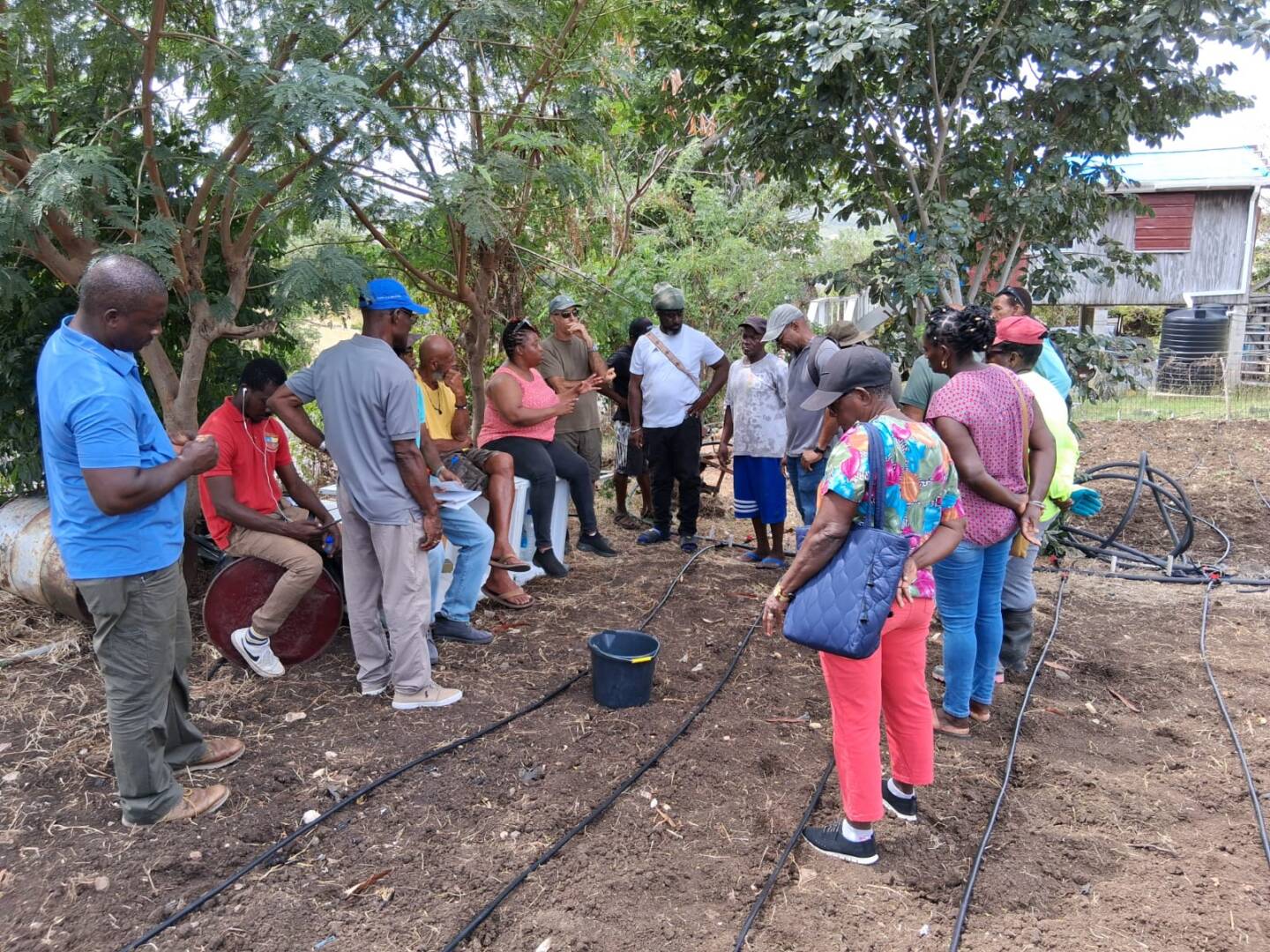
Agricultural producers across the twin islands of Carriacou and Petite Martinique have emerged from specialized hands-on training with new technical skills and critical equipment to boost crop output and strengthen their defenses against the growing impacts of climate change. The initiative focused on training farmers to properly install and maintain two water-efficient irrigation systems: micro-sprinklers and drip irrigation, and follows the recent distribution of purpose-built irrigation hardware to 12 participating producers — seven from Carriacou and five from Petite Martinique.
Both the equipment donation and technical training were made available through the Challenge Fund for Agriculture (CFA), a core component of Grenada’s national Climate-Resilient Water Sector (G-CREWS) project. The ongoing program prioritizes expanding access to water-smart agricultural technologies across the country, encompassing not just micro-sprinkler and drip systems, but also infrastructure for rainwater harvesting. The overarching goal of these investments is to shore up long-term resilience in Grenada’s agriculture sector, which is disproportionately vulnerable to shifting weather patterns linked to climate change.
For island communities like Carriacou and Petite Martinique, where chronic water scarcity and extended dry seasons have long hammered agricultural yields, the new irrigation systems deliver a game-changing improvement to farm operations. Unlike traditional irrigation methods that waste large volumes of water through evaporation or runoff, the technologies deployed through G-CREWS deliver water directly to crop root zones with pinpoint accuracy. This cuts down on water loss dramatically while boosting overall farm efficiency. Beyond immediate production gains, the training has also built lasting local capacity: participating producers now have the skills to independently install, adjust, and repair their own irrigation systems without relying on external support.
Many beneficiary farmers have already highlighted the tangible benefits the program will bring to their operations. Rohan Thomas, one of the participating producers, noted that the training provided practical, actionable knowledge that will transform how he farms. “Thanks to the G-CREWS project. The training was very informative. I learnt a lot. It should help us, as farmers, in a great way. First, in conserving water and farming year-round,” Thomas said.
Fellow beneficiary Kurt Quashie echoed that appreciation, emphasizing that the timing of the equipment and training could not have been better, aligned as it is with the annual dry season. “The equipment comes at a good time, now that it is the dry season. It will help towards improving food security in the near future,” Quashie explained.
Kaitlyn Weekes, who supported the rollout of the new irrigation systems, outlined the broader sector-wide benefits the technology will deliver for the two islands. “It is very important that we have this system in which we can water our plants and get them growing at a faster rate. This system drops the water directly into the roots of the plants, resulting in increased production over time,” Weekes said.
Elhaddaji Lahcen, the training facilitator from Agile Water Solutions, the private firm that led the technical instruction, explained that drip and micro-sprinkler systems stand out as the most water-efficient irrigation solutions available for small-scale producers in arid and water-scarce regions. “The only system that can save water right now on irrigation is drip irrigation and micro-sprinklers, but more drip irrigation. We did a small demonstration on the installation of the drip irrigation system, while reminding farmers of the importance of securing spare parts for repair needs,” Lahcen said.
Derek Charles, a CFA consultant attached to the Grenada Development Bank, reported that participating farmers showed high engagement and curiosity throughout the training process. In addition to irrigation hardware, Charles noted that several producers also received new water storage tanks to support on-farm rainwater harvesting, expanding the resilience benefits of the program. “They had hands-on experience with the layout of the lines and checking the pressure within the lines. From this training we are sure, they would be able to install their own lines,” Charles said.
The G-CREWS project is a collaborative climate initiative, with joint resourcing from the Green Climate Fund (GCF), the German Federal Ministry for the Environment, Climate Action, Nature Conservation and Nuclear Safety (BMUKK) through its International Climate Initiative (IKI), and the Government of Grenada. The project’s core mandate is to advance climate resilience across Grenada’s entire water sector through systemic, multi-level transformation that drives a long-term shift in how the country approaches climate adaptation and builds national resilience.
This article was published by NOW Grenada, which notes it is not responsible for the opinions and statements shared by program contributors in this report.