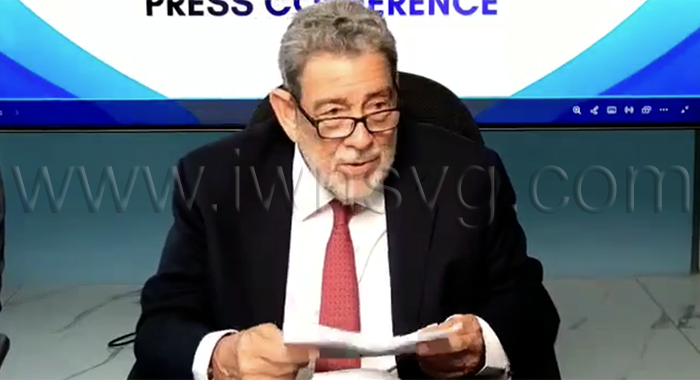
KINGSTOWN, St. Vincent — A post-election political firestorm has erupted in St. Vincent and the Grenadines (SVG), as former long-ruling Prime Minister and current Opposition Leader Ralph Gonsalves is sounding the alarm over a controversial proposal from the newly elected government led by Prime Minister Godwin Friday, urging local media to speak out against what he frames as an attack on the country’s core democratic institutions.
Gonsalves, whose Unity Labour Party (ULP) lost the November 27 general elections after holding power for 20 consecutive years, laid out his case in a formal letter sent to media editors across the country, centering his criticism on the government’s plan to amend the SVG Constitution retroactively while two election challenges against Friday and Foreign Affairs Minister Dwight Fitzgerald Bramble are already winding through the judicial system.
The election petitions were filed by defeated ULP candidates, who argue that Friday and Bramble are ineligible to hold their parliamentary seats because they hold Canadian citizenship, a question that hinges on the judiciary’s interpretation of Section 26 of the existing Constitution. That clause bars candidates who have voluntarily sworn allegiance to a foreign power from holding office. Gonsalves, a trained attorney, noted that after the government initially dismissed the legal challenges as “frivolous”, it has now taken the unprecedented step of introducing a retroactive constitutional change that would directly alter the legal landscape mid-litigation, potentially swinging the outcome of the cases in the government’s favor.
Gonsalves emphasized that the foundational democratic principles SVG has long cherished are on the line: the supremacy of the national constitution, the rule of law, and the separation of powers between the legislative, executive, and judicial branches. He pointed out that the government’s maneuver is unprecedented not just in SVG, but across global and Caribbean democratic contexts. While dual citizenship eligibility challenges are common around the world, he said there is no recorded example of a sitting government amending its constitution specifically to sidestep an active court challenge to its own top officials.
The proposed amendment, Gonsalves argued, is being rushed through with just one week’s public notice, no meaningful consultation with either the opposition or the general public, and no formal explanation from either the Prime Minister or the Attorney General. Beyond its opacity, he said the amendment directly undermines the core role of the judiciary, which holds the exclusive constitutional authority to interpret constitutional law. A retroactive change tailored to an ongoing case, he contended, does not merely update the law—it effectively interferes with the administration of justice by predetermining the outcome of a matter properly before the courts.
The government has already pushed back against Gonsalves’ claims. Government legislator and attorney Jemalie John told a local radio program last week that the proposed constitutional changes are not intended to impact the two pending election petitions, and rejected the ULP’s accusation that the New Democratic Party (NDP) government sprung the plan on the public without warning. John clarified that public discussion of the proposal was inevitable after official parliamentary notice was published, per the country’s standing rules.
For Gonsalves, however, the risks stretch far beyond this specific dispute. He argued that the amendment violates long-held legal principles, including the ban on retroactive laws that alter existing rights and the accepted boundaries of parliamentary power to amend the constitution. He added that election petitions are a unique cornerstone of electoral accountability, designed to enforce the law as it existed at the time voters cast their ballots. Changing that framework after the fact erodes legal certainty and public trust in the entire electoral process, he said.
“No responsible democracy should permit the Constitution to be amended in a manner that appears designed to shield individuals from judicial scrutiny in an ongoing case,” Gonsalves wrote. “Constitutional power, however broad, is not without limits. It must be exercised consistently with the fundamental structure and values of the Constitution itself — values which include democracy, the rule of law, and the separation of powers.”
In his appeal to the media, Gonsalves stressed that his call is not a partisan maneuver, but a defense of foundational national principles. He urged the press, which has long played a central role in protecting SVG’s democratic traditions, to use its platform to speak out and pressure the government to abandon the amendment, allowing the courts to rule on the pending petitions based on the law in place when the general election was held.
Gonsalves warned that allowing the government’s move to go unchallenged would set a dangerous precedent for future administrations of any political stripe. “If actions of this nature go unchallenged, they risk establishing a precedent by which any government, present or future, may endlessly revise our Constitution — without public consultation — for personal gain or protection. That would have lasting adverse consequences for our democracy,” he said.
The legal challenge is already moving forward: a case management hearing was held on March 5, with the next proceeding scheduled for May 19, and a full three-day trial set to begin on July 28 this year.