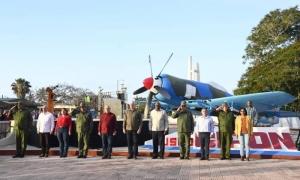
On a cool Sunday morning, April 19, 2026, thousands of Cubans gathered in Playa Girón, Ciénaga de Zapata, Matanzas province — the very stretch of land where Cuba secured its first major defeat of U.S.-backed imperialism in the Americas 65 years earlier — to mark the historic anniversary of the Bay of Pigs Victory. The solemn, celebratory ceremony was led by Miguel Díaz-Canel Bermúdez, First Secretary of the Central Committee of the Communist Party of Cuba and President of the Republic, who laid the first wreath of white flowers at a memorial plaque engraved with the names of the battle’s fallen martyrs, just steps from the local Bay of Pigs Museum.
The commemoration brought together a cross-section of Cuban leadership and public life: top members of the Political Bureau including Salvador Valdés Mesa, Vice President of the Republic; Roberto Morales Ojeda, Secretary of Organization of the Communist Party Central Committee; and Army Corps General Roberto Legrá Sotolongo, First Deputy Minister of the Revolutionary Armed Forces (FAR) and Chief of the General Staff. Also in attendance were representatives of the Communist Party, state institutions, the Union of Young Communists, mass popular organizations, the Association of Combatants of the Cuban Revolution, the FAR, the Ministry of the Interior, local Matanzas government officials, and key delegates who had just wrapped up the 5th International Patria Colloquium, a major global solidarity gathering for Cuba.
The day opened with formal military honors: a command of attention, the playing of Cuba’s national anthem, and a sounding of the Last Post to honor the battle’s fallen heroes. It then blended solemn remembrance with vibrant cultural expression, featuring performances by a roster of Cuban artists including Silvio Alejandro Rodríguez performing iconic protest singer Silvio Rodríguez’s *Fusil contra fusil*, the Korimakao Community Artistic Ensemble, the Revolution Performance Company, students from the National Dance School, and actor Denys Ramos.
Speakers across generations centered the event on the continued relevance of the 1961 victory, when then-Prime Minister Fidel Castro led a coalition of worker, peasant and student militias, the Rebel Army, police forces, medical personnel and ordinary civilians to defeat a U.S.-organized mercenary invasion in less than 72 hours. Speaking on behalf of Cuba’s younger generations, Major Yadian Daniel Medina of the FAR stressed that the 1961 invaders failed to account for one critical factor: the unwavering commitment of the Cuban people to defend their sovereign revolution. He called out the ongoing U.S. economic blockade, which currently targets critical fuel supplies to the island, and reaffirmed Fidel Castro’s core conviction: a people united as one to defend their freedom can never be defeated.
A series of cultural tributes bridged the past and present: the Korimakao ensemble performed Jesús Orta Ruíz’s iconic poem *Elegía de los zapaticos blancos (Elegy of the Little White Shoes)*, which immortalizes a young girl killed during the invasion, followed by a performance of José Martí’s *Abdala* by the Havana University Theater Group. Elianis Martínez Pérez, a young first-grade teacher from a local elementary school, then reminded attendees that before the 1959 Cuban Revolution, the Zapata swamp region was a neglected, forgotten corner of the island. She denounced the ongoing U.S. blockade, which she said aims to break the Cuban people through hunger and exhaustion, and argued that diligent study and work are the most powerful thanks to the revolution for its decades of human-centered progress.
Delivering the ceremony’s keynote address, Roberto Morales Ojeda framed the 1961 Battle of Bay of Pigs as far more than a single military conflict: it was an irreversible declaration of the Cuban people’s refusal to submit to imperial power. “Sixty-five years have passed since, on these very sands, mercenaries in the service of the most powerful nation in history believed they could crush the nascent Cuban Revolution in a matter of hours,” he said. “They came with the misguided and doomed idea that they would find a divided people ready to surrender. They were wrong; they ignored, just as they do today, our unequivocal conviction of independence or death. In less than 72 hours, the invaders were defeated.”
Morales Ojeda emphasized that the Bay of Pigs victory was the product of two inseparable forces: a whole people mobilized as a militia, and a visionary leader who embodied their will to fight. Around 1,200 invading mercenaries were captured, nearly the entire combat-ready attacking force. The battle, he noted, marked the moment where defense of Cuban territory merged with the island’s new revolutionary social project and collective national identity, forging the unity that would later give birth to the Communist Party of Cuba.
He recalled that in the months leading up to the 1961 invasion, the young revolutionary government had already delivered transformative change: the Agrarian Reform Law that transferred land to poor cultivators, universal healthcare as a fundamental right, and the launch of the national Literacy Campaign, the most sweeping cultural initiative in the country’s revolutionary history. These gains, he said, made Cuba a dangerous example for U.S. imperial interests, prompting decades of sustained aggression: cut credit lines, blocked oil imports, revoked sugar export quotas, a brutal economic blockade, sabotage, piracy, repeated assassination attempts against revolutionary leaders, all of which have failed to break the revolution.
Addressing current challenges, Morales Ojeda acknowledged the harsh realities facing ordinary Cubans today: economic hardship, widespread supply shortages, and material constraints, almost all rooted in the ongoing U.S. blockade. But he stressed that the revolution will never collapse. He noted that just days earlier, more than 50,000 Cubans had gathered for a patriotic event marking the 65th anniversary of the Proclamation of the Socialist Character of the Revolution, issuing a call to spread the truth about Cuba across the globe.
“The enemy does not abandon its sinister plans,” he said. “The economic, commercial, and financial blockade has intensified, now transformed into an inhumane energy siege that seeks to suffocate us. The media campaigns, disinformation, diplomatic pressure, threats, sanctions — this entire arsenal — is being used against us today with the same ferocity and the same frustration as more than six decades ago. Now, as then, unity and firmness are the pillars that cannot be weakened.”
He called on all Cubans to join the new popular campaign *My Signature for the Homeland*, which launched at the Sunday ceremony, with attendees adding their signatures to a massive national registry in protest of the blockade, which Cuban officials describe as an act of economic genocide. He also reaffirmed Cuba’s commitment to peace, but warned that if the island faces new aggression, the Cuban people will once again mobilize as one to defeat any invader.
Morales Ojeda tied the 1961 victory directly to the battles Cuba faces today: overcoming the island’s ongoing energy crisis by expanding renewable energy, boosting domestic food production, improving public service quality, cracking down on speculation, corruption and illegal activity, and restoring economic growth to strengthen Cuban socialism. “This battle, like that of Bay of Pigs, will win with unity, with awareness, with creativity, and with work,” he said. “Cuba wants peace and promotes peace, but it knows no fear.”
The ceremony closed with a moving performance of Sara González’s *La Victoria* by young artist Annie Garcés, who performed while standing on a vintage tank holding the Cuban flag, moving the crowd with her powerful performance. A poignant connection to the 1961 battle came when Nemesia, the now-adult woman who as a child was killed during the invasion and immortalized in the *Elegy of the Little White Shoes*, joined the crowd to stand with the modern generation of Cuban activists. The gathering closed as the first step of a nationwide campaign to demand an end to the blockade and reaffirm the Cuban people’s right to sovereign self-determination.