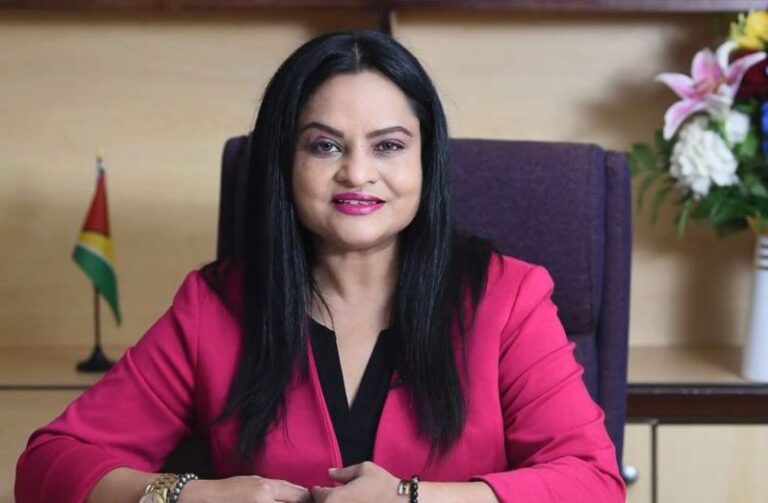
ISTANBUL, TURKEY – During the second meeting of the Group of Parliaments in Support of Palestine, held alongside the 152nd Inter-Parliamentary Union (IPU) Assembly on Wednesday, Guyana’s top human services official has amplified a urgent global demand for immediate expanded humanitarian access to Gaza and an immediate end to Israel’s blockade of the enclave. Dr. Vindhya Persaud, Guyana’s Minister of Human Services and Social Security, used the high-profile international platform to sound the alarm that ongoing armed conflict in the region is inflicting a disproportionately catastrophic harm on Palestinian women and girls.
In her address to the gathering of parliamentary leaders from across the globe, Persaud framed the gendered impact of the Gaza crisis as part of a deeply troubling, widespread global trend. She noted that as armed conflicts escalate in regions around the world, women and girls are consistently pushed to the front lines of suffering, facing elevated risks of gender-based violence, systematic exploitation, and extreme deprivation that leave them disproportionately displaced and bereft of basic necessities.
Persaud characterized the current situation in Gaza as one of the most devastating humanitarian catastrophes of the 21st century, pointing to the near-total collapse of critical public infrastructure and essential services that has unfolded since the outbreak of renewed hostilities on October 7, 2023. She argued that the deliberate weaponization of life-saving humanitarian aid, paired with the staggering scale of civilian suffering in the enclave, amounts to a catastrophic moral failure of the global international community to uphold its core commitments to human rights and human dignity.
Beyond her call for immediate action on Gaza, Persaud reaffirmed Guyana’s long-standing, unwavering support for the fundamental right of the Palestinian people to self-determination. She emphasized the South American nation’s firm commitment to a negotiated two-state solution as the only sustainable path to lasting peace in the region, and noted that Guyana has consistently backed all United Nations resolutions that advance the cause of peace and justice for the Palestinian people. Guyana formally recognized the State of Palestine as a sovereign nation back in 2011, and continues to actively advocate for Palestinian statehood across multilateral global forums.
To illustrate how nations can center gender justice in both conflict and peacetime policy, Persaud drew a parallel between her government’s international advocacy and domestic gender equity reforms implemented in Guyana. She highlighted that the nation has recently strengthened legal frameworks addressing family violence and sexual offenses, established specialized courts to hear gender-based violence cases, rolled out secure digital incident reporting systems, and opened dedicated “Hope and Justice Centers” that provide wrap-around support services for survivors of violence. She stressed that these domestic reforms underscore Guyana’s core commitment to guaranteeing access to justice for all women, regardless of context.
Closing her address, Persaud emphasized that expanding women’s empowerment, particularly through advancing economic independence, is a non-negotiable foundation for both recovery during active conflict and long-term reconstruction in post-conflict societies.