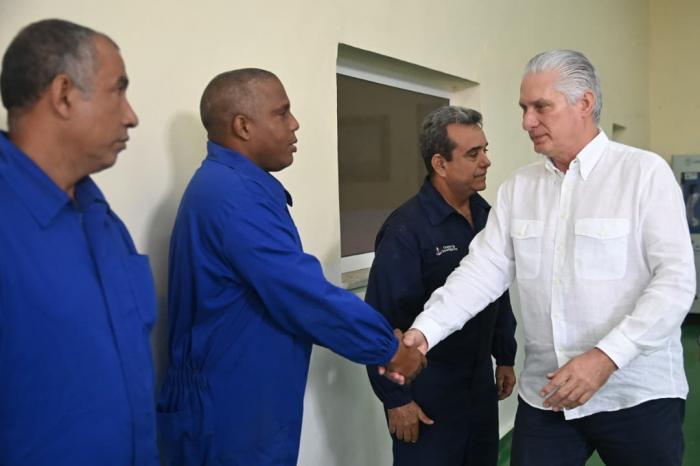
On a Monday morning in mid-April 2026, Cuba’s highest leader, Miguel Díaz-Canel Bermúdez — who holds dual roles as First Secretary of the Central Committee of the Communist Party of Cuba and President of the Republic — undertook an official visit to the Granma Military-Industrial Company, a key industrial facility based in Regla municipality, Havana. He was accompanied by two senior Political Bureau members: Army Corps General Álvaro López Miera, Minister of the Revolutionary Armed Forces (FAR), and Army Corps General Lázaro Alberto Álvarez Casas, Minister of the Interior.
During the facility tour, the country’s top leadership received a comprehensive briefing from Lázaro Raúl Hernández Gómez, the company’s director and a Fleet Captain. Hernández outlined the company’s operational structure: it comprises 19 distinct production units that employ 686 skilled workers, and it successfully achieved its full annual sales target in 2025, even amid the challenging economic conditions the island nation currently navigates.
As Hernández explained to the press following the visit, the Granma Military-Industrial Company’s core mandate centers on maintaining, restoring, and guaranteeing the combat readiness of the Revolutionary Armed Forces and the Cuban Navy. In line with a long-running strategy to leverage industrial capacity for national development, the facility has expanded its scope to meet critical demands across the civilian national economy.
The company is currently pursuing a number of new civilian-focused initiatives, including the manufacturing of floating docks, the modernization of commercial fishing vessels, and production to support the transportation and water resource management sectors. It has also pioneered domestic industrial capability that previously relied on foreign providers: the facility now handles repairs for electric motors ranging from 5 to 500 kW, including electric motors for Chinese-manufactured locomotives that were once sent abroad for maintenance.
To address the basic needs of Cuban households, the company produces a range of kitchen wares and has ramped up manufacturing of alternative biomass stoves that run on coal, sawdust, or firewood, which are distributed across the country to meet energy access needs. Beyond household goods, it manufactures water tankers and fuel storage tanks, produces custom supplies for the tourism sector (including restaurant equipment and refrigeration services), and has successfully salvaged dozens of idle vessels that are now back in full commercial use.
The visit reflects a longstanding tradition of Cuban national leadership engaging directly with military-industrial enterprises, a practice rooted in the unique role these facilities play in the country’s development. Military-industrial hubs like Granma stand out as core centers of research and adaptive innovation, upholding a philosophy of proactive resilience that rejects inaction and prioritizes problem-solving to meet pressing national needs. At a time when Cuba faces sustained economic pressure, this model of leveraging industrial capacity for dual military-civilian use has grown increasingly important to advancing public welfare and keeping national development moving forward.