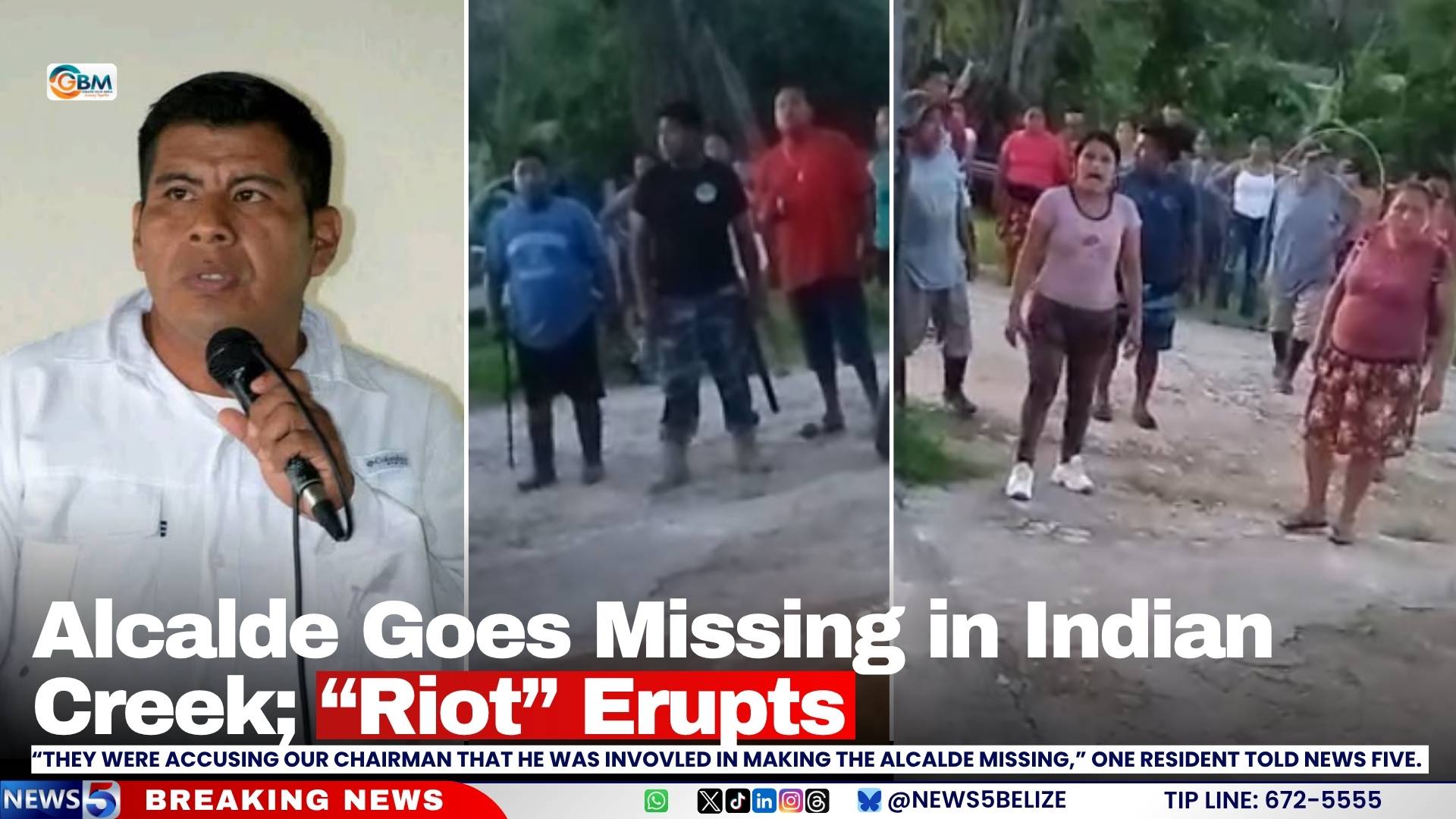
In the remote community of Indian Creek Village, Toledo District, a developing crisis is unfolding after 41-year-old local Indigenous leader Marcos Canti, who serves as the village’s alcalde, was reported missing on Monday, April 13, 2026, triggering violent unrest that has left local property damaged and residents on edge over personal safety.
Canti was last documented working his farm earlier that day, and by 3 p.m., his abandoned personal items — including his machete, bicycle, and traditional cuxtal bag — were discovered at the site where he had been working. As news of his disappearance spread through the tight-knit village, community tensions that had been building for years boiled over into public unrest.
By early evening, a large crowd had gathered, and around 6:30 p.m., demonstrators marched to the residence of Domingo Choc, chair of the village council, who was not home at the time of the incident. Protesters, who accused Choc of being complicit in Canti’s disappearance, pelted his home with stones and damaged his adjacent shop and bar. Local residents report that community members called for police intervention immediately after the violence began, but law enforcement officers arrived after an extended delay.
The unrest quickly spread beyond Choc’s property, with demonstrators targeting the home of the village’s second alcalde — a leader aligned with Choc, as the two top officials have been publicly at odds for months. Threats were also issued against the home of local resident Anselmo Cholom and the Ya’axché Conservation Trust’s local field station.
As of April 14, Belizean law enforcement has issued an official missing person bulletin for Canti, and one person of interest is currently in custody for questioning. In a public statement posted to social media on April 14, global Indigenous rights advocacy group Indigenous Peoples Rights International claimed that Canti was kidnapped amid ongoing illegal land grabs targeting Indigenous communities in the region. The organization also alleged that community police received an audio clip sent from Canti’s phone in which the leader can be heard being assaulted and tortured, pleading for assistance in his native Maya language. These claims have not yet been independently verified by official law enforcement.
The unrest and Canti’s disappearance come against a backdrop of a deepening, long-running land conflict that has divided the community for months. On April 6, just one week before Canti went missing, he issued 200 communal land certificates for territory at Boden Creek that is claimed as private property by the Ya’axché Conservation Trust. Canti justified the distribution by referencing the Caribbean Court of Justice’s landmark 2015 Consent Order, which formally recognizes customary land tenure rights for Maya communities in Belize.
The move drew immediate condemnation from the Toledo Private and Lease Landowners Ltd. (TPLL), which labeled the issued certificates fraudulent and warned that the unilateral action would directly fuel community conflict. Shortly after the distribution began, Dr. Louis Zabaneh, head of Belize’s Ministry of Indigenous Affairs, ordered Canti to halt the process, issuing a formal clarification that alcaldes hold no legal authority to grant formal land rights until national enabling legislation is passed to codify the 2015 CCJ ruling.
For decades, Indian Creek has operated under two overlapping systems of governance: the traditional Alcalde system, which was formally legitimized for land matters by the 2015 CCJ ruling, and the state-established Village Council system. While the two structures coexisted uneasily for many years, disputes between the two factions have sharpened dramatically in recent years as demand for land and pressure for formal land rights recognition have grown. This remains an actively developing story, with more updates expected as the search for Canti and investigation into the unrest continue.