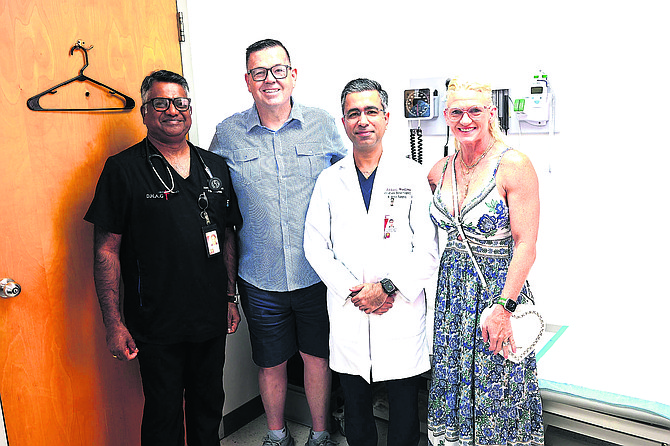
Five years after a catastrophic stroke nearly claimed his life during a romantic anniversary trip to The Bahamas, former 28-year police veteran Ray Wood, 54, has finally fulfilled a year-long mission: meeting the neurosurgeon who pulled him through the most critical weeks of his medical battle to say thank you in person.
The fateful event unfolded in July 2019 (corrected from original date misstatement) when Wood and his wife Raemie, also a police officer, traveled from their home in Southern California to celebrate their 10th wedding anniversary. Frequent Caribbean travelers, the couple was four days into their trip when Wood developed a sudden, severe headache and breathing trouble ahead of a planned scuba dive. Though he initially rested on the boat, he joined the dive roughly 45 minutes later; by the time the group returned to shore, his condition deteriorated rapidly.
After returning to their hotel, Wood lost consciousness and all memory of the hours that followed. Raemie quickly recognized the signs of a life-threatening event: her husband’s speech was slurred, he could not walk steadily, he had been vomiting, and he could barely navigate their hotel room. She immediately called for emergency services, packed essential items for a hospital stay, and reached out to a doctor acquaintance for guidance while waiting in the emergency department hallway as her husband underwent emergency imaging. “There was no time to cry at first,” Raemie recalled of the chaotic night. “I only broke down once I was in the hallway making calls.”
Imaging scans confirmed a devastating brain bleed that affected nearly one-quarter of Wood’s brain. He arrived at Doctor’s Hospital around 2 a.m. with right-side weakness, complete inability to speak, and rapidly declining consciousness. When Dr. Susheel Wadhwa, the consultant neurosurgeon on the case, assessed him, his Glasgow Coma Score — a standard scale measuring consciousness levels — had fallen to just 10 and was dropping quickly.
The case was uniquely high-risk from the start. The bleed occurred on the left side of Wood’s brain, the dominant hemisphere that controls critical motor and cognitive function for right-handed people like him. Compounding matters, Wood had a pre-existing heart condition: he had undergone a heart ablation procedure in 2019 and was taking daily aspirin, which significantly increases bleeding risk during brain surgery. He also tested positive for COVID-19, adding another layer of complexity to his care.
Wadhwa led the first emergency surgery that lasted four hours, with the entire perioperative process stretching to seven to eight hours total. In the days that followed, Wood’s condition slowly stabilized, but the severe brain impairment left him unable to form new memories, resulting in little to no recollection of his two-week stay in the Bahamian hospital. When he finally regained full consciousness, his first question was not about his own condition — he asked if his wife was safe. He later underwent a second, shorter procedure, and part of his skull was temporarily removed and stored in his abdomen to reduce swelling before being reattached during a later procedure in Florida that November.
After two weeks of critical care in Nassau, Wood was transferred to a rehabilitation facility in Florida to begin the long, grueling process of recovery. For the former law enforcement officer, re-learning basic daily skills was a humbling, disorienting experience: he struggled with speech and mobility, and the stroke left him with permanent vision loss that prevents him from seeing anything below chest level, causing persistent balance issues. Today, he relies on a cane to walk to avoid falls. Raemie retired from her own police career to serve as his full-time caregiver, and the couple has entered a new chapter of life permanently reshaped by the near-tragedy.
For more than a year, Wood held one unwavering goal: to return to The Bahamas and meet the surgical team that saved him, to express his gratitude in person. That long-awaited meeting happened last Friday, when Wood and Wadhwa sat down together to revisit the original CT scan that showed the life-threatening brain bleed.
With tears in his eyes, Wood reflected on the extraordinary circumstances of his survival. “I was a policeman for 28 years, I can’t tell you how many times I was shot at, how many times bad guys tried to take my life,” he told The Tribune. “Here I am, celebrating life and having a great time, and this comes out of nowhere — and a man that can save my life. Today I’m just grateful to be alive.”
For Wadhwa and his medical team, these rare in-person reunions carry profound meaning, especially for intensive care staff who rarely get to see the long-term outcomes of the critical patients they treat. “When you are amidst all of this work, and you have a story like this that just comes back, it brightens the whole team,” Wadhwa said. “Even the team’s morale, especially with nurses in the ICU — they’re seeing very sick patients every day, and they so rarely get to find out what that person’s outcome ends up being. This means more than you know.”