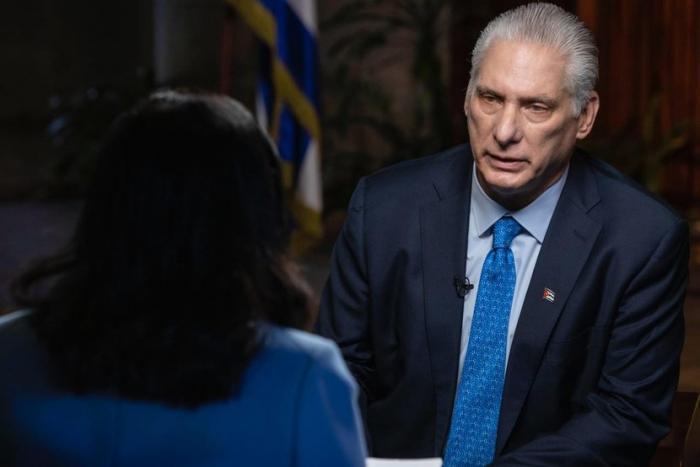
In a wide-ranging April 9, 2026 interview with NBC News *Meet the Press* moderator Kristen Welker, conducted at Havana’s José Martí Memorial, Cuban President Miguel Mario Díaz-Canel Bermúdez addressed mounting threats from U.S. leadership, the crippling impact of the decades-long American blockade, and Cuba’s longstanding commitment to national sovereignty.
Welker opened the conversation by pressing Díaz-Canel on recent aggressive rhetoric from former president and current U.S. leader Donald Trump, who has claimed he “can do whatever I want with Cuba” and implied plans to take control of the island nation. Díaz-Canel framed the threats as a reflection of long-standing U.S. aggression against Cuba, rooted in a 150-year struggle for Cuban independence from foreign domination. He emphasized that Cuba’s national identity is inextricably tied to sovereignty, noting that the 1959 Cuban Revolution ended decades of foreign subjugation and delivered transformative social gains that the Cuban people will never abandon. Echoing legendary Cuban independence hero Antonio Maceo, he stated: “Whoever attempts to seize Cuba will only gather the dust of its blood-soaked soil, if they do not perish in the struggle.”
While affirming Cuba’s commitment to peace and regional solidarity, Díaz-Canel made clear that the country is not intimidated by threats and remains fully prepared to defend itself against any invasion. He rejected U.S. claims that Cuba is on the brink of collapse, pointing to the island’s six decades of resilience in the face of the longest-running blockade in modern history, which he described as a “criminal, genocidal” act of aggression. When asked if he feared assassination or arrest by the U.S. following Trump’s pattern of aggressive actions against foreign leaders, Díaz-Canel said he holds no personal fear, noting that all Cuban revolutionary leaders are prepared to sacrifice their lives for the nation. He pushed back on the framing that the Cuban Revolution’s leadership is centered on a single individual, explaining that Cuba operates under a unified collective leadership structure where hundreds of leaders are prepared to step into any role if needed. Any attack on Cuba would be met with full national resistance, he added, noting that the Cuban national anthem’s mantra “To die for the Fatherland is to live” is not an empty slogan but a core value held by all Cubans from childhood to old age.
Confirming that Cuba is actively preparing for potential U.S. attack, Díaz-Canel stressed that Cuba’s defense doctrine is entirely defensive. The country’s “War of the Entire People” strategy, developed during past periods of heightened U.S. threat, organizes every Cuban citizen to participate in national defense, ensuring that any invasion would be unsustainable for foreign forces, even one as powerful as the United States. “Preparing to defend ourselves is the best way to avoid war and the best way to preserve peace,” he said, adding that the only legitimate path forward for U.S.-Cuba relations is dialogue, not confrontation, which would bring unnecessary loss of life and instability to both nations and the entire Caribbean region.
Turning to the ongoing energy crisis, Díaz-Canel addressed the recent U.S. suspension of all fuel supplies to Cuba and the arrival of a Russian fuel shipment delivered as humanitarian aid. He explained that the new U.S. energy blockade is just the latest escalation of 67 years of economic war and 60+ years of total blockade, a policy that was first intensified during Trump’s first term in 2019, maintained through the Biden administration, and is now being ramped up to unprecedented levels. He noted that the Russian shipment only covers one-third of Cuba’s monthly fuel demand, and while the aid is greatly appreciated, it does not resolve the ongoing crisis. Díaz-Canel outlined Cuba’s comprehensive long-term strategy to achieve energy independence, including expanding domestic oil production, welcoming foreign investment in the energy sector (including from U.S. companies, if the blockade allows), investing in renewable energy, and developing domestic refining technology for Cuba’s heavy high-sulfur crude. He stressed that despite external pressure, Cuba will persist and adapt through the resilience and creativity of its people.
Responding to claims that Cuba requires Russian support to survive and is on the edge of collapse, Díaz-Canel emphasized that Cuba’s strength ultimately comes from its own people, who have consistently demonstrated creative resistance to decades of blockade. He welcomed aid from partner nations including Russia, China, Vietnam, and Mexico, but noted that the U.S. could also choose to abandon its hostile policy and contribute to Cuba’s development. Rejecting the U.S. narrative of imminent collapse, he asked: “What country in the world would be capable, as Cuba has been, of withstanding 67 years of sustained aggression from the world’s most powerful nation… and not collapse?” He pointed to Cuba’s enduring social gains, including universal free healthcare and education, top global Olympic medal per capita rates, world-leading biotechnology innovation, and a society free of corruption, drug trafficking, and organized crime, arguing that these achievements are impossible under a “failed state.”
When pressed on widespread suffering from energy and food shortages, Díaz-Canel placed full blame on the intensified U.S. blockade, noting that the 2019 escalation cut off all external financing, imposed harsh secondary sanctions on any country or company that trades with Cuba, and crippled key sectors including tourism, manufacturing, and public infrastructure. He pushed back on claims that the Cuban government is responsible for economic decline, pointing to the cumulative impact of decades of escalating blockade pressure. He highlighted Cuba’s response to the COVID-19 pandemic as evidence of the government’s commitment to its people: when the U.S. blocked access to vaccines, ventilators, and medical oxygen, Cuban scientists developed domestic mRNA vaccines, locally produced ventilators, and achieved better COVID mortality outcomes than the United States, despite decades of blockade. “It is unjust to blame a government whose sole purpose is to serve its people… for these evils,” he said. “The U.S. government should reflect on how cruel it has been toward Cuba and the Cuban people. It has no right to present itself as our savior, nor does it have the moral authority to do so.”
Addressing calls for economic reform and a shift away from Cuba’s one-party socialist system, Díaz-Canel noted that the Cuban government regularly conducts self-critical assessments and works to improve its policies, but that the national political system, approved by the Cuban people via popular referendum, is not the cause of the country’s hardships. He pointed to the successful development of socialist economies in China and Vietnam, which advanced rapidly once their blockades were lifted, noting that Cuba has studied their reforms as a reference but must adapt to its own unique context: an island nation 90 miles from the U.S. that has lived under an unbroken six-decade blockade. “Lift the blockade and let’s see how we fare,” he challenged. “If even under the blockade we have achieved victories and shown solidarity to other nations, imagine what we could do without it.”
On the topic of potential negotiations with the Trump administration, Díaz-Canel said that while a civilized, mutually respectful agreement between the two nations is possible, deep mistrust remains after 67 years of U.S. hostility and repeated American violations of past bilateral agreements. Cuba has always been open to dialogue based on mutual respect and equality, with no preconditions, he said, and there are many areas of potential cooperation including counter-narcotics, counter-terrorism, migration, trade, investment, cultural exchange, and public health collaboration. He highlighted two ongoing groundbreaking cooperative projects: a joint decade-long clinical trial for a Cuban lung cancer vaccine with a top U.S. cancer research center, which has produced extremely encouraging results, and a collaboration on an innovative Cuban Alzheimer’s treatment with a Colorado clinic, where American patients have seen better outcomes than with existing U.S. medications. “We cannot allow a blockade policy that serves only minorities and elites to undermine the relationship that our two peoples could have,” he said.
When asked about U.S. demands for political reforms including free press, the release of purported political prisoners, and fair elections, Díaz-Canel said Cuba’s internal constitutional order is not up for negotiation with the United States. He rejected the narrative that Cuba holds political prisoners, explaining that people are only incarcerated for committing violent or disruptive criminal acts, often encouraged and funded by U.S. subversion programs, not for peaceful protest. Peaceful protests are regularly held and addressed by government officials without imprisonment, he added, noting that the narrative of political prisoners is a manufactured slander designed to discredit the Cuban Revolution. When asked if he would resign to meet U.S. demands, Díaz-Canel rejected the premise of the question, noting that no U.S. journalist would ask any other sitting head of state to resign at the demand of a foreign power. He stressed that Cuban leaders are elected by the Cuban people via a grassroots democratic system, and only the Cuban people have the right to remove their leadership. The U.S. has no moral standing to demand changes to Cuba’s political system, he said, as it bears full responsibility for the suffering the Cuban people endure.
Closing the interview, Díaz-Canel reiterated that Cuba remains open to good-faith dialogue with the United States, focused on mutual respect, shared interests, and avoiding confrontation, to build a relationship of good neighborliness that benefits both peoples, the Caribbean, and Latin America. He thanked Welker for the opportunity to speak directly to the American people and extended an invitation for further discussion on unresolved issues.