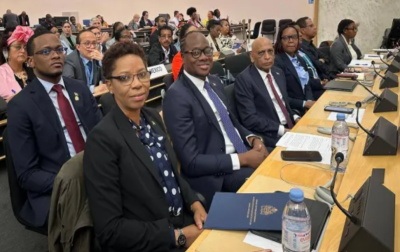
GENEVA, Switzerland — Representing the 15-nation Caribbean Community (Caricom) at the Fifth Session of the Permanent Forum of People of African Descent, Guyana’s Minister within the Ministry of Culture, Youth and Sports Steven Jacobs stood before the global assembly Tuesday to reinforce the regional bloc’s longstanding demand for reparatory justice for the harms of the transatlantic slave trade.
In his address to the forum, which centered its discussions on the interconnected themes of reparations, equitable sustainable development and economic justice, Jacobs voiced unwavering Caricom backing for the forum’s work. He framed the moment as a critical turning point: while the well-documented history of systemic injustice against people of African descent cannot be erased, the future of this community remains open to collective action. For centuries, he noted, the narrative of people of African descent has been defined by state-enforced dispossession, systemic exclusion, and structural inequality — harms whose intergenerational impacts continue to limit outcomes for marginalized communities across the globe today.
Jacobs recalled that the United Nations General Assembly has formally recognized the transatlantic trade in enslaved African people and the institution of chattel slavery as among the worst crimes against humanity in recorded history. This international acknowledgment, he emphasized, enshrines a critical truth in global collective memory — but formal recognition alone is not enough to undo centuries of harm. Without concrete action to address the lingering legacies of slavery, Jacobs argued, these inequities will continue to shape access to opportunity, public resources, and developmental progress for generations to come, a reality that Caricom member states experience directly every day.
“Our call for reparatory justice is therefore grounded in responsibility and equity,” Jacobs told delegates. Through the bloc’s landmark 10-Point Plan for Reparatory Justice, Caricom has steadily advanced a flexible, actionable framework centered on accountability for historical harms, targeted developmental investment, and cross-regional partnership to advance redress.
He also highlighted the growing global momentum behind the reparations movement, pointing to the widely endorsed Accra Proclamation as well as deepening collaborative work between African and Caribbean nations. These coordinated efforts, Jacobs noted, reflect a growing global consensus that the legacy of the transatlantic slave trade is a shared historical responsibility — and meaningful progress will only come through collective, coordinated action.
The structural legacies of enslavement and colonialism, Jacobs added, are not confined to individual national contexts; they remain embedded in core global systems, driving persistent economic imbalances and blocking inclusive developmental pathways for formerly colonized nations. For Small Island Developing States (SIDS) like many members of Caricom, these longstanding structural challenges have been further exacerbated by the accelerating climate crisis, which disproportionately threatens small, low-lying coastal nations that contributed almost nothing to historical greenhouse gas emissions.
Tackling these overlapping crises, Jacobs argued, requires integrated, coordinated policy action that connects the push for reparatory justice to broader efforts to reform the unfair global financial architecture and deliver urgent, equitable climate action that centers the needs of the most vulnerable nations. He emphasized that the Second International Decade for People of African Descent must be a period of tangible delivery, turning non-binding global commitments into measurable, life-changing progress for communities of African descent around the world.
Closing his address, Jacobs reaffirmed Caricom’s commitment to constructive collaboration with the Permanent Forum and the broader international community. The bloc’s goal, he said, is to ensure that the next chapter of the global story of people of African descent is not written for the community by outside powers — but written by the community itself, in partnership with global allies, and rooted in justice for their past, present, and future.