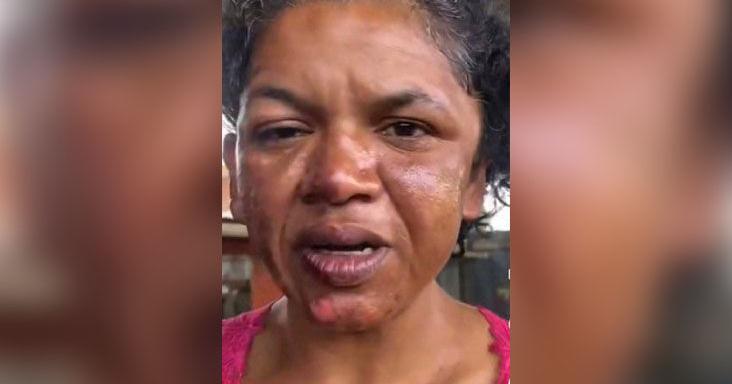
After enduring more than seven months of captivity, brutal abuse and false imprisonment at a private residence in Penal, a 42-year-old domestic worker named Sabita Basdeo has finally escaped her captors, leading to the arrest of a local woman and her teenage son, Trinidad and Tobago law enforcement confirmed.
Basdeo told investigators she was held against her will from September of last year through early this month at the Penal property, where she was forced to perform unpaid domestic labor without any permission to leave or contact her family. Her account of the abuse details unthinkable violence: repeated beatings, having her head slammed repeatedly against a solid wall, burns across her body, and even pepper rubbed into her skin as a form of torture. When she was finally rescued, medical personnel documented visible bruising across her face and torso, along with abnormal discoloration on her hands that matched her claims of prolonged mistreatment.
In an emotional interview with reporters at the family’s Penal Rock Road home on Sunday, Sabita’s husband Krishendeo Basdeo, 55, shared that his family had been separated from Sabita for far longer than the seven months she was formally held at the Penal property. He described the devastating scene when he saw her after her escape: her face swollen and disfigured by bruises, her complexion unnaturally pale, and she was dressed in filthy, tattered clothing. He added that the captors threatened to kill Sabita if she dared to speak out about her treatment, and forced her to perform humiliating acts against her will.
Krishendeo, a casual laborer who lives with a chronic kidney condition, told reporters he made multiple efforts to secure his wife’s release long before her escape. He attempted to visit her at the Penal residence twice, and was beaten both times when he tried to see her. He also filed multiple missing person reports with local police, but his complaints were never acted on prior to the recent public outcry.
Sabita was finally brought out of captivity on Saturday, when the 38-year-old suspect and her 17-year-old son took her to the Barrackpore Police Station. She immediately identified the pair as her captors, and law enforcement moved quickly to place both under arrest. Following her identification, she was transferred to a local hospital for a full medical evaluation and treatment for the injuries she sustained during her months of captivity. She was reunited with her two teenage sons shortly after her release, in an emotional meeting that saw the family hug for the first time in months.
In a public statement confirming the arrests, the Trinidad and Tobago Police Service said that officers from the Barrackpore Police Station and the Southern Division Task Force launched a coordinated response after receiving an official report of false imprisonment in the Barrackpore jurisdiction. The agency confirmed that the two suspects – a 38-year-old woman and her 17-year-old son, both residents of Penal – were taken into custody at the scene, and are expected to face formal charges including false imprisonment and aggravated assault. The police’s Victim and Witness Support Unit has also been assigned to the case to support Basdeo through the legal process.
The case drew public attention after social media videos of the abuse circulated online, prompting social activist and Trinidad and Tobago Red Cross Society Vice President Edward Moodie to intervene. Moodie condemned the abuse in the strongest possible terms, saying that the mistreatment Basdeo endured went beyond modern slavery, and amounted to some of the worst abuse he had ever encountered.
“These acts are unconscionable, they must be condemned at the highest level, and as a society we cannot stand by – we must demand full justice for Sabita,” Moodie said in a statement Sunday. After seeing the online content, Moodie reached out directly to Minister of Homeland Security Roger Alexander, Commissioner of Police Allister Gvearro, and the area’s senior superintendent to push for urgent action. He thanked Commissioner Guevarro for his rapid response once the case was brought to his attention, and noted that while the family credits divine intervention for Sabita’s safe return, they still need significant long-term support from government social services to recover from the trauma they have endured.