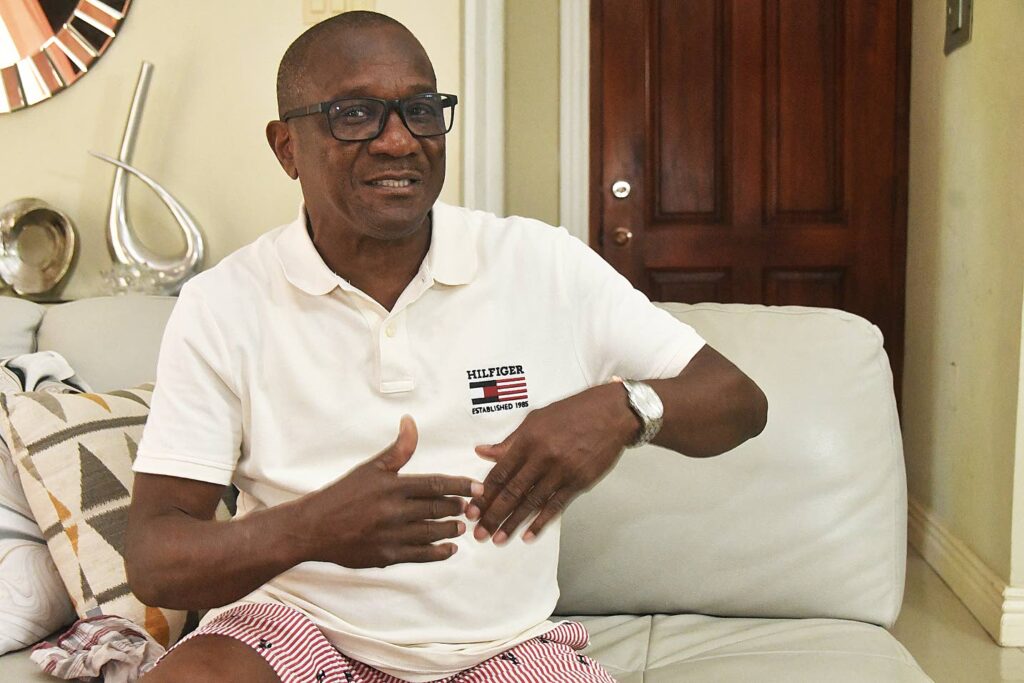
A soft, knowing laugh, steeped in the quiet triumph of a life built against all odds, escapes 67-year-old former Jamaican national footballer Michael “Zun” Clarke as he looks back on a journey few would have bet on. His path winds from the tough, working-class streets of Waltham Park Road in Kingston, through the high-stakes glory of Jamaica’s Manning Cup schoolboy football at Tivoli Gardens High School, all the way to the lecture halls of American universities, where he would eventually graduate with a bachelor’s degree in counselling and guidance.
What hides beneath that warm laughter is a story of almost unbelievable grit, rooted in a secret few knew during his childhood: for all of his primary school years, Michael Clarke could not read.
Speaking with the Jamaica Observer, Clarke explained that poverty, not lack of ability, created that barrier. Raised by a single mother after his father passed away when he was just four years old, the youngest of nine siblings grew up in a household so strapped for cash that his mother Isadora simply could not afford to buy him a basic reading book for his studies at Whitfield Town Primary School.
Rather than surrender to self-pity or let his circumstance define his future, Clarke made a quiet, deliberate choice to teach himself literacy — and he turned his daily football training into a classroom. While training at the old Cable and Wireless playing field near his Cortina Avenue home, he built his reading skills one word at a time.
“I started out by pulling a word from the dictionary, writing out each letter, and as I ran around the track in the evenings, I’d spell the word out loud and practice pronouncing it,” Clarke recalled. “Every single day I learned at least two or three new words. Over time, I started putting them together into sentences — I actually taught myself how to read.”
By the time he enrolled at Tivoli Gardens High School, he still had years of catching up to do to match the literacy level expected for his grade. Even after graduating high school with no O-Level qualifications, Clarke knew he was already far behind his peers — so when a rare football scholarship opened up to Alderson Broaddus University in the United States, he vowed to squeeze every possible opportunity out of the second chance.
“When I got that scholarship, I thought to myself, ‘What the hell is this? This is your last shot to build something for yourself,’” he told the Sunday Observer. “And trust me, I made it count. I studied almost day and night, made the Dean’s List with a 3.6 GPA first, then a 3.8. I never failed a single class in college.”
His academic performance was so strong that after completing his undergraduate degree, Clarke earned a full academic scholarship to pursue abnormal psychology at West Virginia University in 1985. That remarkable academic rise came just over a decade after a fateful encounter that changed the course of his life as a teenager.
At 15, Clarke was attending Tivoli High on the evening shift when he crossed paths with Neville Myton, the school’s football coach and a former Jamaican Olympian who competed at the 1964 Tokyo Games while still a student at Excelsior High. Myton had built a reputation for spotting hidden raw talent, and that evening he spotted Clarke playing in the school auditorium.
“He asked me my name, then asked if I wanted to switch to the morning shift to join the football program. I said yes immediately. He told me to show up before the school gate opened on Monday, and that’s exactly what I did,” Clarke said, smiling at the decades-old memory.
Myton placed Clarke on the school’s Colts youth team, and that year, they took home the championship. One victory that still stands out to him is a 1-0 win over powerhouse Kingston College — the first time Tivoli Gardens had ever beaten Kingston College in any sport, by Clarke’s recollection.
By 1976, Clarke was a starting striker on Tivoli Gardens’ Manning Cup squad, a team stacked with extraordinary young talent that included Dennis “Den Den” Hutchinson, Ken Bailey, Leon Osbourne, and brothers Dave and Delmonte Clarke (no relation to Zun), that claimed the Manning Cup title. For a school that was only five years old at the time, the win felt almost otherworldly.
“To be honest, it was almost surreal that a young program just five years old could achieve that much in so little time,” Clarke said. “After a while it hit me: ‘Holy crap, we actually did this.’ We nearly repeated the win the next year, too. It taught me that big things are actually possible, even when everyone counts you out.”
While fans across Jamaica marveled at the underdog win, Clarke said the team simply saw it as the result of playing the game they loved the way they always had. “We didn’t do anything extra. We just played like we normally did,” he said.
After high school, Clarke played for Jamaican club side Cavalier, worked on the production line at local manufacturer Seprod, and earned a call-up to represent Jamaica at the national level. His final cap for the Reggae Boyz came in 1987, after he had already moved to the U.S. He flew back to Jamaica after picking up his green card, trained with the squad, and came on as a substitute in an exhibition match against a side that included English stars John Barnes and Luther Blissett.
Clarke soon found that the discipline, quick thinking, and strategy he had honed on the football pitch translated seamlessly to his post-academic career. After graduating university, he took a role with New York City Parks and Recreation, before spending decades as a youth counsellor with the New York State Office of Children and Family Services, working with court-ordered juvenile delinquents.
“As a youth counsellor, you hear some terrible, dangerous stories — especially from the girls, 12 to 18 years old, talking about ongoing abuse and trauma,” Clarke explained. Early in his tenure, the weight of those stories drained him mentally, especially as a father of two daughters with his wife Sandra. “At one point my wife told me, ‘Don’t bring this work home. If it’s eating at you this much, leave and find something else.’ Over time, I learned how to process it, how to empathize without carrying the pain home with me, but it was always heavy work hearing what those kids had gone through.”
Clarke retired from his role in December 2000, just a month after celebrating his 67th birthday in January this year, he splits his time between Jamaica and the United States, where he owns property, and spends much of his time traveling between the two countries to visit his three children, all of whom have built successful careers of their own.
His son Leon, from a previous relationship, is a high school principal in Delaware with a PhD, who earned an American football scholarship to the University of Delaware. His oldest daughter Aneka, 41, is a certified public accountant after graduating Temple University on an academic scholarship, while his youngest daughter Michelle, 31, a Howard Business School graduate, works as a strategy consultant for a digital technology firm in Washington, D.C. Clarke speaks of his children with a father’s quiet, unshakable pride.
But for all the joy and success Clarke has earned in his later years, he carries a quiet grief: when his mother Isadora passed away in 2020, at the height of the COVID-19 pandemic, he was stuck abroad and could not get home to be with her before she died. Jamaica had closed its borders and locked down to slow the spread of the virus, so Clarke could not return before she died of natural causes, aged 102.
“COVID didn’t kill her, she died of natural causes, but it hurts to talk about it. The country was shut down, the ports were closed, no one could come in, and I was stuck overseas,” he said, his voice thick with emotion. As soon as lockdown restrictions lifted, Clarke booked the first available flight home to honor the woman who made endless sacrifices to support his education, even when she could not afford a reading book for him. He finds solace in the fact that she lived to 102, a milestone he describes with a typically Jamaican cricketing metaphor: “She was a good batswoman. She batted the whole innings well.”