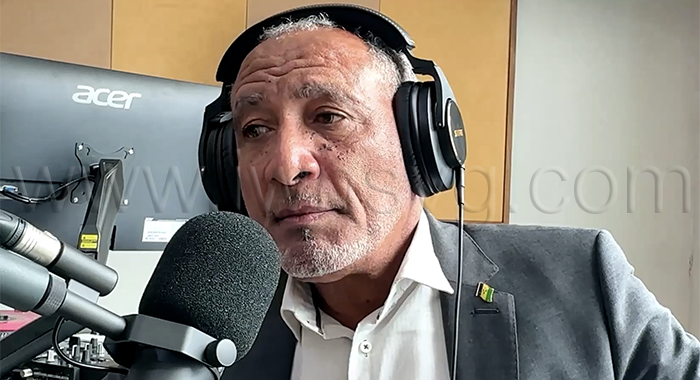
A decades-long policy rejection of citizenship-by-investment (CBI) has left St. Vincent and the Grenadines (SVG) with up to US$1 billion in unrealized revenue over the past 10 years, according to newly elected Prime Minister Godwin Friday. In a candid interview aired on Hot 97 FM last Friday, the leader of the New Democratic Party (NDP) — which won general elections in November 2024 after ousting the 25-year incumbent Unity Labour Party (ULP) — opened up about the economic costs of the previous administration’s hardline opposition to CBI programs, noting that fellow Caribbean leaders have repeatedly questioned SVG’s refusal to adopt the popular economic development tool.
During the interview, radio host Luke Boyea shared a striking comment from a senior St. Lucia Labour Party official — a ideological ally of the SVG ULP — who claimed that SVG’s refusal to launch CBI under former Prime Minister Ralph Gonsalves had turned the country into a regional laughing stock. Boyea noted that while the ULP made bold public claims about SVG’s economic standing, the absence of CBI revenue left clear gaps in the country’s development progress that were obvious to regional observers.
CBI programs grant foreign nationals full citizenship and a valid national passport in exchange for a substantial contribution to the host country’s economy, usually targeted at infrastructure, social programs, or other public projects. SVG is currently the only one of the five independent member states of the Organisation of Eastern Caribbean States (OECS) that does not operate a CBI program. The NDP made the introduction of CBI a core campaign promise during its 2024 election run, and Friday confirmed that the new government remains on track to launch the program within 2025 despite minor delays to some campaign pledges.
Gonsalves, who now serves as leader of the opposition, has maintained his long-standing opposition to CBI, repeatedly framing the program as little more than selling passports. Last year, his public comments labeling CBI an inherently corrupt model drew sharp pushback from Antigua and Barbuda Prime Minister Gaston Browne, whose country operates one of the region’s most successful CBI programs.
Friday acknowledged that the new administration has delivered on some of its 60-day campaign pledges, while other initiatives have been pushed back to later in the year. He cited ongoing global economic uncertainty stemming from regional conflicts as a key factor that requires responsible policy timing, noting that it would be reckless for the small island nation to ignore shifting global conditions when rolling out new programs.
“It would be irresponsible to simply disregard what’s happening in the world and simply do whatever you like,” Friday said. “As a responsible government, we will consider these global factors as we advance our agenda, but our core strategic objective remains unchanged: we will manage public finances to keep our debt sustainable, meet the basic needs of all Vincentians, and expand investment opportunities to bring renewed prosperity to St. Vincent and the Grenadines.”
Alongside CBI, Friday confirmed that repairs to the derelict Ottley Hall Marina and Shipyard — a flagship project of the last NDP administration that held office from 1984 to 2001, which was left to fall into ruin under the ULP’s 2001–2024 tenure — will move forward this year, with multiple serious investors already expressing interest in the high-potential site. The prime minister also noted that new hotel investment projects are in the pipeline for the island nation, which relies heavily on tourism as a core economic driver.
Responding to criticism of CBI from opposition figures, Friday emphasized that the program offers a unique path to raise government revenue without taking on new debt or increasing domestic taxes. “You’re not borrowing it and you’re not taxing people to get it,” he said, framing the previous administration’s rejection of CBI as a reckless decision that carried massive opportunity costs for the country.
Now that he holds office, Friday said regular conversations with regional peer leaders who operate successful CBI programs have underscored the scale of the missed opportunity. “They’re looking at us like say, ‘Boy, what an opportunity you guys missed,’” he told listeners.
When asked why the ULP spent decades framing CBI as a harmful, unethical practice that the country should avoid, Friday said the media host had correctly identified the core issue: a small group of loud political opponents convinced the public of the narrative, leaving the entire country to bear the economic cost.
As an example of what CBI revenue can fund, Friday pointed to Dominica’s new international airport, a major infrastructure project that has been largely financed by CBI proceeds. Friday’s own estimate places SVG’s cumulative missed revenue over 10 years at up to US$1 billion, a figure that lines up with informal estimates from a fellow regional prime minister, who pegged potential annual revenue at EC$200 million (roughly US$74 million), even the lower projection amounts to substantial unborrowed, untaxed revenue that the country could have used for development.
Friday specifically noted that the US$78 million hospital currently under construction at Arnos Vale, for which the previous ULP government borrowed US$100 million from Taiwan, could have been fully paid for with CBI revenue had the program been adopted years earlier.