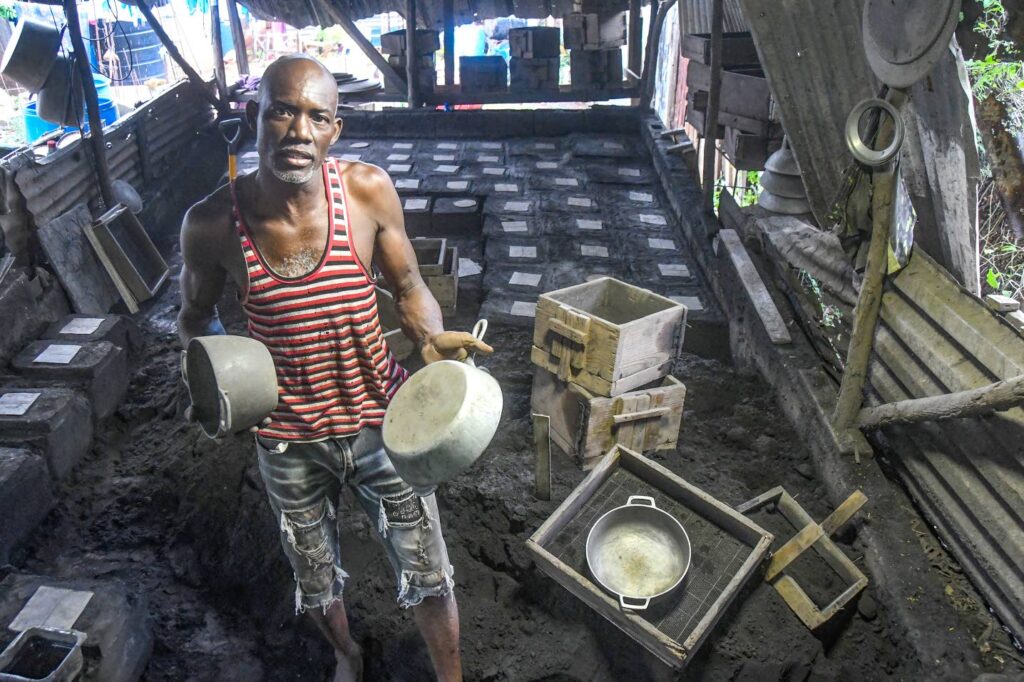
More than four decades ago, a seven-year-old Kevin Campbell sat quietly among veteran craftsmen in the Frazer’s Content neighbourhood of Spanish Town, St Catherine, Jamaica, watching intently as they shaped handcrafted Dutch pots and coal stoves by hand. Now 52, Campbell has turned this childhood fascination into a thriving small business, producing more than 100 handcrafted aluminium pots per week — and he is on a mission to recruit a new generation to save the fading Jamaican tradition before it disappears entirely.
Campbell recalls that metal pot and cookware crafting was once a booming trade that supported dozens of households across his community. But as the elder artisans who held the knowledge passed away or migrated abroad, the craft declined sharply. Today, only four people in the entire community still practice the traditional skill, and dwindling young interest has left Campbell deeply concerned about its future.
“From the start, Campbell learned the craft from local artisans Kenroy Hylton and a craftsman known only as Culture, who brought the trade — a branch of a tradition originating in Waterhouse, St Andrew. The early exposure stuck with Campbell through decades of work. While many artisans abandoned the trade over the years due to its demanding nature, Campbell’s lifelong passion has kept him committed to the craft. Two years ago, he branched out to launch his own independent business, producing custom-made pieces ranging from small teapots to large soup pots, frying pans and traditional coal stoves in a full range of sizes.
His durable handcrafted products are sold both wholesale and retail to local restaurants and households across St Catherine’s Linstead, as well as Mandeville and Christiana in Manchester, with prices ranging from JMD $1,700 to $20,000 depending on size, type and purchase volume.
The craft is intensely labour-intensive, with each piece taking two to three full days to complete. Campbell crafts all his pots exclusively from aluminium for a smooth, polished finish. The traditional process starts with shaping moulds for both the pot and its lid from topsoil, followed by pouring molten aluminium into the dried mould. Once the metal sets, the raw pot is removed and carefully polished by hand.
Campbell points to his first ever completed pot — a four-pound rice pot he made when he was 10 years old — as proof of his products’ longevity. His family still uses the pot regularly to this day. “It came out wonderful — nice, clean, and pretty. I felt so much joy when I saw that I had made something that turned out perfectly. There’s no feeling like that,” he told reporters, smiling as he held the well-worn piece.
While demand for his traditional cookware has fluctuated over the decades, the craft has been a reliable livelihood that allowed Campbell to support his family and put all four of his children through high school. Though his children have pursued their own independent career paths, they all pitch in to help with the business side of the operation, handling marketing, transportation and sales. His daughter Lamoya has taken on day-to-day operational management, coordinating orders and transactions across the region.
For Campbell, no other line of work can compare to the satisfaction of pot-making. He jokes he would live a million years if it meant he could keep crafting his wares. But he also knows he cannot carry the tradition on his own forever, which is why he is actively inviting young Jamaicans — even college students just curious about the process — to learn the craft from him for free. His contact information is posted on social media (876-435-4960 and 876-797-8623), and he says he is ready and willing to teach anyone who wants to learn.
Campbell follows the example set by the artisans who taught him, who never closed the door to him when he was a curious child. “They could have hidden the knowledge from me, but they didn’t. They gave me the willingness to pass it on by showing me kindness when I wanted to learn,” he explained. “Even if someone just wants to learn the process and doesn’t want to build a whole business out of it, I’m still happy to teach them. Sharing this craft brings me joy.”