Five years after the worst of the COVID-19 pandemic, the global economy still struggles to find its footing in a steady, broad-based recovery. Now, a new and destabilizing shock has emerged: the lingering economic fallout from a recently paused conflict in the Middle East is sending ripples through every corner of the global economy, amplifying existing vulnerabilities and threatening progress for vulnerable nations and communities.
The most immediate and acute impact has played out in global energy markets, where the conflict created the largest global energy supply shock in decades. At the height of hostilities, analysts estimate that roughly 13 percent of the world’s daily oil supply and 20 percent of global liquefied natural gas (LNG) exports were pulled from the market, triggering a dramatic spike in prices. Before the conflict began, benchmark Brent crude traded at around $72 per barrel; at its peak, the price surged to $120 per barrel. While prices have pulled back from their highest point following the pause in fighting, they remain well above pre-conflict levels, forcing importing countries to pay steep premiums to secure enough fuel to meet domestic demand.
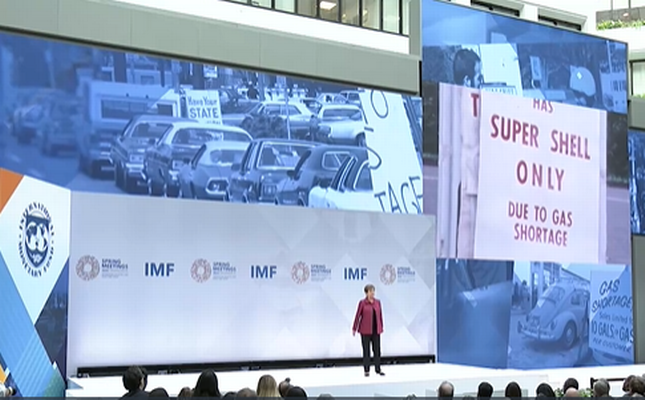
This energy market disruption has cascaded across nearly every sector of the global economy, touching populations far beyond the Middle East. The conflict’s human toll is already severe: millions of people around the world face growing uncertainty about access to basic goods, and food insecurity has deepened dramatically. Kristalina Georgieva, Managing Director of the International Monetary Fund (IMF), outlined the scope of the crisis in remarks delivered Thursday at the World Bank’s pre-meeting Curtain Raiser Event. She noted that transport disruptions tied to energy price hikes have pushed an additional 45 million people into food insecurity, raising the total number of people facing acute hunger globally to more than 360 million. Rising fertilizer costs, driven by higher energy and natural gas prices, are expected to worsen this crisis in the coming months by suppressing agricultural output.
Industrial supply chains, which have only just begun to unwind pandemic-era backlogs, are also facing new strain. Key industrial materials that are largely produced in the Middle East, including sulfur, helium, and naphtha, have seen widespread shortages. These inputs are critical to everything from semiconductor manufacturing to medical imaging equipment and plastic production, meaning shortages are now rippling through advanced manufacturing sectors on a global scale.
Small island developing states, such as St. Kitts, are among the hardest hit by the crisis. Sitting at the end of most long-haul supply chains, these nations rely on consistent fuel shipments to power their economies and support critical sectors like tourism. Ongoing disruptions have left these countries facing heightened uncertainty over when their next fuel deliveries will arrive, pushing their already fragile economies closer to crisis.
Economists categorize the crisis as a textbook large-scale global supply shock: one that hits unevenly across regions, with low-income and vulnerable nations bearing a far greater burden than large advanced economies. The combination of higher energy costs, disrupted production chains, and rising consumer prices has created a difficult balancing act for policymakers: higher energy costs are pushing overall inflation upward across most major economies, while also dampening consumer and business demand. Recent data shows short-term inflation expectations have risen in major economies including the United States and the eurozone, though longer-term expectations have remained steady – a small positive that offers policymakers some breathing room to avoid a sustained wage-price inflation spiral.
In just days, top international financial leaders, finance ministers, and central bank governors from around the world will gather in Washington, D.C. for the annual spring meetings of the IMF and World Bank, where addressing this new crisis will top the agenda. The gathering is expected to focus on forging coordinated global policy responses to stabilize volatile energy markets, untangle snarled supply chains, and deliver targeted support to the vulnerable populations and low-income nations that are bearing the brunt of the new shock.