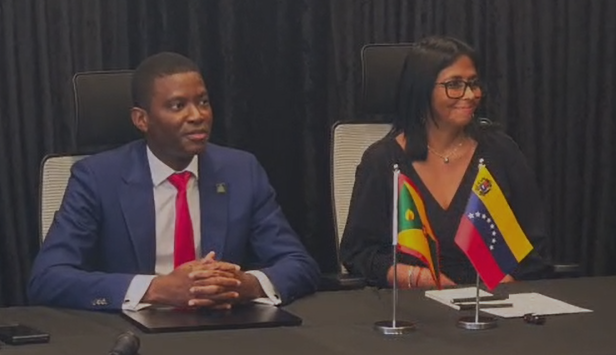
On Thursday, April 9, 2026, Delcy Rodriguez, the interim president of Venezuela, made her first international visit to the Caribbean island nation of Grenada since assuming leadership of the oil-rich South American country. During the trip, she held high-level talks with Grenadian Prime Minister Dickon Mitchell in St. George’s, Grenada’s capital, and outlined her administration’s goal of using enhanced bilateral cooperation with Grenada as a stepping stone to deepen ties across the entire Caribbean region.
Speaking to reporters through an interpreter alongside Mitchell, Rodriguez noted that the planned bilateral cooperation agenda spans multiple key sectors, including educator exchange programs, public health collaboration, maritime and air transportation infrastructure development, domestic food production expansion, bilateral and regional trade initiatives, hydrocarbon development, and maritime boundary negotiation. Neither leader shared specific timelines or financial details of the proposed partnerships during the public briefing.
A key bilateral matter on the meeting’s agenda was the negotiation of the two nations’ shared maritime boundary, a pressing issue as Grenada moves forward with plans to restart offshore oil and natural gas exploration in its territorial waters.
The visit comes against a dramatic geopolitical backdrop: earlier this year on January 3, former Venezuelan President Nicolas Maduro was detained by U.S. forces and transported to New York to face trial on charges of drug trafficking and weapons trafficking. Rodriguez emphasized that her new administration favors resolving all international disputes through diplomatic and peaceful channels. She also added that the Venezuelan government seeks constructive diplomatic engagement with the United States and other global powers to assert the fundamental right of all nations to pursue autonomous development. Notably, U.S. sanctions targeting Rodriguez over previous allegations of anti-democratic activity have now been lifted.
Rodriguez used the platform to speak out against ongoing oil sanctions imposed on both Venezuela and Cuba, stressing that unilateral coercive measures have inflicted severe harm on ordinary civilian populations in both nations. She reaffirmed that Venezuela’s long-standing close relationship with Cuba remains fully intact, and called for an immediate end to the decades-long U.S. blockade of the island nation. “The people of Venezuela as well as the people of Cuba have a right to live free of sanctions,” she stated.
At the same time, Rodriguez highlighted that Caracas is currently opening new channels of cooperation with the United States across multiple sectors, and expressed hope that the entire Latin American and Caribbean region can advance collectively through collaborative engagement.
The long-standing diplomatic ties between Caracas and several Eastern Caribbean states date back to the governments of Hugo Chavez and later Nicolas Maduro. Countries including Grenada, Dominica, St. Lucia, St. Kitts and Nevis, and Antigua and Barbuda have maintained close relations with Venezuelan administrations for decades, and the new Jennifer Geerlings-Simons administration in St. Vincent and the Grenadines, which took office last year, is also broadly viewed as sympathetic to Caracas.