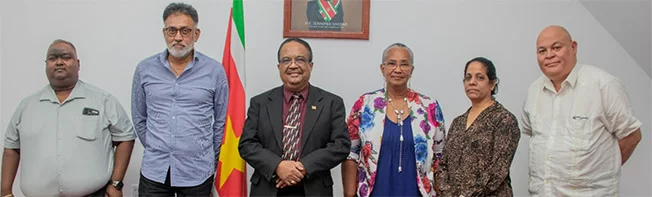
A standoff between Suriname’s academic scientific staff and national authorities has moved toward de-escalation, after the Vakvereniging Wetenschappelijk Personeel Universiteit (VWPU), the union representing scientific staff at Anton de Kom University, agreed to suspend its industrial actions following high-level negotiations led by Surinamese Vice President Gregory Rusland. The talks, held earlier this month, brought together leadership from the university’s governing board and union representatives to address long-running grievances over working conditions and staff support that had prompted the union to ramp up protest actions in recent weeks.
The Anton de Kom University board was led by chair Virginia Assin-Oostburg and vice chair Patrick Peneux during the discussions, while the VWPU delegation included its president Roy Badal, secretary Sunita Bipat, and treasurer Sanjeevkoemar Bisessar. Over the course of the meeting, participants thoroughly mapped out the core bottlenecks that had pushed the union to escalate its actions, centering on gaps in basic provisions for the university’s scientific workforce.
Vice President Rusland opened the discussion by framing the issue of basic staff provisions—including competitive salaries and fair overall employment terms—as an issue that cannot be addressed in isolation. He emphasized that these demands are inherently tied to broader ongoing negotiations between the Surinamese government and national labor unions over working conditions for all public sector employees, a group that includes education workers alongside employees across other state-run sectors.
Despite this broader context, Rusland confirmed that the government remains open to adopting targeted, immediate improvements to the working conditions of the university’s academic researchers and instructors. Specific measures tabled during the talks include institutional support for academic staff to purchase new work computers, upgrades to campus data connectivity and internet infrastructure, increased transportation stipends for faculty supervising students during off-site internships, and a limited end-of-year bonus to recognize additional academic workload.
Under the terms of the preliminary agreement reached during the meeting, Vice President Rusland has ordered the university’s governing board to flesh out the full details of these proposed measures, with a final progress report due no later than this coming Friday. Once finalized, the proposals will be forwarded to relevant government authorities for coordination and final approval. The vice president’s office also confirmed that President Jennifer Simons has already been consulted on the framework, to ensure a coordinated, whole-of-government approach to resolving the dispute.
Following the conclusion of productive talks, Rusland requested that VWPU leadership scale back its ongoing protest actions, a proposal that the union’s governing body put to a vote with its membership. The union ultimately approved the request, moving forward with a full suspension of all active industrial actions.
Multiple participants in the meeting described the negotiations as taking place in a constructive, solution-focused atmosphere. Vice President Rusland emphasized that all stakeholders must uphold their shared social responsibility to advance progress for the country’s higher education sector. He stressed that collaborative effort is the only path to meaningful improvements for scientific staff, part of the government’s broader long-term goal of incrementally strengthening public services and working conditions for all Surinamese residents.
Negotiations between the government and labor unions over broader public sector basic provisions remain ongoing, with no slowdown in discussions planned. Going forward, the government has committed to rolling out additional targeted measures in consultation with worker representatives as economic conditions allow. Officials also noted that the administration has already implemented a series of relief measures for workers and the general public, enacted to buffer the population against the impact of global economic shifts that have spilled over to affect Suriname’s domestic economy. The government has reiterated its commitment to mitigating these external impacts as much as possible within the country’s available fiscal resources.