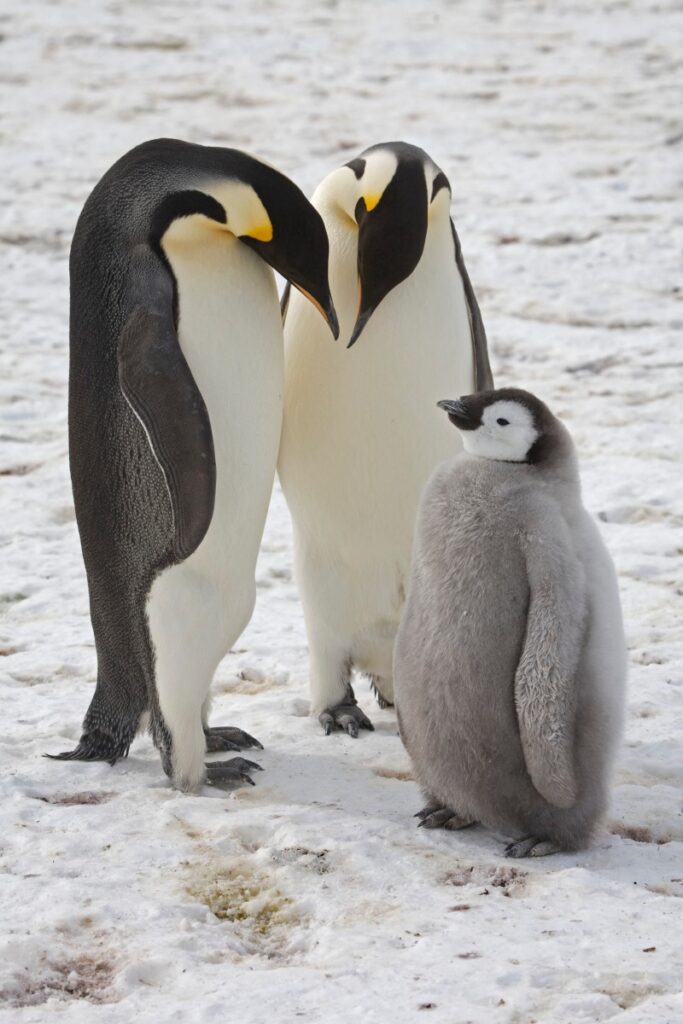
PARIS, France – In a landmark warning about the cascading ecological damage of human-caused global warming, the International Union for Conservation of Nature (IUCN), the world’s leading authority on threatened wildlife, officially upgraded the emperor penguin from “near threatened” to endangered on Thursday. The reclassification puts the iconic Antarctic species just two steps away from total extinction in the wild, shining a harsh spotlight on the existential crisis facing ice-dependent animals as rising temperatures rapidly transform Earth’s southernmost continent.
Emperor penguins, the largest and most recognizable penguin species with their distinctive golden-orange neck plumage, have long become a global symbol of Antarctic wildlife resilience. Their entire life cycle is tied to stable Antarctic sea ice: the frozen platforms serve as breeding grounds where males incubate eggs through the harshest winter months on Earth, and as safe habitats for young chicks while they grow their waterproof feathers during moulting. Unlike most other wildlife habitats, Antarctic sea ice shifts dramatically with the seasons, expanding in winter and contracting in summer. But as global temperatures climb to record highs, sea ice now retreats far earlier each spring and remains far less stable than historical norms. Since 2016, Antarctic sea ice has hit repeated record-low extents, and the impact on penguin populations has been severe. IUCN data shows that roughly 10 percent of the global emperor penguin population – around 20,000 adult birds – vanished between 2009 and 2018 alone. If current greenhouse gas emission trends continue, IUCN projects that the total emperor penguin population will drop by 50 percent by the 2080s.
The reclassification is not limited to emperor penguins. The Antarctic fur seal, once hunted to the brink of extinction for its pelt in the 19th and early 20th centuries, was also moved to the endangered category. The species has seen its global population fall by more than 50 percent since 1999, driven by the same climate change that is harming penguins. Rising ocean temperatures and shrinking sea ice have pushed krill – the tiny crustaceans that form the base of the Antarctic food web and the primary food source for fur seals – deeper into the ocean to find cold enough water, drastically reducing food availability for seals. In a separate update, the IUCN also reclassified the southern elephant seal from “least concern” to vulnerable, after sharp population drops linked to an outbreak of a deadly contagious pathogen.
Philip Trathan, a member of the IUCN expert group that conducted the latest Red List assessment, confirmed that the core threat to emperor penguins is human-induced climate change. Christophe Barbraud, a scientist with France’s national research institute CNRS, told AFP that the species cannot survive without stable sea ice, and the dramatic drop in Antarctic sea ice extent since 2016 has left the birds with increasingly limited habitat. The IUCN Red List of Threatened Species, the global gold standard for tracking extinction risk for plants, animals, and fungi, sorts species into six categories ranging from “least concern” at the lowest risk to “extinct” at the highest. Conservation leaders warn that the new classification of emperor penguins is a wake-up call for urgent global action to cut greenhouse gas emissions and protect Antarctic ecosystems.
“The fate of these magnificent birds is in our hands,” said Rod Downie, a senior advisor at global conservation group WWF. “With the shocking decline in Antarctic sea ice that we are currently witnessing, these icons on ice may well be heading down the slippery slope towards extinction by the end of this century — unless we act now.”