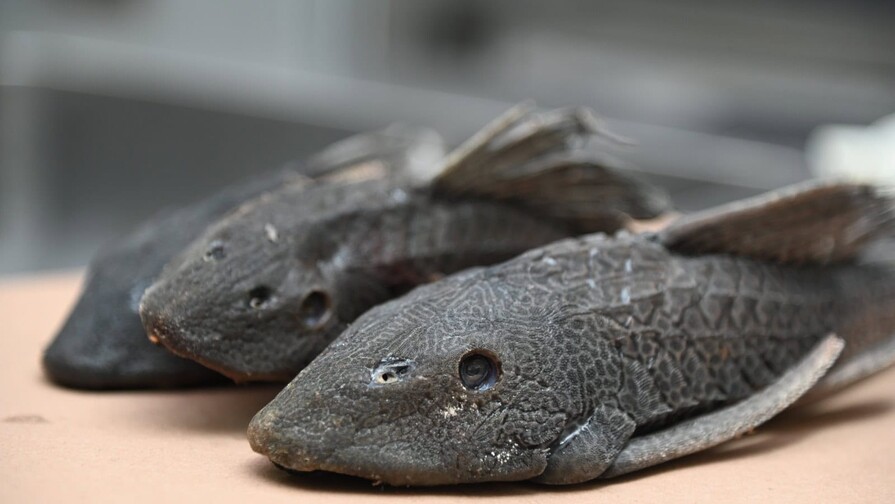
SANTO DOMINGO — An invasive aquatic species that has thrown off the fragile ecological balance of Montecristi province’s Saladilla Lagoon is now at the center of an innovative pilot initiative that re-frames an environmental crisis as a pathway to long-term sustainable economic growth for local communities.
Native to the Amazon basin, the devil fish has spread rapidly across Saladilla Lagoon in recent years, outcompeting native and commercially important species such as tilapia. Its unchecked proliferation has decimated local fish populations, disrupted the lagoon’s natural ecosystem, and undermined the livelihoods of area fishermen who rely on the waterway for income.
Rather than focusing solely on population control for this problematic invasive species, a new collaborative project led by development non-profit People for Development (AVSI Dominican Republic) in partnership with the Dominican Ministry of Environment is aiming to integrate the devil fish into a circular local production chain. The core plan of the initiative is to process devil fish and other invasive species caught in the lagoon into nutrient-dense fishmeal.
Per an official statement from the Ministry of Environment, local community members are carrying out the fishmeal processing work. Once production is complete, samples will undergo rigorous laboratory testing to confirm the safety and efficacy of the final product for two key uses: as an organic soil fertilizer for local farms, and as a nutritional feed supplement for domestic livestock.
This model marks a critical shift in how invasive species are managed across many affected regions. Instead of treating invasive organisms as a costly problem that drains public resources, the project turns a species with no existing commercial value into a sellable commodity that can generate consistent local income.
Gustavo Benigno Toribio, project manager for AVSI, explained that the pilot’s greatest potential lies in its scalability. Beyond the small group of initial participants, the project is designed to expand economic opportunity for every community that relies on Saladilla Lagoon for work and resources.
From the project’s launch, local stakeholders have been at the center of every step of development. After a open selection process, volunteer local farmers and ranchers received specialized training to launch the pilot phase, which kicked off on March 9, 2026. Local fishermen have also been integrated into the workforce, taking on roles in harvesting and initial processing of captured devil fish.
This deep community ownership has cleared the way for the potential development of a permanent community microenterprise, which would formalize the process of converting the invasive species into a sustained economic asset for the region. Notably, the project has prioritized the participation of organized local women in the processing stage, expanding economic inclusion and strengthening the resilience of the local production chain.
Project progress was formally validated during a March 26, 2026 site visit by Marina Hernández, Director of Biodiversity at the Dominican Ministry of Environment, where she reviewed the initial outputs of the devil fish transformation process.
The pilot is one component of a much larger initiative focused on improving environmental management at the Laguna Saladilla Wildlife Refuge, which receives core funding from the Japan International Cooperation Agency.
Alongside the production and economic work, the initiative embeds environmental education as a cross-cutting priority for long-term impact. A dedicated education program for local students and teachers has been developed, with curriculum modules covering key topics including invasive species dynamics, coastal ecosystem health, and the environmental impacts of local productive activities. These educational efforts are designed to build widespread community understanding of the challenges posed by the devil fish invasion, while empowering local people to contribute to context-appropriate, community-led solutions.