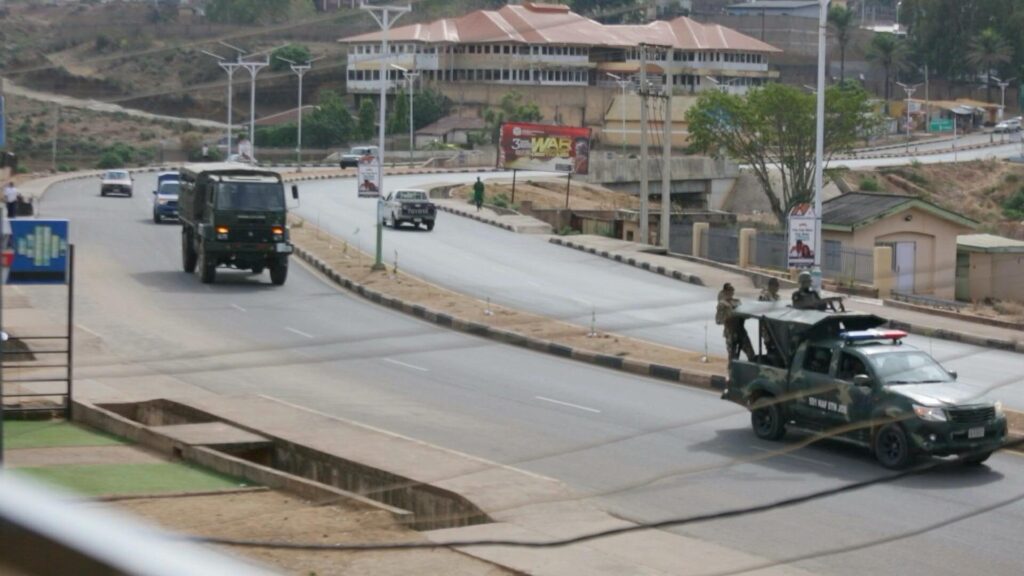
JOS, Nigeria – Just seven days after a mass shooting claimed roughly 30 lives in central Nigeria’s Plateau state, Christian worshippers gathered for Easter Sunday Mass in the capital city of Jos under a heavy cloud of insecurity.
The region’s most important Christian festival, a moment traditionally marked by joyful, packed congregations, looked drastically different this year. One of the city’s largest churches, standing just meters from the site of the deadly Palm Sunday attack at an open-air bar, saw attendance fall to less than half of its normal capacity. The state-imposed curfew, which restricts movement between 3 a.m. and 7 p.m. local time, has left most city streets eerily deserted, with only a handful of civilians venturing out for essential activities.
Along the road leading to the church in Jos’ Anguwan Rukuba district, just one single police checkpoint was visible, a sparse security presence that has done little to reassure residents. In response to last week’s attack, Nigerian military authorities announced they had deployed an extra 850 troops to the restive state to bolster security. But for many worshippers, the reinforcement has come too late, and official promises of protection ring hollow.
Standing outside the beige facade of the Evangelical Church Winning All (ECWA), 57-year-old congregant John Abo Galadima told reporters he sees no real improvement in local safety. “I don’t feel safe in the community, because the government is not doing enough…in terms of security,” Galadima said. “There is no sufficient security presence here.” To compensate for gaps in state security, church leadership has arranged for its own private security team to screen all attendees before allowing entry to worship services.
Fellow worshipper Marian Mark Andy echoed Galadima’s concerns, explaining that widespread anxiety kept many adherents from joining the Easter celebrations. “I don’t feel safe. People are afraid, they could not come to church,” Andy said.
During his sermon, Reverend Luka Musa Madaki led the congregation in prayers for an end to violence while urging attendees to remain constantly alert to potential threats. “As people of God, you need to stand up, spiritually and physically. The attacks are coming to us too much. You should always remain vigilant and reach out to each other,” Madaki told the assembled crowd.
While Plateau state has a long history of repeated rural violence, much of it tied to long-running resource conflicts between farming and herding communities, last week’s attack in Jos marks a rare and particularly alarming episode of urban violence. Jos itself is home to a mixed population of Christians and Muslims, most of whom have coexisted peacefully for generations. But the region has a decades-long history of deadly ethnic and sectarian tension that has sparked large-scale outbreaks of violence in the past.
This most recent attack is part of a grim pattern of bloodshed in the landlocked state. In one of the deadliest recent incidents, nearly 200 people were killed in December 2023 during raids targeting majority Christian communities across the state. The worst sectarian violence in Jos’ modern history dates back to September 2001, when five days of rioting left nearly 1,000 people dead.
The ripple effects of the attack extended to the city’s Muslim community as well. During weekly Juma’a prayers held the Friday after the shooting, worshippers gathered at Jos’ central mosque under significantly heightened security, with both soldiers and police deployed to guard the site. In his post-prayer sermon, the chief Imam of Jos, Sheikh Ghazali Ismail Adam, called on all believers to prioritize mutual respect. “Dignify humanity, uphold fear of Allah and…promote peaceful coexistence,” Adam urged his congregation.