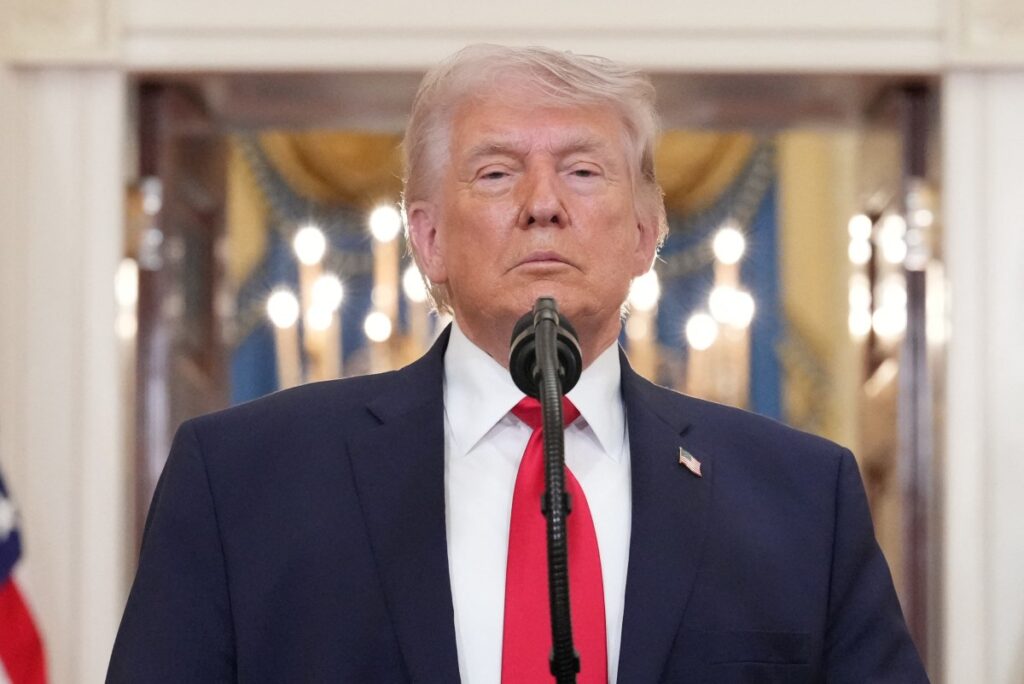
Escalating tensions between the United States, Israel and Iran have reached a new boiling point, with former U.S. President Donald Trump issuing a stark 48-hour ultimatum to Tehran: reach a negotiated deal or face overwhelming retaliation. This latest threat comes as multiple fronts of conflict expand across the Middle East, search operations continue for a missing American airman, and a strike near a critical Iranian nuclear facility has sparked international alarm over nuclear safety.
The full-scale conflict erupted more than a month ago, when joint U.S.-Israeli strikes against Iranian targets triggered a wave of Iranian retaliation that has destabilized the entire region and sent shockwaves through global energy markets. The disruption has been particularly acute because Iran has closed the Strait of Hormuz, the world’s most critical chokepoint for global oil and natural gas supplies, through which roughly a fifth of the world’s daily oil consumption passes.
In a post to his Truth Social platform Saturday, Trump referenced an earlier ultimatum he issued on March 26 that gave Tehran 10 days to strike an agreement and reopen the strategic waterway. “Time is running out — 48 hours before all Hell will reign down on them,” the U.S. president wrote.
Concurrent with Trump’s threat, military forces from both the U.S. and Iran are engaged in a tense search for a downed American service member. On Friday, Iran announced it had shot down a U.S. F-15 fighter jet; U.S. media reports confirm special operations teams have rescued one of the two crew members, but the second remains unaccounted for. Iran also claims to have downed a U.S. A-10 ground attack aircraft over the Persian Gulf, with U.S. outlets confirming that plane’s pilot has already been recovered.
Local search operations for the missing F-15 crew member are being led by combined Iranian military, popular forces and local tribal groups in southwestern Iran’s Kohgiluyeh and Boyer-Ahmad province, deputy provincial governor Fattah Mohammadi told Mehr News Agency Saturday. Mohammadi added that local civilians confronted American search helicopters overnight, opening fire with small arms and preventing U.S. forces from landing to extract the downed pilot. AFPTV-verified social media footage confirms Iranian security forces fired on a U.S. helicopter operating in the southwestern border region during the search.
Iran’s parliamentary speaker Mohammad Ghalibaf used the incident to mock the Trump administration, quipping that the war the U.S. launched has devolved from its original goal of regime change to a frantic plea: “Hey! Can anyone find our pilots?” adding sarcastically, “What incredible progress. Absolute geniuses.”
Retired U.S. Brigadier General Houston Cantwell, a combat pilot with 400 hours of flight experience in conflict zones, told AFP that any downed pilot would rely on standard survival training to avoid capture immediately after ejecting. “My priority would be, first of all, concealment, because I don’t want to be captured,” Cantwell explained.
The threat level rose further Saturday after a strike near Iran’s Bushehr nuclear power plant left one security guard dead. Russia, which co-built the facility and supports its ongoing operations, announced it would evacuate 198 Russian personnel from the site in response. Iranian Foreign Minister Abbas Araghchi issued a dire warning that repeated strikes on the coastal nuclear facility could trigger catastrophic radioactive contamination. “Continued attacks could eventually lead to radioactive fallout that would end life in GCC (Gulf Cooperation Council) capitals, not Tehran,” Araghchi noted, a warning amplified by the fact that Bushehr sits far closer to Kuwait, Bahrain and Qatar than it does to the Iranian capital.
Rafael Grossi, head of the International Atomic Energy Agency (IAEA), wrote on X that the agency has not yet recorded any abnormal spike in radiation levels at the site, but nonetheless voiced “deep concern” over the incident, which marks the fourth strike near a Iranian nuclear facility in recent weeks. “NPP (nuclear power plant) sites or nearby areas must never be attacked,” Grossi emphasized.
Strikes have also continued across the Iranian capital Tehran, where an AFP correspondent on the ground reported thick grey smoke blanketing the city’s skyline Saturday. For ordinary Iranians caught in the crossfire, the conflict has brought widespread chaos and uncertainty. “This war wasn’t for freedom… we just ended up trapped with something even more savage,” 31-year-old Tehran resident Faezeh told AFP via a messaging app. “They bomb randomly, there’s no sign of any specific target these recent days.”
Maryam, a 35-year-old resident of Khansar in Isfahan Province, said Iranian public opinion is deeply split: some citizens hope for an end to the current Islamic government, while others are more terrified of long-term economic collapse. “I’m honestly really scared about our future,” Maryam said. “Things are a disaster right now. Mass layoffs, widespread shutdowns… everything feels overwhelming.”
In recent days, strikes from both belligerent sides have increasingly targeted critical economic and industrial infrastructure, stoking fears that global energy supplies will face even deeper disruption. On Saturday alone, U.S.-Israeli strikes hit an Iranian petrochemical hub, a cement production plant and a cross-border trade terminal on the Iran-Iraq border, leaving one person dead at the terminal site.
For its part, Iran has responded with waves of drone and missile strikes against Israel and U.S. allied states across the Persian Gulf. Bahraini authorities reported Saturday that shrapnel from intercepted Iranian drones injured four people on the island, while debris from downed drones hit two buildings in Dubai, including an office complex hosting U.S. cloud computing giant Oracle. Iran’s Islamic Revolutionary Guard Corps also claimed responsibility for an attack on the commercial vessel MSC Ishyka, which the Guards claims is owned by Israel and flagged to a third country, docked at Bahrain’s Khalifa Bin Salman Port.
The conflict has spilled over into Lebanon as well, where the Israeli military has been engaged in nearly daily fighting with Iran-backed Hezbollah for a month. The Israeli military announced Friday that it has struck more than 3,500 targets across Lebanon since the latest round of border clashes erupted. After issuing advance warnings of planned strikes on key infrastructure, Israeli warplanes destroyed a bridge in Lebanon’s Bekaa Valley, with local reports confirming a second bridge was also hit.
An AFP correspondent in Beirut reported two loud explosions in the capital early Saturday, with thick smoke rising from the site of one blast. The Lebanese health ministry reported that a hospital in the coastal city of Tyre was damaged in Israeli strikes on nearby buildings, which left 11 people wounded. The Israeli military later issued an urgent evacuation order for Tyre’s remaining residents ahead of planned expanded strikes. Tens of thousands of residents have already left the city, but an estimated 20,000 people remain, including 15,000 people who were already displaced from surrounding border villages.