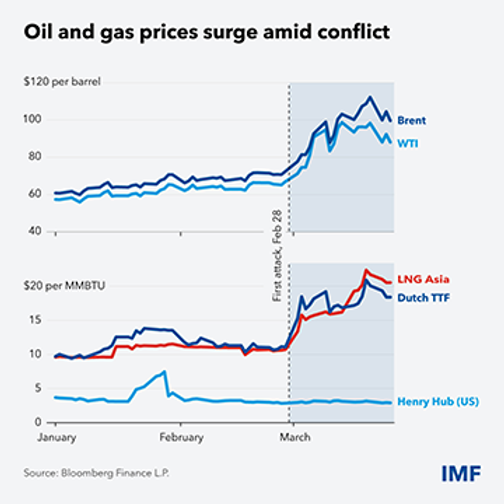
The escalating conflict spreading across the Middle East is sending shockwaves through the global economy, driving sharp upward pressure on energy and food commodity prices while tightening access to credit worldwide, according to new analysis from the International Monetary Fund (IMF). The multilateral institution warns that this unexpected economic shock could decelerate global expansion and amplify the cost-of-living crisis that has strained households across every continent over the past three years. The conflict has already created one of the most severe disruptions to global energy markets in modern history, the IMF reports. Key shipping and transit routes for fossil fuels have been hit hard by growing instability, putting significant upward pressure on global prices. Of particular concern is the Strait of Hormuz, a strategically vital waterway that separates Iran and the Arabian Peninsula. Roughly 25% of the world’s total daily oil output and 20% of global liquefied natural gas (LNG) shipments move through this chokepoint, making any disruption to transit there a core driver of the current energy price surge. The IMF’s analysis makes clear that the economic fallout from the conflict is not evenly distributed across the global economy. Nations that rely heavily on energy imports are facing ballooning fuel import costs that are draining foreign exchange reserves and stretching already stretched government budgets to breaking point. On the opposite side of the ledger, energy exporting nations that are able to maintain consistent production through the period of instability stand to gain from elevated global commodity prices. Higher energy costs are directly feeding into broad-based inflation across the global economy, the IMF emphasizes. Elevated fuel prices push up the cost of transportation and industrial production, and these higher expenses are ultimately passed through to consumers in the form of higher prices for nearly all goods and services. This dynamic creates a meaningful risk that persistent high inflation could return in major economies that had only just managed to bring price growth under control after the post-pandemic inflation surge. Beyond energy markets, global supply chains are facing new disruptions that are adding to cost pressures. The IMF notes that shipping companies are being forced to reroute vessels away from high-risk regions, which drives up freight and insurance premiums while causing costly delays to deliveries. One of the most pressing concerns is the interruption to global fertilizer shipments: roughly one-third of all global fertilizer exports move through the affected Middle East region, and the disruption to these supplies has sparked widespread fears about lower agricultural output in the coming growing season and even higher food prices down the line. Low-income households and developing economies are the most vulnerable to these shocks, the IMF further stresses. For lower-income populations, food makes up a far larger share of total household spending than it does for wealthier groups, meaning price hikes hit these households harder. Rising food and agricultural input costs increase the risk of widespread food insecurity, while also adding unplanned budget pressure to governments in low-income countries that already have very limited fiscal space to respond to crises. Global financial markets have also already reacted to the growing uncertainty, with the IMF documenting falling global equity prices, rising government bond yields, and much tighter borrowing conditions for both public and private borrowers. These tighter conditions push up the cost of servicing existing debt for governments and companies alike, creating additional strains on balance sheets at a time when many are already recovering from recent economic shocks. In its concluding assessment, the IMF says the ultimate severity of the economic damage will depend on how long the conflict lasts and how far it spreads across the region. Prolonged disruptions to energy and food transit, the institution warns, are likely to lock in permanently higher energy costs, keep inflation elevated for much longer, and leave the global economy with much weaker growth than previously projected.