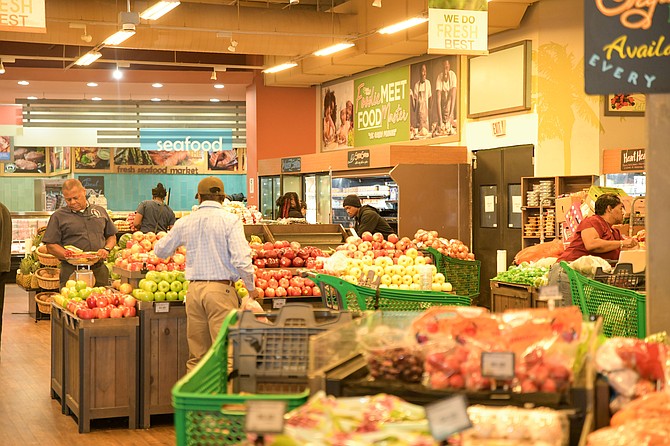
One day after the Davis administration in the Bahamas implemented a flagship policy cutting value-added tax (VAT) on unprepared grocery items from 5% to zero, early consumer feedback across major retail locations in New Providence reveals a deeply uneven impact, with most shoppers reporting little to no immediate savings at checkout and growing concerns over transparency, pricing fairness, and inconsistent retailer implementation.
The zero-VAT initiative, which took effect April 1, is a core plank of the Progressive Liberal Party-led government’s strategy to alleviate persistent cost-of-living pressures facing Bahamian households. Economic Affairs Minister Michael Halkitis has publicly committed to keeping the policy in place for as long as his party holds office, noting that projected economic growth will allow the government to absorb the roughly $15 million in annual lost revenue from the tax cut.
But early on-the-ground interviews with consumers across multiple New Providence grocery stores suggest gaps between the policy’s goals and its real-world outcomes. At Harbour Bay’s Fresh Market, Ortland Bodie Jr. said he broadly welcomes the intent of the VAT cut, but saw no meaningful reductions to his overall grocery bill. “VAT has gone down, but it seem like the prices ain’t going down,” Bodie explained, noting that the cut only shaved a few cents off his total purchase. He also raised questions about whether small, independent “mom and pop” retailers, which lack the sophisticated pricing infrastructure of larger chain stores, will apply the tax cut consistently across their inventory.
Similar skepticism emerged at Oakes Field’s Xtra Value location, where executive chef Noel Claude said his total grocery spend remained largely unchanged despite the policy shift. Claude echoed widespread consumer concern that many retailers are not passing the full benefit of the VAT cut on to shoppers, with some potentially inflating base prices to protect their own profit margins. “I honestly feel like certain things are overpriced,” he said. “I believe sometimes people do inflate it so they could get something at the end of the day too. Because the more they make, the better life is for them, and the sad thing is, it’s the consumer that suffers.”
Lisa Williams, another shopper at the same Xtra Value location, said she detected no noticeable difference to her checkout total. Comparing current grocery prices to decades past, she noted that even when economic conditions were tight under previous administrations, consumers saw clearer price adjustments aligned with policy changes. Williams pointed to broader systemic cost pressures, including rising gas prices and soaring rent, that are pushing overall grocery costs higher regardless of the VAT cut, and suggested some retailers are raising base prices specifically to offset the elimination of VAT.
While most shoppers reported no meaningful savings, a small number saw modest reductions to their bills. At Nassau Street’s Super Value location, Diane Jones said she saved roughly $25 on her large grocery order, a reduction she called welcome relief for households navigating widespread price increases. But not all shoppers at that location shared her positive experience: Tashantae Gibson said she encountered far higher prices than expected for staple items including ground beef, which typically retails for $7 to $9 per package but was priced between $10 and $15 on the day of the VAT cut. Gibson added she had not even heard of the new VAT policy before arriving to shop. One anonymous shopper at the same location also confirmed they had spotted price increases on multiple items following the policy rollout.
Even among consumers who support the policy in principle, widespread concern remains that broader external economic pressures will erase any benefits from the VAT cut. Multiple shoppers pointed to global market volatility and rising fuel costs as ongoing drivers of grocery price inflation that will outpace any savings from the zero-VAT measure.
Worries over a rocky rollout were not limited to consumers: even before the policy took effect, retailers warned that updating price tags across tens of thousands of individual inventory items would take significant time, even if point-of-sale checkout systems are programmed to apply the zero-VAT rate immediately. That delay has contributed to consumer confusion and distrust in the early days of the policy’s implementation.