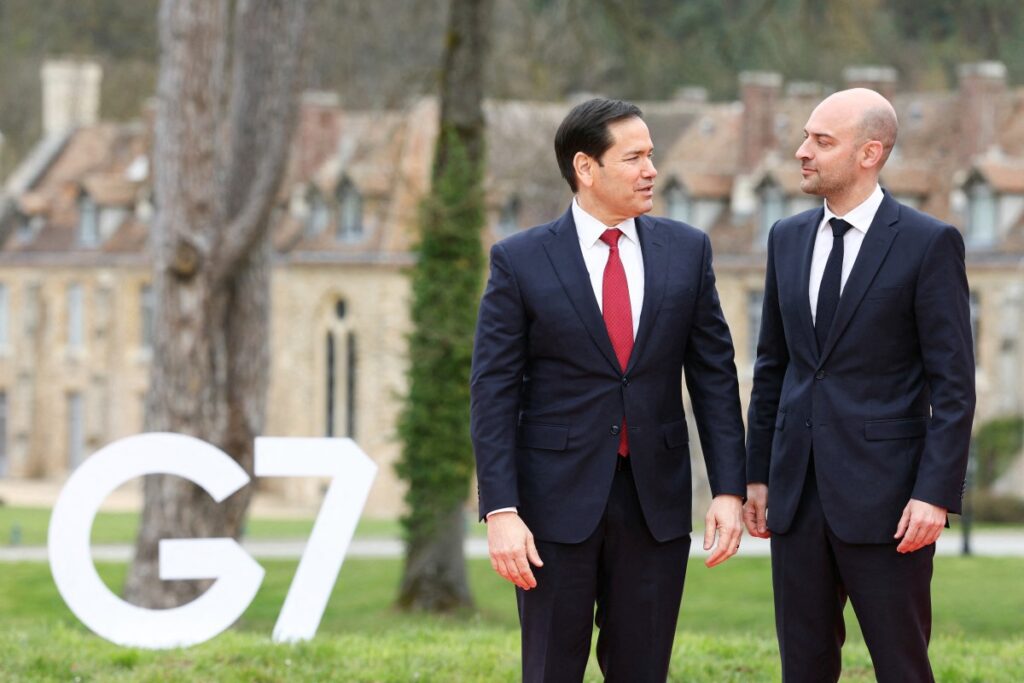
CERNAY-LA-VILLE, France — Foreign ministers from the Group of Seven nations convened Friday at the historic Vaux-de-Cernay Abbey outside Paris, with allies pressing U.S. Secretary of State Marco Rubio for clarity on Washington’s strategy toward Iran amid the ongoing Middle East conflict. The gathering marked Rubio’s first international trip since the U.S. and Israel initiated military operations against Iran on February 28, resulting in the death of Supreme Leader Ali Khamenei.
The meeting unfolded against a backdrop of heightened concerns over the deepening military cooperation between Iran and Russia, with German Foreign Minister Johann Wadephul emphasizing the need for strengthened Western unity. ‘Given that Iran and Russia are working together in the closest way, we must stand even closer together,’ Wadephul told reporters, noting that allies needed to understand ‘how the U.S. will proceed’ in its Iran policy.
In a departure from diplomatic norms signaling transatlantic tensions, the meeting concluded without a joint communiqué. Instead, the French G7 presidency issued a separate statement, according to diplomatic sources speaking on condition of anonymity.
UK Foreign Minister Yvette Cooper highlighted the economic implications of Iran’s de facto blockade of the Strait of Hormuz, which has disrupted global shipping routes and driven up oil prices. ‘Iran cannot be able to just hold the global economy hostage,’ Cooper stated, urging a ‘swift resolution to this conflict that restores regional stability.’
Secretary Rubio defended the military campaign before departing for France, asserting that President Trump’s actions served global interests rather than just American ones. ‘The president is not just doing a favour to the United States and to our people. This is for the world,’ Rubio said.
European ministers also emphasized that the focus on Middle East tensions should not diminish support for Ukraine. Wadephul warned that any compromise on Ukraine’s defense capabilities would ‘play into Putin’s hands,’ noting that the Russian leader was ‘cynically hoping that the escalation in the Middle East will divert our attention.’
In his first public comments from the meeting, Rubio posted on X that he had reiterated President Trump’s commitment to ‘reaching a ceasefire and negotiated settlement to the Russia-Ukraine war as soon as possible.’
The French hosts expanded the traditional G7 format by inviting foreign ministers from Brazil, India, Saudi Arabia, and South Korea, reflecting Paris’s desire to engage emerging powers. The diplomatic gathering sets the stage for the G7 summit scheduled for June in Evian, chaired by French President Emmanuel Macron.
Controversy emerged regarding attendance at the upcoming summit when South Africa alleged that Washington had pressured Paris to disinvite President Cyril Ramaphosa. French Foreign Minister Jean-Noel Barrot denied the claims, stating that Kenya—not South Africa—had received the invitation and emphasizing that France ‘did not give in to any pressure.’