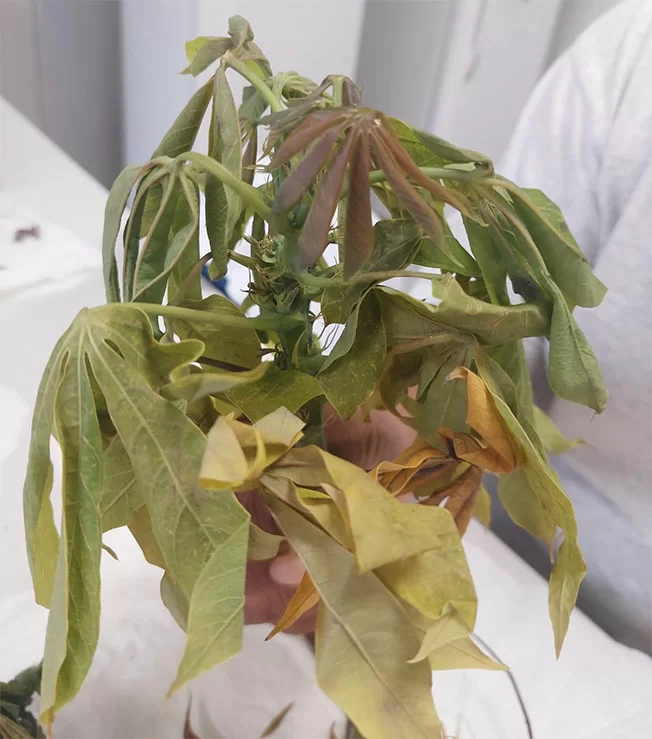
Residents of Pokigron village have urgently appealed to Agriculture Minister Mike Noersalim for governmental intervention against the spreading Cassava Witches’ Broom Disease, a devastating plant pathogen threatening food security in Suriname’s interior regions.
During the minister’s official visit to the village, Captain Albert Jeroe presented the gravity of the situation, revealing that numerous female farmers have been forced to uproot and discard their entire cassava plantations. The disease, while not yet affecting every community, has established a concerning presence throughout the Upper Suriname region.
“We require immediate assistance to eliminate this disease before it destroys our primary crop,” Captain Jeroe stated. “We anticipate requesting in-vitro cassava plants from your ministry that demonstrate stronger resistance characteristics.” The community leader pledged full cooperation from traditional authorities and villagers in implementing any containment measures.
Regional Development Minister Miquella Huur joined the appeal, confirming that her ministry has partnered with Agriculture officials to conduct extensive awareness sessions for farmers. Extension workers are currently visiting affected areas to educate agriculturalists on pest management techniques. Minister Huur characterized the pathogen as a significant challenge for interior farmers and expressed hope for near-term solutions.
The government is collaborating with multiple organizations including the Center for Agricultural Research in Suriname (CELOS), Amazon Conservation Team foundation, and international agencies to develop countermeasures. However, Minister Noersalim acknowledged the global scientific community has yet to produce effective treatment options.
Survey data indicates the disease has infiltrated eight of Suriname’s ten districts, with only Nickerie and Coronie remaining unaffected. Current efforts focus on identifying resistant cassava varieties and preventing human-assisted transmission through educational programs.
“We’re emphasizing strict protocols against moving infected plant materials between districts,” Minister Noersalim explained. “Contaminated specimens must be destroyed through incineration immediately upon detection. Simultaneously, we’re screening alternative varieties for natural resistance with the ultimate goal of providing farmers with durable planting materials.”
The disease manifests through stunted growth, abnormal development, shortened stem segments, and clustered yellow leaves resembling a witch’s broom—hence its name. Internal browning appears in stems and roots, with severe cases showing blackened, dying shoot tips. While tubers may form, they remain undersized and discolored, rendering them unusable despite some yield production.
The Ministry of Agriculture recommends immediate removal and controlled burning of infected plants to prevent further epidemiological spread.