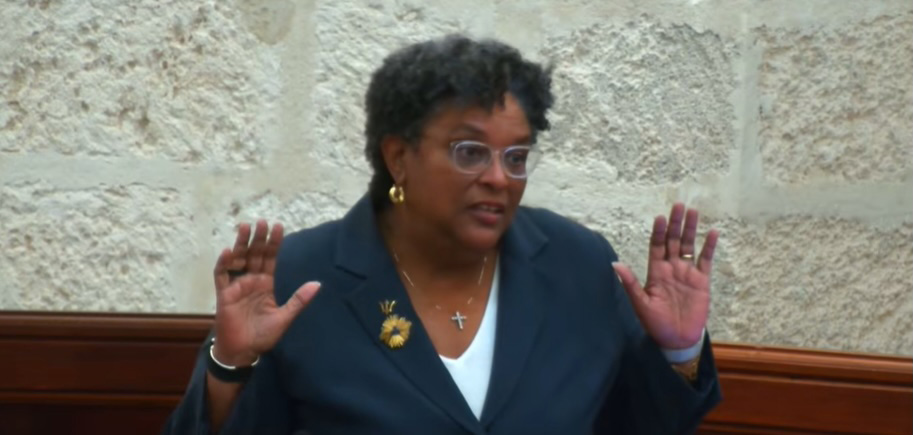
Prime Minister Mia Mottley has declared an aggressive national initiative to drastically reduce Barbados’ dependence on imported fossil fuels, framing the transition to renewable energy as both an economic imperative and a national security priority. During a comprehensive 90-minute parliamentary defense of her administration’s budget on Wednesday, Mottley outlined a multi-faceted strategy to build economic resilience against global oil market instability.
The urgency of this energy transformation was underscored by recent historical experience. Mottley revealed that Barbados’ fuel import bill skyrocketed to approximately $1.122 billion during the 2022 Russian invasion of Ukraine, a dramatic increase from the $728 million spent in 2019. ‘What folly is this?’ Mottley questioned parliament, emphasizing the paradox of a sun-rich nation spending over a billion dollars on imported oil.
With fresh conflicts involving the United States, Israel, and Iran creating renewed uncertainty in global energy markets, Mottley warned that oil prices reaching $200 per barrel would present insurmountable challenges to the island’s economy. ‘There is no arithmetical solution to oil at $200,’ she stated. ‘The only solution is change of behavior—from government, households, and businesses alike.’
The comprehensive energy security plan includes significantly expanded battery storage capacity, an urgent national colloquium on energy security scheduled for next month, and accelerated investment in renewable infrastructure. Mottley emphasized that the transition would proceed with ‘absolute speed and efficiency’ to reduce reliance on imported fossil fuels to ‘negligible amounts.’
Beyond energy security, the Prime Minister framed renewable energy as a tool for economic enfranchisement and wealth democratization. ‘We need to make sure that whoever is delivering the energy to people are not exploiting households,’ Mottley stated, promising that new energy generation opportunities would serve as ‘a democratizing and an enfranchising tool for the creation of wealth in this country.’
The budget defense also highlighted substantial social protection measures, including expanded reverse tax credits for low-income earners, increased tax relief for pensioners, and the establishment of the Barbados Republic Child Wealth Fund. Mottley acknowledged ongoing pressures on middle-income earners while pointing to significant economic progress: 18 consecutive quarters of growth, debt reduction from over 170% of GDP to just above 90%, and foreign reserves now exceeding $3 billion.
‘Poverty is not only about economic policy,’ Mottley concluded, ‘but about the social things—the abuse, the physical challenges—all of those things help to constitute poverty. Dealing with intergenerational poverty and getting rid of it is the mission of this government.’