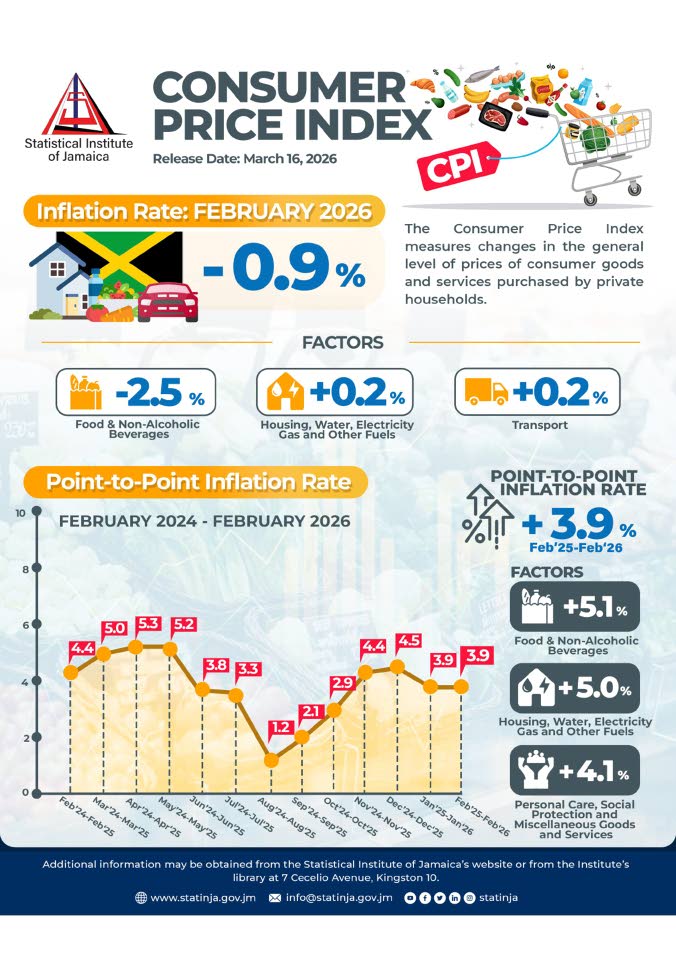
Jamaica experienced a significant downturn in inflation during February, with official statistics revealing a 0.9% monthly contraction in the All-Jamaica Consumer Price Index. This substantial decline was predominantly propelled by a dramatic 11.3% collapse in vegetable prices alongside reductions in tubers, plantains, and pulses, culminating in a 2.5% decrease within the food and non-alcoholic beverages category. Superficially, these figures position annual inflation at 3.9%—comfortably within the Bank of Jamaica’s target corridor of 4-6%—suggesting economic stability.
However, beneath this apparent tranquility lies a more complex economic narrative. Despite the dramatic monthly food price correction, annualized food inflation persists at 5.1%, maintaining its position as the primary driver of overall price increases. Concurrently, housing utilities and fuels recorded 5% inflation while personal care services rose 4.1%, indicating sustained pressure across essential expenditure categories.
The February data reveals critical sectoral divergences: while agricultural products experienced deflationary trends, housing-related costs including electricity advanced 0.2% alongside similar increases in transportation fueled by rising petrol prices. This dichotomy underscores Jamaica’s fundamental inflation characteristic—volatile food prices creating optical illusions that mask structural cost increases in energy-dependent sectors.
This presents policymakers with a formidable challenge, as monetary tools designed to combat demand-driven inflation remain largely ineffective against supply-side volatility in agricultural production. The current stability thus appears contingent upon unpredictable factors including harvest yields and global energy markets, creating a fragile equilibrium that could rapidly reverse.
For Jamaican households, the statistical decline offers limited relief as reduced grocery expenses are offset by mounting utility and transportation costs, maintaining constant pressure on household budgets. The economy consequently demonstrates superficially controlled inflation while remaining vulnerable to sudden shifts in commodity markets and energy pricing.