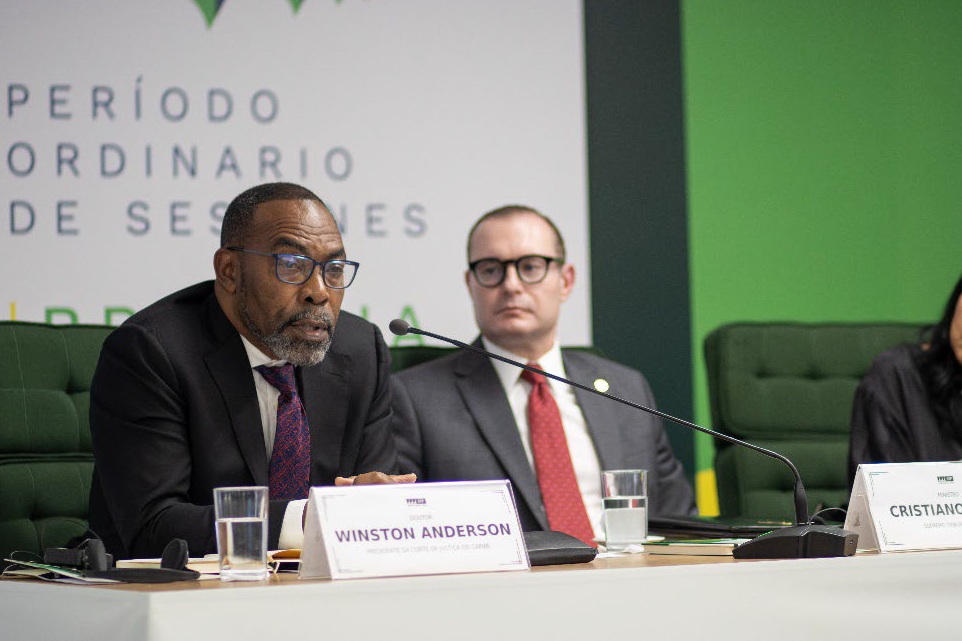
In a significant development in climate justice advocacy, Caribbean Court of Justice (CCJ) President Winston Anderson has formally proposed the creation of an International Climate Injuries Compensation (ICIC) Fund during the Inter-American Seminar on Climate Emergency and Human Rights in Brasilia, Brazil. The landmark proposal, presented on March 16, 2026, calls for mandatory corporate contributions to address climate-related damages in vulnerable nations.
President Anderson articulated his vision before the gathering hosted by the Inter-American Court of Human Rights and Brazil’s Supreme Court, emphasizing that existing regulatory frameworks fall short of addressing urgent climate realities. While acknowledging the importance of the Inter-American Court’s Advisory Opinion No.32 of 2025, which establishes government obligations to regulate climate-harming corporations, Anderson stressed the necessity of practical implementation mechanisms.
The proposed ICIC Fund would operate under the ‘Polluter Pays’ principle, requiring multinational corporations exceeding specific greenhouse emission thresholds to contribute financially through their operating states. Drawing inspiration from the International Maritime Organisation’s successful oil pollution compensation model, the fund would possess legal personality enabling affected nations to seek compensation for damages caused by extreme weather events.
Anderson expressed particular concern about the inadequate capitalization of the existing Fund for Responding to Loss and Damage (FRLD) established under the Paris Agreement. He highlighted the stark disparity between actual damages and available compensation, noting Jamaica’s situation where USD 6-7 billion in hurricane damages contrasts with maximum potential FRLD compensation of merely USD 20 million.
The initiative, first introduced during Anderson’s keynote address at the CANARI Partners Forum in Barbados this January, represents a growing consensus among vulnerable nations that corporate accountability must translate into tangible financial responsibility for climate impacts.