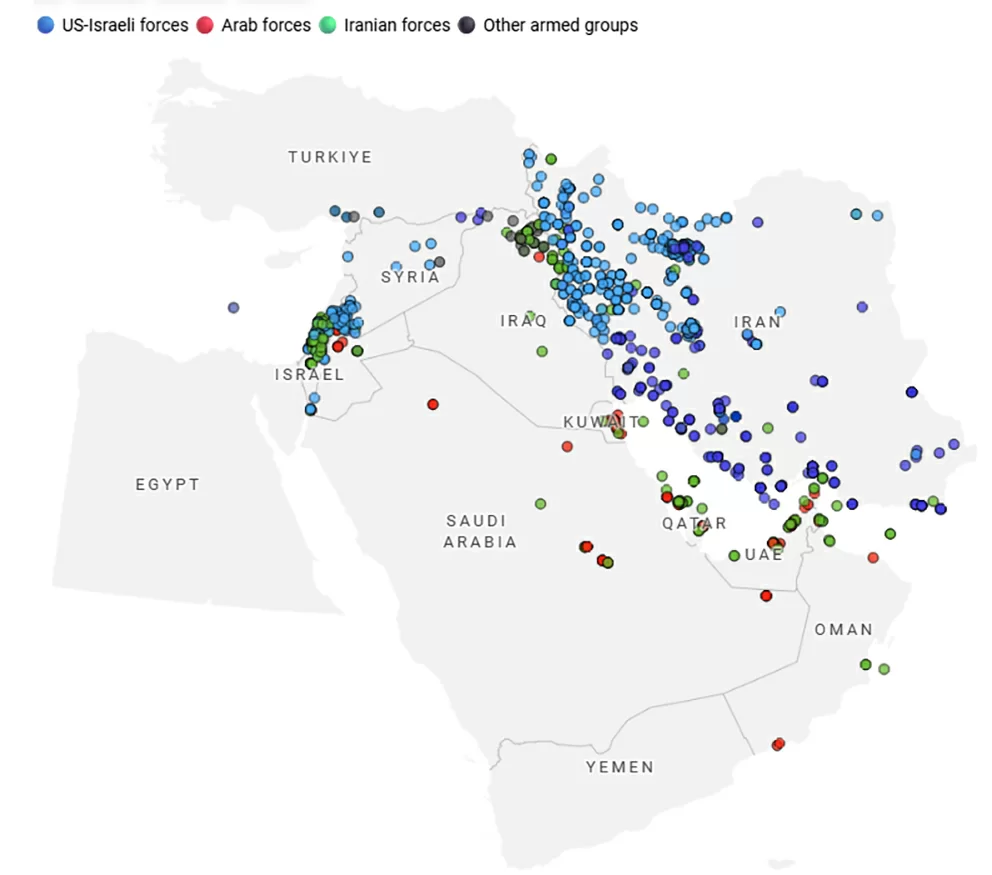
The military confrontation between the United States, Israel, and Iran has entered its seventeenth consecutive day, marking a significant escalation of hostilities across the Gulf region and neighboring territories. Despite concerted efforts by US and Israeli forces to degrade Iran’s military capabilities through sustained aerial campaigns, Tehran continues to demonstrate resilient defensive operations and asymmetric warfare tactics.
Israeli forces executed renewed airstrikes targeting strategic locations in Tehran, prompting Iranian authorities to report successful defensive countermeasures against ‘hostile aerial targets’ over the capital. While Iranian officials acknowledge utilizing older missile systems, they maintain that the Islamic Revolutionary Guard Corps (IRGC) retains substantial operational capacity for prolonged defensive operations.
The conflict has generated dangerous regional spillover effects, with drone and missile attacks intensifying against critical infrastructure in United Arab Emirates, Saudi Arabia, Bahrain, Kuwait, and Qatar. A notable drone incident near Dubai International Airport triggered significant fires and temporary flight cancellations, while Saudi defense systems reportedly intercepted dozens of unmanned aerial vehicles. Industrial facilities in Fujairah similarly experienced fires following suspected drone strikes.
Iran’s adoption of asymmetric warfare methodologies has substantially heightened regional instability, compelling Gulf states to enhance air defense coordination and diplomatic engagement. High-level discussions between Saudi Crown Prince Mohammed bin Salman and UAE President Sheikh Mohamed bin Zayed Al Nahyan underscore growing regional security concerns.
Politically, the conflict has generated intensified rhetoric from all involved parties. Former US President Trump emphasized targeted operations against Iranian drone manufacturing facilities while accusing Iran of disseminating artificial intelligence-generated disinformation. Iranian leadership has consistently denied seeking ceasefire negotiations, with Foreign Ministry officials emphasizing Tehran’s commitment to sustained self-defense operations.
The humanitarian impact continues to worsen with Iranian authorities reporting approximately 1,400 fatalities and nearly 19,000 injuries. Conflict escalation in Lebanon and Iraq has produced additional civilian casualties, including significant numbers of children, while non-state actors have targeted UN peacekeeping forces in Lebanon.
International response has been characterized by growing concern, with United Nations Secretary-General António Guterres emphasizing diplomatic solutions and warning of severe humanitarian consequences. The European Union has urged dialogue and peaceful resolution while noting potential impacts on global energy markets and economic stability. China and Russia have called for restraint and adherence to international law without explicit alignment with any conflict participant.
Global markets have reacted nervously to escalating tensions, with oil prices surging due to potential disruptions in the Strait of Hormuz transit corridor, which facilitates approximately 20% of global oil shipments. This development threatens increased energy costs worldwide and heightened inflationary pressures, particularly affecting oil-importing nations.
After seventeen days of intensive combat operations, the conflict shows minimal signs of de-escalation. Iran maintains its asymmetric defense strategy and economic pressure campaigns, while US and Israeli forces continue aerial bombardments and political pressure tactics. The Gulf region remains in a state of extreme fragility with ongoing escalation threats that endanger global energy security, as diplomatic channels demonstrate limited effectiveness in resolving the prolonged confrontation.