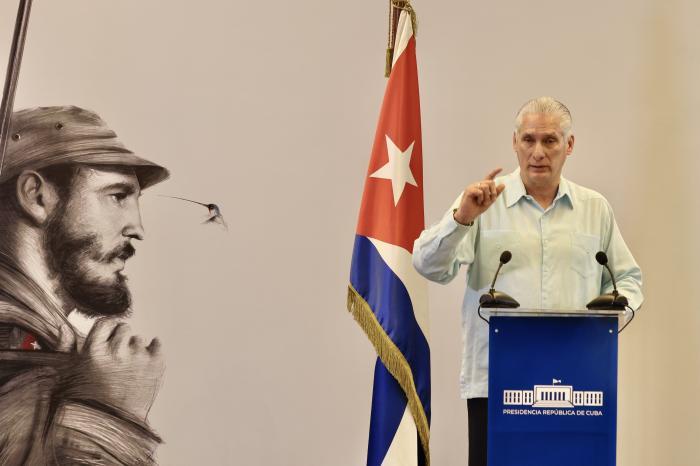
In a major address to the national press from the Palace of the Revolution, Cuban President Miguel Díaz-Canel provided a comprehensive assessment of the nation’s ongoing fuel crisis, confirmed preliminary diplomatic contacts with the United States, and detailed the government’s multifaceted response to severe economic challenges.
The President confirmed that Cuba has not received fuel shipments for over three months due to what he termed an “energy blockade,” creating devastating effects across all sectors of society. The national power grid operates under extreme instability, with prolonged blackouts lasting over 30 hours in some municipalities affecting water supply, healthcare, education, transportation, and communications.
Despite these challenges, Díaz-Canel highlighted several adaptive measures: solar farms now provide 49-51% of daytime energy, over 1,000 photovoltaic systems have been installed in remote communities, and 10,034 solar modules have been provided to essential workers. The energy transition includes converting bakeries to alternative fuels, expanding electric transportation, and developing battery storage systems for grid stability.
Regarding international relations, the President confirmed that Cuban officials have held preliminary talks with U.S. representatives through international facilitators. He emphasized that any dialogue must proceed on principles of equality, respect for sovereignty, and reciprocity. The process remains in early stages with no concrete agreements yet reached.
The address also covered labor adjustments necessitated by the crisis, with the government encouraging job relocations to community projects rather than layoffs. Educational institutions have shifted to blended learning models utilizing community settings, while maintaining academic continuity despite power limitations.
President Díaz-Canel strongly defended Cuba’s handling of international donations, particularly from Mexico, emphasizing transparent distribution systems and audit mechanisms. He also provided updates on security matters, including an ongoing investigation into a recent armed infiltration attempt and cooperation with U.S. authorities through FBI involvement.
The government announced the sovereign decision to release 51 prisoners based on good behavior, characterizing it as a humanitarian gesture consistent with Cuban legal practices.
Throughout the address, Díaz-Canel emphasized national resilience, praising electricity workers maintaining systems despite personal hardships and highlighting continued functioning of essential services despite unprecedented challenges.