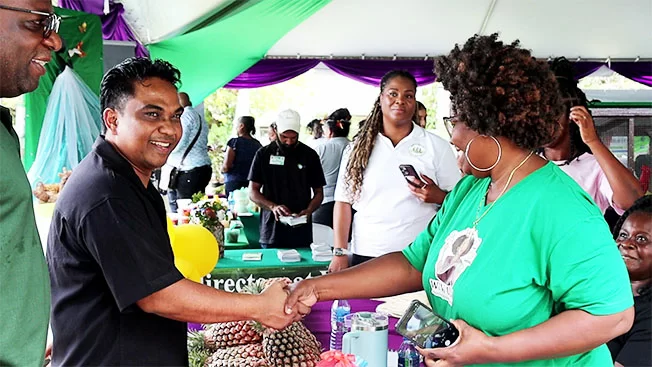
Suriname’s agricultural sector is taking decisive steps to address persistent gender inequalities, as highlighted during the recent Women in Agriculture Fair held in Paramaribo’s Orchid Garden. The event, timed with International Women’s Day celebrations, brought together female entrepreneurs, government officials, and international partners to address the 36% legal rights gap women face globally in economic spheres.
Agriculture Minister Mike Noersalim delivered a powerful address challenging traditional perceptions of women’s roles in farming. “We must recognize that women are not merely ‘helping hands’ in the fields but the backbone of our food security system,” Noersalim stated. “Your rights to land, capital, and policy participation are non-negotiable.”
The fair, organized by the Ministry of Agriculture, Livestock and Fisheries (LVV) in collaboration with the Inter-American Institute for Cooperation on Agriculture and the Inter-American Development Bank, focused on the global theme of “Rights, Justice, Action.” Minister Noersalim elaborated on this framework, explaining that justice requires removing invisible structural barriers that disproportionately affect women in rural areas.
Innovation emerged as a key solution, with the ministry promising improved access to new technologies, tailored training programs, and sustainable practices. These initiatives aim to create a level playing field where female entrepreneurs can develop, grow, export, and thrive equally with their male counterparts.
Sandy Cameron, Commissioner of the National Development Bank, acknowledged financing challenges faced by women but emphasized support mechanisms are available. “Access to funding sometimes appears more difficult for women, but it’s not impossible—we must guide them through the process,” Cameron noted.
Experienced entrepreneur Grace Watamaleo offered encouragement to aspiring female farmers, particularly those in interior regions where agriculture represents both cultural tradition and economic survival. “Don’t be discouraged if you don’t know where to begin,” Watamaleo advised. “Today information is readily accessible. Be strong, persist in your efforts, and if you haven’t started yet, simply take that first step.”