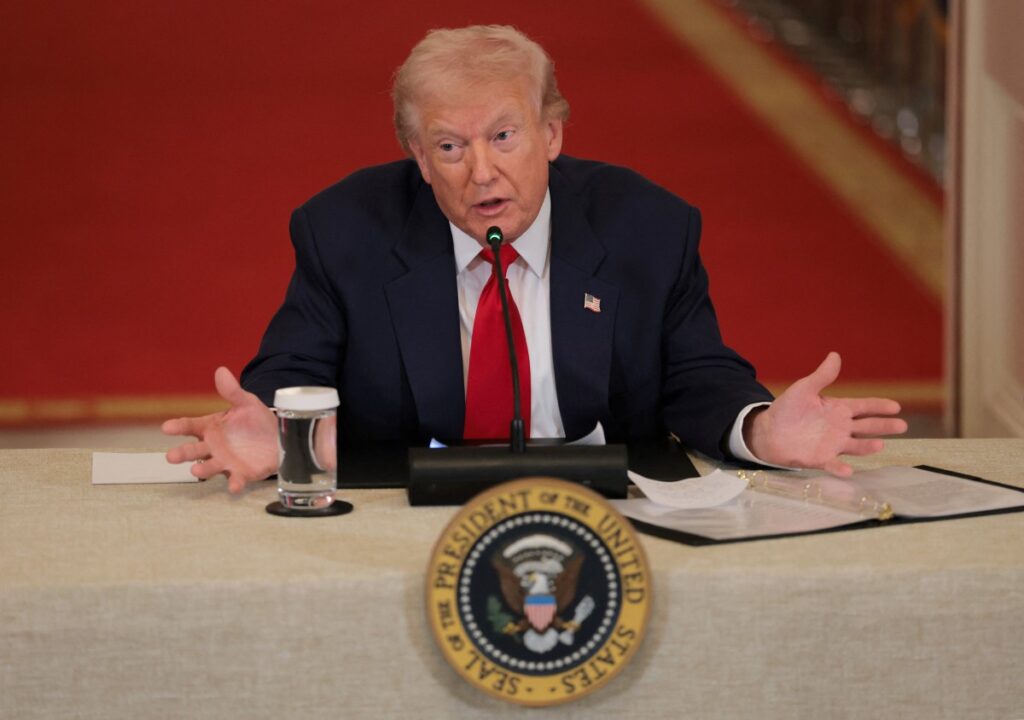
MIAMI, United States – President Donald Trump is convening a significant gathering of right-wing leaders from Latin America and the Caribbean this Saturday. Dubbed the ‘Shield of the Americas’ summit, the meeting at Trump’s Doral, Florida golf club will focus on pressing regional challenges, including the escalating threat of organized crime and the ongoing issue of illegal immigration.
The assembly represents a strategic maneuver by Washington to reinforce U.S. influence and counter the expanding footprint of foreign powers, notably China, in the Western Hemisphere. This event is a practical application of Trump’s ‘Donroe Doctrine,’ which advocates for an expanded U.S. authority in the region.
Attendees include a roster of prominent conservative figures, such as Argentina’s libertarian President Javier Milei, Ecuador’s Daniel Noboa, and El Salvador’s Nayib Bukele, whose stringent security policies have become a regional benchmark. The summit also includes leaders from Bolivia, Costa Rica, the Dominican Republic, Guyana, Honduras, Panama, Paraguay, Trinidad and Tobago, and Chile’s president-elect, Jose Antonio Kast.
A central concern uniting these leaders is the alarming surge in power of drug cartels, which has destabilized nations previously considered secure, like Ecuador and Chile. This deteriorating security landscape has, in part, propelled right-wing candidates to electoral victories, creating a more receptive environment for U.S. collaboration. Recent joint military operations between the U.S. and Ecuador, targeting ‘narcoterrorists,’ underscore this renewed partnership.
However, the coalition’s effectiveness is questioned by experts. Irene Mia, a Latin America specialist at the International Institute for Strategic Studies, notes the ‘negative agenda’ focused solely on U.S. security threats like migration and crime. The conspicuous absence of major regional powers Mexico and Brazil—both under leftist leadership—poses a significant hurdle to comprehensively addressing narco-trafficking, given their critical roles in the drug trade supply chain. Mia concludes that the support for Trump’s policies remains ‘quite fragile,’ dependent on a ‘very fine balance’ of public approval in historically skeptical nations.